Border-free EU travel brings 'thrilled' ethnic Hungarians closer / Photo: Attila KISBENEDEK - AFP
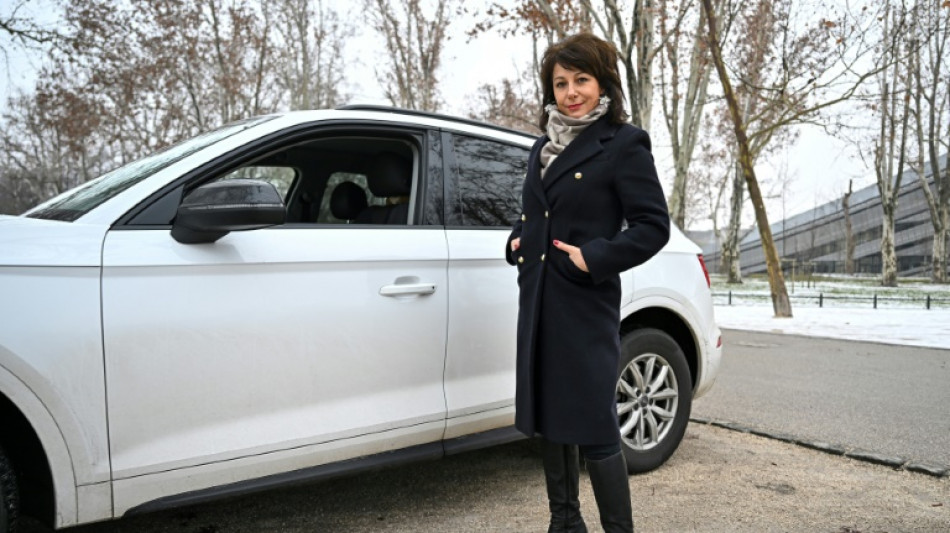
Visiting Hungary as a teenager, opera singer Katalin Benedekffy used to have to wait up to a whole day at the border with her childhood home, Romania. Now, to her delight, she can cross straightaway.
In the early hours of New Year's Day, she made the crossing unhindered for the first time, after Romania joined Europe's border-free travel zone.
"It's a miracle," said Benedekffy.
"I asked my husband to back up because I wanted to record it," she told AFP. "It's an incredible feeling."
Benedekffy, 47, now lives in Budapest and often travels back and forth to visit relatives in her hometown of Szeklerland in Romania's Transylvania region. She made her first control-free crossing on her return trip to Hungary.
"It's like being in the same country as my loved ones, as there are practically no borders anymore," she said.
For centuries, the region was part of the Austro-Hungarian empire in so-called "Greater Hungary" -- a notion referred to with nostalgia by the current nationalist government in Budapest.
Almost a fifth of Hungary's population has relatives in neighbouring countries, within the historical boundaries of what was Hungary before it was partitioned in the aftermath of World War I, a 2020 survey showed.
Romania and Bulgaria became full members of Europe's so-called Schengen zone from January 1, when land border checks ceased.
That ended years of waiting for the countries after they qualified to join Schengen, with political resistance from certain other EU states having delayed the move.
- 'Trianon trauma' -
Hungarian Prime Minister Viktor Orban, who took credit for the final negotiations on joining Schengen, hailed the expansion as an "important step for national unity" that dismantled barriers "between families".
About one million ethnic Hungarians -- Magyars -- live in Romania, the largest such community outside of Hungary, with other significant ones in Slovakia, Serbia and Ukraine.
Under the Treaty of Trianon, signed in Versailles in 1920 after the dissolution of the defeated Austro-Hungarian empire, Hungary had to surrender two-thirds of its territory to neighbouring states.
Many Hungarians still resent the territorial and population losses, sometimes described as "Trianon trauma".
Since Orban's return to power in 2010, the nationalist leader has regularly irked neighbouring countries by focusing on pre-World War I Hungary's territory.
Orban has continued to woo Magyar communities by opening up an easy path to Hungarian citizenship -- and thus voting rights -- and financing projects such as schools for them.
- 'Imaginary wall' -
Following the fall of communism in 1989 -- years before Orban's rise to power -- one of Hungary's main foreign policy goals was to "make surrounding borders irrelevant, without revising them", Nandor Bardi, an expert on minority research at the Hungarian HUN-REN research centre, told AFP.
Magyars are "relieved it finally happened", he said.
Benedekffy well remembers the "humiliating waits" of up to 24 hours at the border that she had endured since she was a girl.
Although waiting times significantly decreased after Hungary and Romania joined the European Union -- in 2004 and 2007 respectively -- lorry drivers and travellers still had to queue for at least an hour at border crossings, police told AFP.
"We used to do calculations, how to avoid delays at the border," said Zoltan Nagy, 39, a manager at a car manufacturer in Budapest.
He once celebrated Easter with his family in Transylvania two weeks in advance to avoid the crowds.
But now "the journey has become a lot more predictable -- we no longer have to stress about how much time we spend at the border".
In neighbouring countries with Magyar populations, Orban's policies have stirred up fears that he is trying to exert influence on their territory.
Criticising Brussels and courting US President Donald Trump and Russia's Vladimir Putin, the nationalist leader is nowadays "more concerned about geopolitics", however, said analyst Bardi.
The disappearance of border checks holds symbolic value for many Transylvanian Magyars, such as Mihaly Fazakas, a 77-year-old retired textile engineer.
"We are thrilled because we no longer have that imaginary wall dividing us," he told AFP.
"It feels almost as if Transylvania got returned."
E.Leuenberger--NZN