Zürcher Nachrichten - Study reveals how Earth's orbit controls ice ages

EUR -
AED 4.162744
AFN 73.101983
ALL 92.001456
AMD 411.660892
ANG 2.029363
AOA 1039.410702
ARS 1728.561274
AUD 1.624168
AWG 2.0417
AZN 1.920186
BAM 1.953725
BBD 2.283474
BDT 139.394382
BGN 1.908165
BHD 0.427346
BIF 3397.29109
BMD 1.133491
BND 1.448461
BOB 13.667361
BRL 5.926912
BSD 1.133696
BTN 108.761464
BWP 15.480419
BYN 3.422165
BYR 22216.421705
BZD 2.280178
CAD 1.608798
CDF 2635.366028
CHF 0.946091
CLF 0.027887
CLP 1103.475716
CNY 7.606234
CNH 7.605027
COP 3799.710876
CRC 516.551272
CUC 1.133491
CUP 27.209096
CVE 110.147991
CZK 24.433419
DJF 201.885539
DKK 7.47526
DOP 67.418382
DZD 151.606301
EGP 59.020646
ERN 17.002364
ETB 185.183248
FJD 2.542651
FKP 0.855036
GBP 0.858172
GEL 2.941352
GGP 0.855036
GHS 13.213846
GIP 0.855036
GMD 83.878217
GNF 9971.407468
GTQ 8.655958
GYD 237.218006
HKD 8.894333
HNL 30.435668
HRK 7.528758
HTG 148.372385
HUF 367.432977
IDR 20360.897096
ILS 3.476484
IMP 0.855036
INR 108.726204
IQD 1485.222262
IRR 1558379.968379
ISK 136.801448
JEP 0.855036
JMD 179.479341
JOD 0.803639
JPY 178.670473
KES 146.999199
KGS 99.121848
KHR 4601.071733
KMF 490.801979
KPW 1020.142173
KRW 1537.999731
KWD 0.349976
KYD 0.944788
KZT 497.711286
LAK 25437.977476
LBP 101523.756597
LKR 375.271353
LRD 194.431742
LSL 18.573569
LTL 3.346904
LVL 0.685638
LYD 7.252168
MAD 10.980336
MDL 20.117452
MGA 4992.696306
MKD 61.514654
MMK 2379.618612
MNT 4077.41833
MOP 9.162548
MRU 45.394778
MUR 53.965208
MVR 17.523476
MWK 1965.911631
MXN 20.432891
MYR 4.62782
MZN 72.431091
NAD 18.573242
NGN 1501.705172
NIO 41.726411
NOK 10.882006
NPR 174.016609
NZD 2.012535
OMR 0.43582
PAB 1.133696
PEN 3.899826
PGK 5.129551
PHP 71.010911
PKR 314.068967
PLN 4.373677
PYG 6659.925224
QAR 4.13251
RON 5.278439
RSD 117.502685
RUB 94.930688
RWF 1673.907057
SAR 4.257974
SBD 9.097624
SCR 15.681732
SDG 681.796159
SEK 11.347015
SGD 1.449486
SHP 0.85511
SLE 27.895124
SLL 23768.728294
SOS 647.90602
SRD 42.792647
STD 23460.973189
STN 24.474001
SVC 9.920462
SYP 14737.649013
SZL 18.569274
THB 38.081321
TJS 10.435914
TMT 3.967218
TND 3.365425
TOP 2.729174
TRY 55.540036
TTD 7.69083
TWD 36.098622
TZS 2986.751918
UAH 50.851883
UGX 4444.278884
USD 1.133491
UYU 45.451717
UZS 13400.764494
VES 971.078943
VND 29439.592486
VUV 134.79082
WST 3.138988
XAF 655.957
XAG 0.018547
XAU 0.000272205822
XCD 3.063315
XCG 2.043229
XDR 0.801437
XOF 655.957
XPF 119.331742
YER 268.212286
ZAR 18.64418
ZMK 10202.781156
ZMW 22.19223
ZWL 364.983608
SSP 6475.170952
MXV 2.313465
  • RELX

    -0.1300

    32.94

    -0.39%

  • RIO

    -0.6200

    93.79

    -0.66%

  • NGG

    -0.8350

    74.405

    -1.12%

  • CMSC

    -0.2900

    20.11

    -1.44%

  • GSK

    -0.5300

    49.17

    -1.08%

  • RYCEF

    0.4000

    19.71

    +2.03%

  • BP

    -0.7700

    43.66

    -1.76%

  • VOD

    -0.3050

    16.275

    -1.87%

  • AZN

    -1.8000

    164.35

    -1.1%

  • BCC

    -1.0300

    75.56

    -1.36%

  • CMSD

    -0.3950

    19.875

    -1.99%

  • JRI

    -0.0400

    10.73

    -0.37%

  • BTI

    -1.4150

    54.635

    -2.59%

  • RBGPF

    0.5300

    65

    +0.82%

  • BCE

    -0.3150

    20.245

    -1.56%

Study reveals how Earth's orbit controls ice ages
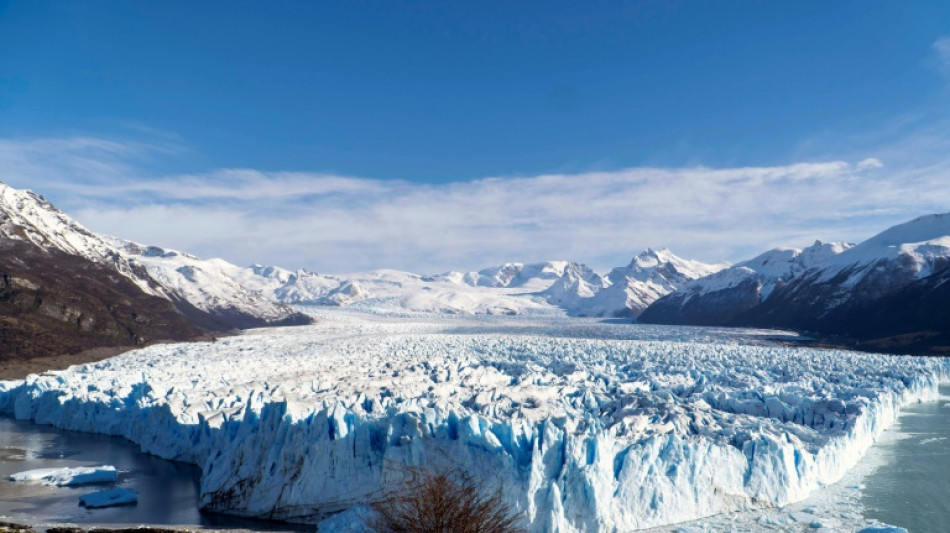
Study reveals how Earth's orbit controls ice ages / Photo: Walter Diaz - AFP

Study reveals how Earth's orbit controls ice ages

The Earth's next ice age is expected to begin in about 11,000 years -- unless human-caused global warming disrupts natural cycles.

Text size:

That's according to a new study published Thursday in Science, which analyzed how subtle shifts in Earth's orbit around the Sun have historically triggered massive climate changes.

A research team examined a million-year record of climate change, focusing on land-based ice sheets across the Northern Hemisphere and deep ocean temperatures.

They then paired this data with small but cyclical variations in Earth's orbital patterns.

"For many years, the difficulty in answering how small changes in Earth's orbit around the Sun translate to large shifts between glacial and interglacial states has been a central theme in paleoclimate research," lead author Stephen Barker, a professor at Cardiff University, told AFP.

Earth has long alternated between ice ages and warmer interglacial periods, with the last glaciation ending approximately 11,700 years ago. This transition marked the beginning of the Holocene epoch, an era of relative climate stability that enabled early human societies to shift from nomadic hunting and gathering to settled agriculture.

Scientists have long recognized a connection between Earth's orbit and ice ages. However, due to challenges in accurately dating climate changes that occurred so far in the past, they struggled to pinpoint which orbital parameters were responsible for starting and ending these glacial cycles.

According to Barker, the key breakthrough came from analyzing the "shape" of the ancient climate record -- the curves showing how temperatures rose and fell over time -- rather than just the timing of ice age transitions.

This approach allowed the team to determine how the three orbital factors -- tilt, wobble, and the shape of Earth's orbit around the Sun -- interact to drive ice age cycles over the past 900,000 years.

Barker said that without the Industrial Revolution, assuming fossil fuels had never been burned, "we would expect a glaciation to occur within the next 11,000 years, and it would end in 66,000 years' time."

Co-author Lorraine Lisiecki, a professor at the University of California, Santa Barbara, emphasized the significance of the study, stating that it "confirms the natural climate change cycles we observe on Earth over tens of thousands of years are largely predictable and not random or chaotic."

However, Barker strongly cautioned against interpreting the findings to suggest that human-caused climate change is beneficial.

Carbon dioxide levels have nearly doubled since the Industrial Revolution, and if emissions remain unchecked, "then in around 8,000 years' time, Antarctica would have melted, leading to around 70 meters of sea-level rise," said Barker.

"Instead of there being glaciers, you'll be underwater," he warned.

Looking ahead, the research team aims to expand on their findings by investigating the long-term impact of human-driven climate change and how it may reshape the planet's natural climate cycles.

F.E.Ackermann--NZN