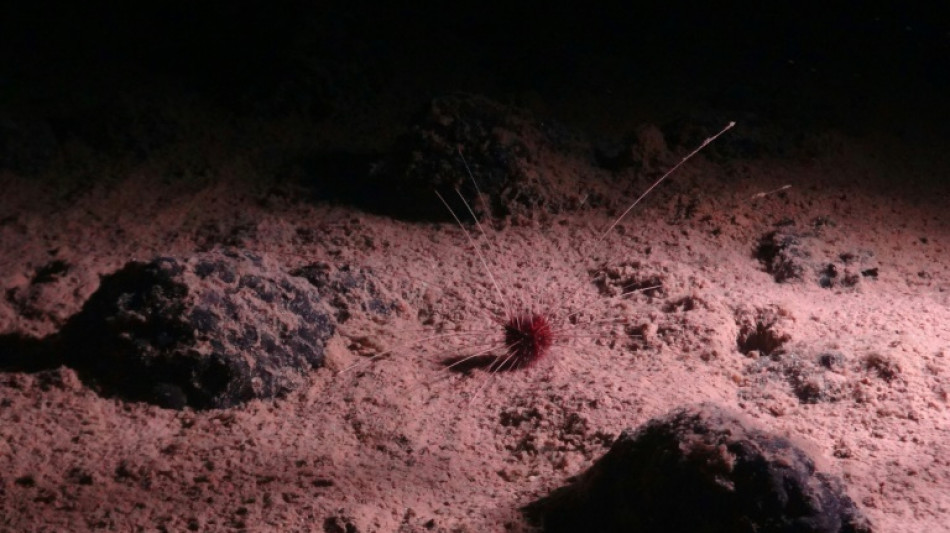
'Dark oxygen': a deep-sea discovery that has split scientists / Photo: Handout - National Oceanography Centre / Smartex project (NERC)/AFP/File
Could lumpy metallic rocks in the deepest, darkest reaches of the ocean be making oxygen in the absence of sunlight?
Some scientists think so, but others have challenged the claim that so-called "dark oxygen" is being produced in the lightless abyss of the seabed.
The discovery -- detailed last July in the journal Nature Geoscience -- called into question long-held assumptions about the origins of life on Earth, and sparked intense scientific debate.
The findings were also consequential for mining companies eager to extract the precious metals contained within these polymetallic nodules.
Researchers said that potato-sized nodules could be producing enough electrical current to split seawater into hydrogen and oxygen, a process known as electrolysis.
This cast doubt on the long-established view that life was made possible when organisms started producing oxygen via photosynthesis, which requires sunlight, about 2.7 billion years ago.
"Deep-sea discovery calls into question the origins of life," the Scottish Association for Marine Science said in a press release to accompany the publication of the research.
- Delicate ecosystem -
Environmentalists said the presence of dark oxygen showed just how little is known about life at these extreme depths, and supported their case that deep-sea mining posed unacceptable ecological risks.
"Greenpeace has long campaigned to stop deep sea mining from beginning in the Pacific due to the damage it could do to delicate, deep sea ecosystems," the environmental organisation said.
"This incredible discovery underlines the urgency of that call".
The discovery was made in the Clarion-Clipperton Zone, a vast underwater region of the Pacific Ocean between Mexico and Hawaii of growing interest to mining companies.
Scattered on the seafloor four kilometres (2.5 miles) beneath the surface, polymetallic nodules contain manganese, nickel and cobalt, metals used in electric car batteries and other low-carbon technologies.
The research that gave rise to the dark oxygen discovery was partly funded by a Canadian deep-sea mining business, The Metals Company, that wanted to assess the ecological impact of such exploration.
It has sharply criticised the study by marine ecologist Andrew Sweetman and his team as plagued by "methodological flaws".
Michael Clarke, environmental manager at The Metals Company, told AFP that the findings "are more logically attributable to poor scientific technique and shoddy science than a never before observed phenomenon."
- Scientific doubts -
Sweetman's findings proved explosive, with many in the scientific community expressing reservations or rejecting the conclusions.
Since July, five academic research papers refuting Sweetman's findings have been submitted for review and publication.
"He did not present clear proof for his observations and hypothesis," said Matthias Haeckel, a biogeochemist at the GEOMAR Helmholtz Centre for Ocean Research in Kiel, Germany.
"Many questions remain after the publication. So, now the scientific community needs to conduct similar experiments etc, and either prove or disprove it."
Olivier Rouxel, a geochemistry researcher at Ifremer, the French national institute for ocean science and technology, told AFP there was "absolutely no consensus on these results".
"Deep-sea sampling is always a challenge," he said, adding it was possible that the oxygen detected was "trapped air bubbles" in the measuring instruments.
He was also sceptical about deep-sea nodules, some tens of millions of years old, still producing enough electrical current when "batteries run out quickly".
"How is it possible to maintain the capacity to generate electrical current in a nodule that is itself extremely slow to form?" he asked.
When contacted by AFP, Sweetman indicated that he was preparing a formal response.
"These types of back and forth are very common with scientific articles and it moves the subject matter forward," he said.
M.Hug--NZN