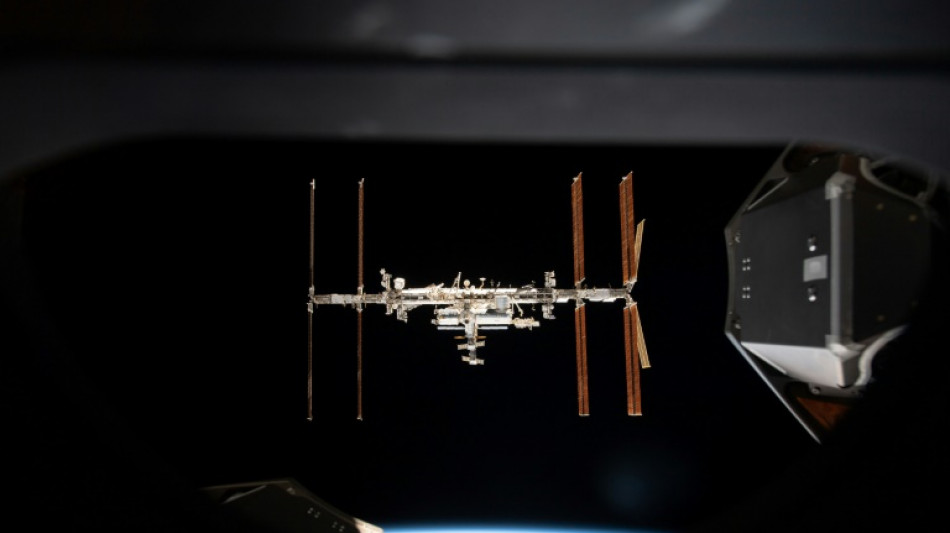
What happens to the human body in deep space? / Photo: - - NASA/AFP/File
Bone and muscle deterioration, radiation exposure, vision impairment -- these are just a few of the challenges space travelers face on long-duration missions, even before considering the psychological toll of isolation.
As US astronauts Butch Wilmore and Suni Williams prepare to return home after nine months aboard the International Space Station (ISS), some of the health risks they've faced are well-documented and managed, while others remain a mystery.
These dangers will only grow as humanity pushes deeper into the solar system, including to Mars, demanding innovative solutions to safeguard the future of space exploration.
- Exercise key -
Despite the attention their mission has received, Wilmore and Williams' nine-month stay is "par for the course," said Rihana Bokhari, an assistant professor at the Center for Space Medicine at Baylor College.
ISS missions typically last six months, but some astronauts stay up to a year, and researchers are confident in their ability to maintain astronaut health for that duration.
Most people know that lifting weights builds muscle and strengthens bones, but even basic movement on Earth resists gravity, an element missing in orbit.
To counteract this, astronauts use three exercise machines on the ISS, including a 2009-installed resistance device that simulates free weights using vacuum tubes and flywheel cables.
A two-hour daily workout keeps them in shape. "The best results that we have to show that we're being very effective is that we don't really have a fracture problem in astronauts when they return to the ground," though bone loss is still detectable on scans, Bokhari told AFP.
Balance disruption is another issue, added Emmanuel Urquieta, vice chair of Aerospace Medicine at the University of Central Florida.
"This happens to every single astronaut, even those who go into space just for a few days," he told AFP, as they work to rebuild trust in their inner ear.
Astronauts must retrain their bodies during NASA's 45-day post-mission rehabilitation program.
Another challenge is "fluid shift" -- the redistribution of bodily fluids toward the head in microgravity. This can increase calcium levels in urine, raising the risk of kidney stones.
Fluid shifts might also contribute to increased intracranial pressure, altering the shape of the eyeball and causing spaceflight-associated neuro-ocular syndrome (SANS), causing mild-to-moderate vision impairment. Another theory suggests raised carbon dioxide levels are the cause.
But in at least one case, the effects have been beneficial. "I had a pretty severe case of SANS," NASA astronaut Jessica Meir said before the latest launch.
"When I launched, I wore glasses and contacts, but due to globe flattening, I now have 20/15 vision -- most expensive corrective surgery possible. Thank you, taxpayers."
- Managing radiation -
Radiation levels aboard the ISS are higher than on the ground, as it passes through through the Van Allen radiation belt, but Earth's magnetic field still provides significant protection.
The shielding is crucial, as NASA aims to limit astronauts' increased lifetime cancer risk to within three percent.
However, missions to the Moon and Mars will give astronauts far greater exposure, explained astrophysicist Siegfried Eggl.
Future space probes could provide some warning time for high-radiation events, such coronal mass ejections -- plasma clouds from the Sun -- but cosmic radiation remains unpredictable.
"Shielding is best done with heavy materials like lead or water, but you need vast quantities of it," said Eggl, of University of Illinois Urbana-Champaign.
Artificial gravity, created by rotating spacecraft frames, could help astronauts stay functional upon arrival after a nine-month journey to Mars.
Alternatively, a spacecraft could use powerful acceleration and deceleration that matches the force of Earth's gravity.
That approach would be speedier -- reducing radiation exposure risks -- but requires nuclear propulsion technologies that don't yet exist.
Preventing infighting among teams will be critical, said Joseph Keebler, a psychologist at Embry-Riddle Aeronautical University.
"Imagine being stuck in a van with anybody for three years: these vessels aren't that big, there's no privacy, there's no backyard to go to," he said.
"I really commend astronauts that commit to this. It's an unfathomable job."
G.Kuhn--NZN