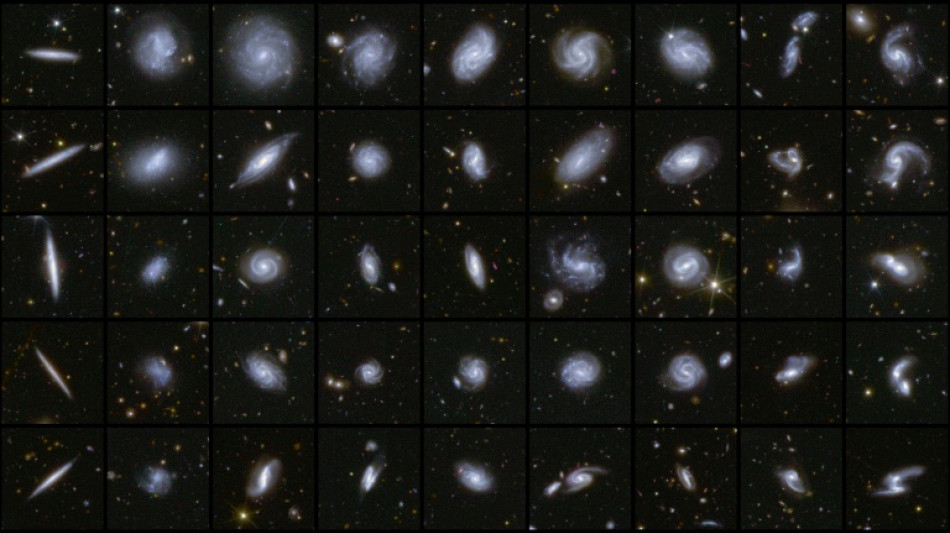
'Dark universe detective' telescope releases first data / Photo: Handout - ESA/Euclid/Euclid Consortium/NASA/AFP
Europe's Euclid space telescope, which is on a mission to shed light on the mysteries of dark matter and dark energy, released its first data Wednesday with a little help from volunteers and artificial intelligence.
The telescope launched in 2023, aiming to chart one third of the sky -- encompassing 1.5 billion galaxies -- to create what has been billed as humanity's most accurate 3D map of the universe.
Euclid, which is now hovering 1.5 million kilometres (932,0000 miles) from Earth, has previously released images of a range of strange galaxies, colourful nebulas and shining stars.
But the first release of astronomical data is "a new milestone for our dark universe detective," the European Space Agency's science director Carole Mundell told a press conference.
The huge amount of data -- which was accompanied by 27 scientific papers -- still only covers less then 0.5 percent of the sky that Euclid will scan over its six-year mission.
- Snagging the 'cosmic web' -
Yet the early data already offers hints about the overall structure of the universe known as the "cosmic web," project scientist Valeria Pettorino said.
Between large empty spaces, there are massive clusters of galaxies connected by filaments of material which make up this web, she explained.
This unimaginably massive structure cannot be explained by visible matte alone, so scientists believe dark matter and dark energy must play a role.
These invisible forces are thought to make up 95 percent of the universe yet remain shrouded in mystery.
Dark matter is believed to be the glue that holds galaxies together, while dark energy pulls them apart by making the universe expand faster and faster over time.
Because looking into distant space also means looking back in time, Euclid allows scientists to track this cosmic tussle over most of the history of the universe -- and hopefully discover more about their true nature.
"Ultimately, we want to test the laws of gravity," Mundell said.
Einstein's theory of relativity has passed every test thrown at it, "but it does not yet, in its current form, explain the accelerated expansion of the universe", which is driven by dark energy, she explained.
However the new data did not contain any major revelations about dark matter and dark energy. That will have to wait until closer to the end of Euclid's mission, the scientists said.
- Capturing the galactic zoo -
The Euclid Consortium, which brings together more than 2,000 researchers from Europe, the United States, Canada and Japan, sorted through the new data.
Wednesday's release contained 35 terabytes of data -- the equivalent of streaming 4K video for 200 days -- yet represented just a week of Euclid's observation time.
This "allows to us see whether the machinery is working", the consortium's deputy scientific director Francis Bernardeau told AFP.
The new data covered three areas of the sky containing 26 million galaxies.
The most distant was 10.5 billion light years away, which is fairly early on in the 13.8 billion-year history of the universe.
The consortium then had to catalogue all the galaxies, quasars and other cosmic oddities captured by the telescope.
This includes what are known as gravitational lenses, which is when a massive object such as a galaxy bends the light of something else huge and bright behind it, creating a kind of magnifying glass.
In just a week, Euclid spotted around 500 gravitational lenses, which is "way more than we expected," said consortium member Mike Walmsley from the University of Toronto.
To help crunch the data, the Euclid consortium used an artificial intelligence (AI) algorithm as well as more than 10,000 keen-eyed human volunteers.
The AI model selected possible gravitational lenses from the data, which were then verified by humans.
More citizens scientists then identified the shapes of the galaxies, which was in turn used to train the AI algorithms to repeat this process, Walmsley said.
But this is all just "a taste of things to come", Mundell added, with Euclid planned to release its first full catalogue of data next year.
T.Gerber--NZN