Record numbers forced to flee climate disasters: UN / Photo: Ioana PLESEA, Sabrina BLANCHARD - AFP
Hundreds of thousands of people were forced to flee climate disasters last year, the United Nations said Wednesday, highlighting the urgent need for early warning systems covering the entire planet.
Poorer countries are severely affected by cyclones, droughts, wildfires and other disasters, according to the State of the Global Climate annual report by the World Meteorological Organization (WMO), the UN's weather and climate agency.
The WMO said the record number of people fleeing climate disasters was based on figures from the International Displacement Monitoring Centre (IDMC), which has been collecting data on the subject since 2008.
In Mozambique, around 100,000 people were displaced by Cyclone Chido.
But wealthy countries were also hit, with the WMO pointing to the floods in the Spanish city of Valencia, which killed 224 people, and the devastating fires in Canada and the United States which forced more than 300,000 people to flee their homes in search of safety.
"In response, WMO and the global community are intensifying efforts to strengthen early warning systems and climate services," said the agency's chief Celeste Saulo.
The WMO wants everyone in the world covered by such systems by the end of 2027.
"We are making progress but need to go further and need to go faster. Only half of all countries worldwide have adequate early warning systems," said Saulo.
- Investment call -
The call comes two months after the return to power of US President Donald Trump -- a climate sceptic -- raised fears of a setback in climate science.
The National Oceanic and Atmospheric Administration (NOAA) -- the leading US agency responsible for weather forecasting, climate analysis and marine conservation -- has become a target for Trump's administration, with hundreds of scientists and experts already let go.
Trump has reappointed meteorologist Neil Jacobs to lead NOAA, despite him, during Trump's first term, being officially censured for bowing to political pressure and misleading the public about a hurricane forecast.
In recent weeks, the WMO has highlighted how essential NOAA and the United States are to a vast system put in place decades ago to monitor weather and the climate globally.
"We are working together with all the scientists around the world and the countries," Omar Baddour, who heads the WMO's climate monitoring and policy services division, said at the report's launch.
"We hope that this will continue, despite the differences in politics and internal changes."
Scientists and environmental advocates have voiced concern about layoffs and a possible dismantling of the NOAA.
Saulo said investment in weather, water and climate services was now more important than ever to build safer, more resilient communities.
- Planet issuing 'distress signals' -
Besides underlining the massive economic and social upheavals from extreme weather, the State of the Global Climate report said climate change indicators had once again reached record levels.
"The clear signs of human-induced climate change reached new heights in 2024, with some of the consequences being irreversible over hundreds if not thousands of years," the WMO said.
The 2015 Paris climate accords aimed to limit global warming to well below two degrees Celsius above pre-industrial levels -- and to 1.5C if possible.
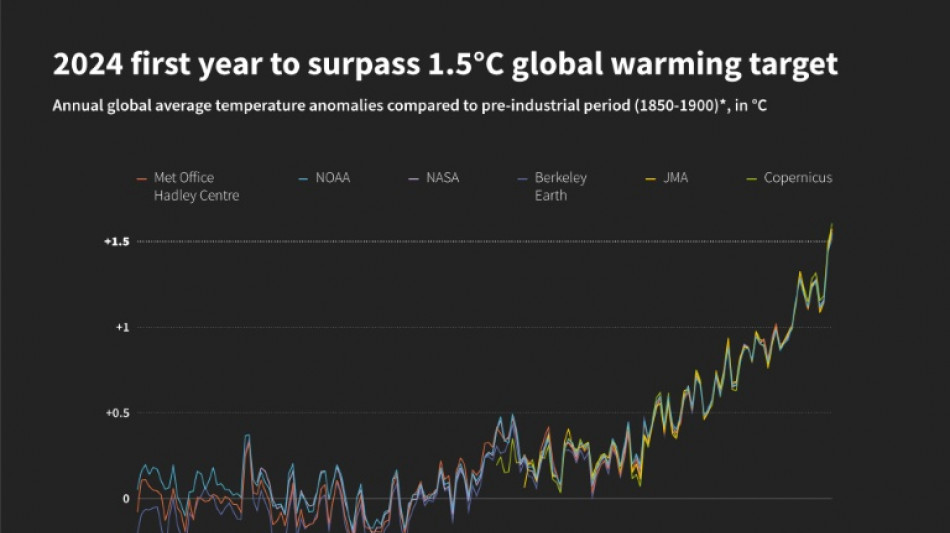
The report said 2024 was the warmest year in the 175-year observational record, and the first calendar year over the 1.5C threshold, with the global mean near-surface temperature 1.55C above the 1850-1900 average, according to an analysis compiling the six major international datasets.
"Our planet is issuing more distress signals -- but this report shows that limiting long-term global temperature rise to 1.5C is still possible," UN chief Antonio Guterres said.
Temperatures are only one part of the picture.
In 2024, "our oceans continued to warm and sea levels continued to rise", said Saulo.
Meanwhile the frozen parts of the Earth's surface are melting at an alarming rate, the WMO chief added.
"Glaciers continue to retreat, and Antarctic sea ice reached its second-lowest extent ever recorded," she said.
During the report's presentation, oceanographer Karina von Schuckmann highlighted the "acceleration" in two global indicators: ocean warming, which has accelerated since 1960, and sea level rise.
R.Schmid--NZN