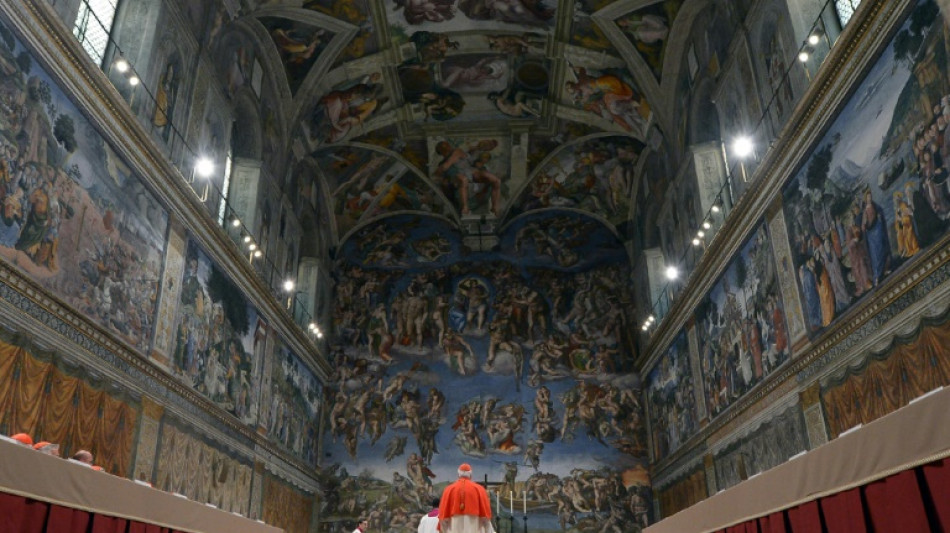
Doves, deaths and rations: Papal elections over time / Photo: - - OSSERVATORE ROMANO/AFP/File
Cardinals electing Pope Francis's successor will have an easier time than many of their predecessors, who endured spartan conditions and were even locked up so long that some of them died.
Here are some notable papal elections through the ages.
- The dove decides -
In 236, the Christian community of Rome was debating potential papal candidates when a white dove landed on the head of a bystander, Fabian.
"At this, everyone, as if moved by a single divine inspiration, eagerly and wholeheartedly called out that Fabian was worthy," according to Eusebius, a Church historian of the era.
The blessing was a mixed one for Fabian, who died 14 years later a martyr, persecuted by Emperor Decius.
- Large-scale bribery -
In the early Church, popes were elected by members of the clergy and the Roman nobility, and the votes were rife with meddling.
One of the most infamous elections was in 532, following the death of Boniface II, which involved "large-scale bribing of royal officials and influential senators", according to P.G. Maxwell-Stuart in "Chronicle of the Popes".
In the end, an ordinary priest was elected, Mercurius. He became the first pope to change his name -- to John.
In 1059, Nicholas II gave cardinals sole authority to choose pontiffs.
- Lock them up -
The idea of locking up the cardinals to encourage a quick decision began in the 13th century -- the word conclave comes from the Latin phrase meaning "with key".
In 1241, when the election was dragging on, the head of Rome's government locked the cardinals into a dilapidated building and refused to clean the lavatories or provide doctors for those who fell ill.
According to Frederic Baumgartner in his "Behind Locked Doors: A History of the Papal Elections", the cardinals only reached a decision after one of them died and the Romans threatened to exhume his corpse and have it make decisions.
After 70 days, they agreed on Goffredo Castiglioni, who became Celestine IV.
- Three years -
The longest conclave in history lasted almost three years following the death of Clement IV in November 1268, held in the papal palace at Viterbo, near Rome.
From late 1269 the cardinals allowed themselves to be locked in to try to reach a decision, and by June 1270, frustrated locals tore the roof off in a bid to speed things along.
They were apparently inspired by a quip by an English cardinal that without the roof, the Holy Spirit could descend unhindered.
Teobaldo Visconti became pope Gregory X in September 1271.
- Rations -
In response to the chaos the led to his election, Gregory X changed the rules, requiring cardinals to meet within 10 days of the pope's death -- and ordering that their food be reduced over time.
If there was no decision in three days, meals were to be reduced to only one of the two traditional Italian main courses.
After five days, they would be cut back to just bread, water and wine, according to John L. Allen's book "Conclave".
The cardinals were also barred from drawing on their incomes during a conclave.
- Camp beds -
Conclaves have for centuries been held in the Apostolic Palace, and since 1878 in its Sistine Chapel.
Cardinals have in the past slept in the Apostolic Palace, with cubicles erected with camp beds, and one bathroom for every 10 electors, according to Allen's "Conclave".
The windows were sealed shut but in 1978, when the conclave took place during a stifling August, there was a near revolt by cardinals who demanded they be opened.
John Paul II -- elected in a second conclave in that year, in October -- ordered the construction of the $20 million Santa Marta guesthouse in the Vatican grounds, where Francis himself lived, and where the cardinals now stay.
It has more than 100 guest suites and around two dozen single rooms. But during the conclave there, too, the windows are sealed shut.
- Non cardinals -
Technically any baptised male can become pope, but the last non-cardinal to be elected was the archbishop of Bari, Bartolomeo Prignano, who became Urban VI in 1378.
- Reluctant pontiff -
Not everyone is keen. The first words of Albino Luciani, on becoming John Paul I in 1978, were "May God forgive you for what you have done!"
He died 33 days later.
- Champagne -
In 1978, after appearing to the crowds in St Peter's Square, John Paul II reportedly walked around pouring champagne for the cardinals, and sang Polish folk songs.
In 2005, Benedict XVI invited all the cardinals to stay for dinner with champagne and there were also songs, the late cardinal Cormac Murphy-O'Connor recalled afterwards.
- Shorter and shorter -
The longest conclave in more recent times was that of 1831, which elected Gregory XVI after more than 50 days.
The longest of the 20th century, lasted only five days (14 ballots) when Pius XI was elected in 1922.
In 2005, Benedict XVI was elected in just two days (four ballots) and Francis in 2013 also in two days (five ballots).
H.Roth--NZN