Zürcher Nachrichten - Huge planet discovered orbiting tiny star puzzles scientists

EUR -
AED 4.35335
AFN 77.050797
ALL 96.614026
AMD 452.873985
ANG 2.121943
AOA 1087.00321
ARS 1723.800654
AUD 1.702936
AWG 2.136666
AZN 2.019869
BAM 1.955248
BBD 2.406031
BDT 145.978765
BGN 1.990709
BHD 0.449191
BIF 3539.115218
BMD 1.18539
BND 1.512879
BOB 8.254703
BRL 6.231008
BSD 1.194568
BTN 109.699013
BWP 15.630651
BYN 3.402439
BYR 23233.647084
BZD 2.402531
CAD 1.615035
CDF 2684.909135
CHF 0.915881
CLF 0.026011
CLP 1027.058063
CNY 8.240537
CNH 8.248946
COP 4354.94563
CRC 591.535401
CUC 1.18539
CUP 31.412839
CVE 110.234327
CZK 24.334287
DJF 212.720809
DKK 7.470097
DOP 74.383698
DZD 153.702477
EGP 55.903178
ERN 17.780852
ETB 185.572763
FJD 2.613371
FKP 0.863571
GBP 0.865754
GEL 3.194674
GGP 0.863571
GHS 12.974143
GIP 0.863571
GMD 86.533903
GNF 10372.164298
GTQ 9.16245
GYD 249.920458
HKD 9.257838
HNL 31.365884
HRK 7.536597
HTG 156.336498
HUF 381.328619
IDR 19883.141804
ILS 3.663335
IMP 0.863571
INR 108.679593
IQD 1553.453801
IRR 49934.560565
ISK 144.985527
JEP 0.863571
JMD 187.197911
JOD 0.840489
JPY 183.433247
KES 152.915746
KGS 103.662825
KHR 4768.236408
KMF 491.93733
KPW 1066.928941
KRW 1719.752641
KWD 0.36382
KYD 0.995519
KZT 600.800289
LAK 25485.888797
LBP 101410.128375
LKR 369.427204
LRD 219.593979
LSL 19.132649
LTL 3.500149
LVL 0.717031
LYD 7.495914
MAD 10.835985
MDL 20.092409
MGA 5260.173275
MKD 61.631889
MMK 2489.287708
MNT 4228.659246
MOP 9.606327
MRU 47.30937
MUR 53.852723
MVR 18.32658
MWK 2059.023112
MXN 20.70407
MYR 4.672854
MZN 75.580924
NAD 18.967522
NGN 1643.520192
NIO 43.508231
NOK 11.437875
NPR 175.519161
NZD 1.96876
OMR 0.458133
PAB 1.194573
PEN 3.994177
PGK 5.066955
PHP 69.837307
PKR 331.998194
PLN 4.215189
PYG 8001.773454
QAR 4.316051
RON 5.097064
RSD 117.111851
RUB 90.544129
RWF 1742.915022
SAR 4.446506
SBD 9.544303
SCR 17.200951
SDG 713.016537
SEK 10.580086
SGD 1.505332
SHP 0.88935
SLE 28.834661
SLL 24857.038036
SOS 677.454816
SRD 45.104693
STD 24535.182964
STN 24.493185
SVC 10.452048
SYP 13109.911225
SZL 19.132635
THB 37.411351
TJS 11.151397
TMT 4.148866
TND 3.37248
TOP 2.854135
TRY 51.47818
TTD 8.110743
TWD 37.456003
TZS 3052.380052
UAH 51.199753
UGX 4270.811618
USD 1.18539
UYU 46.357101
UZS 14603.874776
VES 410.075543
VND 30749.020682
VUV 141.680176
WST 3.213481
XAF 655.774526
XAG 0.014004
XAU 0.000244
XCD 3.203577
XCG 2.153028
XDR 0.815573
XOF 655.774526
XPF 119.331742
YER 282.508153
ZAR 19.136335
ZMK 10669.938133
ZMW 23.443477
ZWL 381.695147
  • SCS

    0.0200

    16.14

    +0.12%

  • RBGPF

    1.3800

    83.78

    +1.65%

  • BCC

    0.5100

    80.81

    +0.63%

  • RIO

    -4.1000

    91.03

    -4.5%

  • RELX

    -0.3700

    35.8

    -1.03%

  • BTI

    0.4600

    60.68

    +0.76%

  • BP

    -0.1600

    37.88

    -0.42%

  • CMSC

    0.0500

    23.76

    +0.21%

  • RYCEF

    -0.4300

    16

    -2.69%

  • NGG

    0.2000

    85.27

    +0.23%

  • GSK

    0.9400

    51.6

    +1.82%

  • JRI

    0.1400

    13.08

    +1.07%

  • BCE

    0.3700

    25.86

    +1.43%

  • CMSD

    -0.0400

    24.05

    -0.17%

  • VOD

    -0.0600

    14.65

    -0.41%

  • AZN

    0.1800

    92.77

    +0.19%

Huge planet discovered orbiting tiny star puzzles scientists
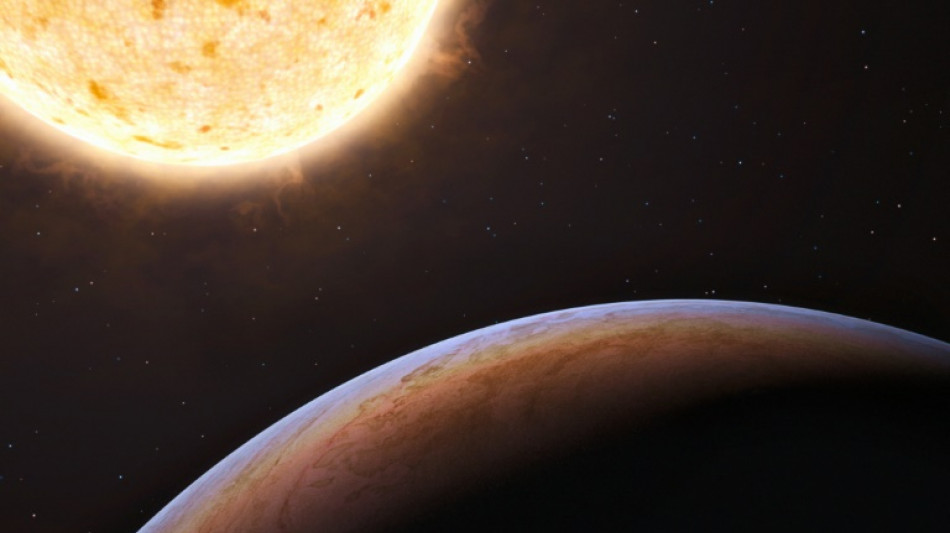
Huge planet discovered orbiting tiny star puzzles scientists / Photo: HO - ESO/AFP/File

Huge planet discovered orbiting tiny star puzzles scientists

Astronomers announced Wednesday they have discovered a massive planet orbiting a tiny star, a bizarre pairing that has stumped scientists.

Text size:

Most of the stars across the Milky Way are small red dwarfs like TOI-6894, which has only 20 percent the mass of our Sun.

It had not been thought possible that such puny, weak stars could provide the conditions needed to form and host huge planets.

But an international team of astronomers have detected the unmistakable signature of a gas giant planet orbiting the undersized TOI-6894, according to a study in the journal Nature Astronomy.

This makes the star the smallest star yet known to host a gas giant.

The planet has a slightly larger radius than Saturn, but only half its mass. It orbits its star in a little over three days.

The astronomers discovered the planet when searching through more than 91,000 low-mass red dwarfs observed by NASA's TESS space telescope.

Its existence was then confirmed by ground-based telescopes, including Chile's Very Large Telescope.

"The fact that this star hosts a giant planet has big implications for the total number of giant planets we estimate exist in our galaxy," study co-author Daniel Bayliss of the UK's Warwick University said in a statement.

Another co-author, Vincent Van Eylen, of University College London, said it was an "intriguing discovery".

"We don't really understand how a star with so little mass can form such a massive planet!" he said.

"This is one of the goals of the search for more exoplanets. By finding planetary systems different from our solar system, we can test our models and better understand how our own solar system formed."

- How do you make a planet? -

The most prominent theory for how planets form is called core accretion.

The process begins when a ring of gas and dust -- called a protoplanetary disc -- which surrounds a newly formed star builds up into a planetary core. This core attracts more gas that forms an atmosphere, eventually snowballing into a gas giant.

Under this theory, it is difficult for low-mass stars to host giant planets because there is not enough gas and dust to begin building a core in the first place.

A rival theory proposes that these planets instead form when their protoplanetary disc becomes gravitationally unstable and breaks up, with the collapsing gas and dust forming a planet.

However neither theory seems to explain the existence of the newly discovered planet, TOI-6894b, the researchers said.

The planet also interests scientists because it is strangely cold.

Most of the gas giants discovered outside our Solar System so far have been what are known as "hot Jupiters", where temperatures soar well over 1,000 degrees Celsius.

But the newly discovered planet appears to be under 150C, the researchers said.

"Temperatures are low enough that atmospheric observations could even show us ammonia, which would be the first time it is found in an exoplanet atmosphere," said study co-author Amaury Triaud of Birmingham University.

The James Webb space telescope is scheduled to turn its powerful gaze towards the planet in the next year, which could help uncover some more mysteries of this strange planet.

P.E.Steiner--NZN