Zürcher Nachrichten - South Korea launches domestically-developed space rocket

EUR -
AED 4.277061
AFN 76.950546
ALL 96.512644
AMD 444.304954
ANG 2.084732
AOA 1067.955685
ARS 1678.804789
AUD 1.753535
AWG 2.09777
AZN 1.982129
BAM 1.955052
BBD 2.344802
BDT 142.412867
BGN 1.955104
BHD 0.439041
BIF 3439.783382
BMD 1.164619
BND 1.508116
BOB 8.044886
BRL 6.22477
BSD 1.164154
BTN 104.671486
BWP 15.467013
BYN 3.347019
BYR 22826.536869
BZD 2.341394
CAD 1.616631
CDF 2597.100737
CHF 0.936267
CLF 0.027301
CLP 1070.960313
CNY 8.23578
CNH 8.234458
COP 4432.074934
CRC 568.68233
CUC 1.164619
CUP 30.86241
CVE 110.205311
CZK 24.214239
DJF 207.30976
DKK 7.468476
DOP 74.51148
DZD 151.354966
EGP 55.402913
ERN 17.469288
ETB 180.576207
FJD 2.634353
FKP 0.872138
GBP 0.87294
GEL 3.121621
GGP 0.872138
GHS 13.242874
GIP 0.872138
GMD 85.017455
GNF 10114.521851
GTQ 8.917587
GYD 243.565727
HKD 9.067021
HNL 30.662264
HRK 7.530546
HTG 152.401666
HUF 381.989861
IDR 19432.836438
ILS 3.753574
IMP 0.872138
INR 104.748008
IQD 1525.116243
IRR 49059.585596
ISK 148.780327
JEP 0.872138
JMD 186.338677
JOD 0.825743
JPY 180.89856
KES 150.585942
KGS 101.845792
KHR 4661.19586
KMF 491.468929
KPW 1048.149375
KRW 1714.796633
KWD 0.357445
KYD 0.970224
KZT 588.75212
LAK 25245.228701
LBP 104252.948348
LKR 359.092553
LRD 204.901571
LSL 19.730748
LTL 3.438817
LVL 0.704466
LYD 6.328578
MAD 10.750877
MDL 19.808333
MGA 5192.990026
MKD 61.616416
MMK 2445.630016
MNT 4130.324554
MOP 9.335627
MRU 46.42523
MUR 53.654236
MVR 17.946357
MWK 2018.718644
MXN 21.180086
MYR 4.787708
MZN 74.415885
NAD 19.730748
NGN 1689.431805
NIO 42.843601
NOK 11.755591
NPR 167.474897
NZD 2.015379
OMR 0.447788
PAB 1.164249
PEN 3.913302
PGK 4.939325
PHP 68.683372
PKR 326.381174
PLN 4.23112
PYG 8006.935249
QAR 4.243476
RON 5.093347
RSD 117.408742
RUB 89.995986
RWF 1693.844389
SAR 4.371082
SBD 9.577623
SCR 15.736221
SDG 700.522602
SEK 10.954705
SGD 1.5087
SHP 0.873766
SLE 26.786325
SLL 24421.480735
SOS 664.14294
SRD 44.988081
STD 24105.266663
STN 24.490626
SVC 10.185483
SYP 12878.643782
SZL 19.715454
THB 37.105348
TJS 10.681466
TMT 4.076167
TND 3.415093
TOP 2.804124
TRY 49.506337
TTD 7.891979
TWD 36.420086
TZS 2835.847776
UAH 48.866733
UGX 4118.423624
USD 1.164619
UYU 45.532572
UZS 13927.669017
VES 289.50792
VND 30699.36285
VUV 142.165196
WST 3.249463
XAF 655.703207
XAG 0.019942
XAU 0.000275
XCD 3.147441
XCG 2.098188
XDR 0.815257
XOF 655.601918
XPF 119.331742
YER 277.642899
ZAR 19.727131
ZMK 10482.964936
ZMW 26.915582
ZWL 375.006916
  • CMSC

    -0.0700

    23.41

    -0.3%

  • RBGPF

    0.0000

    78.35

    0%

  • NGG

    -0.3600

    75.55

    -0.48%

  • GSK

    -0.3250

    48.245

    -0.67%

  • BTI

    -0.8550

    57.185

    -1.5%

  • AZN

    0.3500

    90.38

    +0.39%

  • SCS

    -0.0470

    16.183

    -0.29%

  • BP

    -0.9500

    36.28

    -2.62%

  • RYCEF

    -0.1400

    14.51

    -0.96%

  • JRI

    0.0300

    13.78

    +0.22%

  • RIO

    -0.1300

    73.6

    -0.18%

  • CMSD

    -0.0610

    23.259

    -0.26%

  • BCE

    0.2660

    23.486

    +1.13%

  • VOD

    -0.1530

    12.48

    -1.23%

  • BCC

    -0.8000

    73.46

    -1.09%

  • RELX

    -0.1550

    40.385

    -0.38%

South Korea launches domestically-developed space rocket
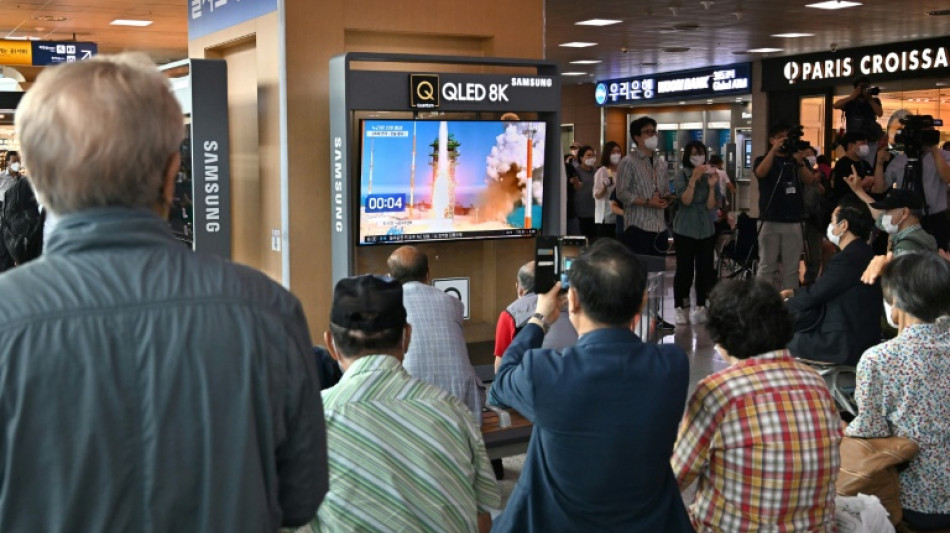
South Korea launches domestically-developed space rocket / Photo: Jung Yeon-je - AFP

South Korea launches domestically-developed space rocket

South Korea launched its first domestically-developed space rocket on Tuesday, the government said, the country's second attempt after a launch last October failed.

Text size:

The Korea Satellite Launch Vehicle II, a 200-tonne liquid fuel rocket informally called Nuri, lifted off from the launch site in Goheung at 4:00pm (0700 GMT).

"Nuri has completed its flight according to plan. Engineers are now analysing its flight data, which will take around 30 minutes to complete," said Oh Tae-seok, Seoul's deputy minister of science, technology and innovation.

South Korea's second test launch of its homegrown space rocket comes eight months after the first test failed to put a dummy satellite into orbit, a setback for the country's attempt to join the ranks of advanced space-faring nations.

All three stages of the rocket worked in the first test last October, with the vehicle reaching an altitude of 700 kilometres (430 miles), and the 1.5-tonne payload separating successfully.

But it failed to put a dummy satellite into orbit after the third-stage engine stopped burning earlier than scheduled.

However, on Tuesday it appeared that stage of the launch had worked as planned.

"Nuri separates dummy satellite," South Korea's YTN Television reported minutes after lift-off, adding shortly after that the launch "appears to be a success".

In Tuesday's test, in addition to the dummy satellite, Nuri carried a rocket performance verification satellite and four cube satellites developed by four local universities for research purposes.

The three-stage Nuri rocket has been a decade in development at a cost of 2 trillion won ($1.5 billion).

It weighs 200 tonnes and is 47.2 metres (155 feet) long, fitted with a total of six liquid-fuelled engines.

In Asia, China, Japan and India all have advanced space programmes, and the South's nuclear-armed neighbour North Korea was the most recent entrant to the club of countries with their own satellite launch capability.

- Lunar ambitions -

Ballistic missiles and space rockets use similar technology and Pyongyang put a 300-kilogram (660-pound) satellite into orbit in 2012 in what Washington condemned as a disguised missile test.

Even now, only six nations -- not including North Korea -- have successfully launched a one-tonne payload on their own rockets.

If Tuesday's launch works, South Korea will become the seventh nation in the world to have mastered technology to launch a space vehicle that carries more than a one-tonne satellite.

The South Korean space programme has a mixed record -- its first two launches in 2009 and 2010, which in part used Russian technology, both ended in failure.

The second one exploded two minutes into the flight, with Seoul and Moscow blaming each other.

Eventually a 2013 launch succeeded, but still relied on a Russian-developed engine for its first stage.

The satellite launch business is increasingly the preserve of private companies, notably Elon Musk's SpaceX, whose clients include the US space agency NASA and the South Korean military.

The Tuesday test looks set to bring South Korea closer to achieving its space ambitions, including a plan to land a probe on the Moon by 2030.

South Korea plans to conduct four more such test launches by 2027.

G.Kuhn--NZN