Zürcher Nachrichten - US, India to launch powerful Earth-monitoring satellite

EUR -
AED 4.330578
AFN 75.468553
ALL 95.370831
AMD 434.26718
ANG 2.110613
AOA 1082.496254
ARS 1649.279971
AUD 1.625347
AWG 2.125489
AZN 2.009303
BAM 1.955202
BBD 2.368676
BDT 144.305864
BGN 1.967008
BHD 0.444064
BIF 3500.4294
BMD 1.179189
BND 1.491244
BOB 8.126515
BRL 5.795828
BSD 1.17604
BTN 111.057033
BWP 15.789171
BYN 3.323484
BYR 23112.111202
BZD 2.365277
CAD 1.609181
CDF 2670.864298
CHF 0.915942
CLF 0.026704
CLP 1050.508704
CNY 8.019372
CNH 8.014083
COP 4394.855841
CRC 540.634648
CUC 1.179189
CUP 31.248518
CVE 110.231286
CZK 24.334582
DJF 209.425947
DKK 7.476537
DOP 69.938609
DZD 156.038276
EGP 62.195977
ERN 17.68784
ETB 183.631137
FJD 2.574218
FKP 0.86512
GBP 0.864667
GEL 3.154379
GGP 0.86512
GHS 13.247948
GIP 0.86512
GMD 86.674958
GNF 10318.844
GTQ 8.979254
GYD 246.064742
HKD 9.236241
HNL 31.264438
HRK 7.538916
HTG 153.972908
HUF 353.981307
IDR 20491.303919
ILS 3.421187
IMP 0.86512
INR 111.345548
IQD 1540.628801
IRR 1546506.829043
ISK 143.873347
JEP 0.86512
JMD 185.35331
JOD 0.836092
JPY 184.70237
KES 151.883547
KGS 103.085327
KHR 4718.556838
KMF 492.90156
KPW 1061.270109
KRW 1723.751231
KWD 0.36279
KYD 0.9801
KZT 543.543758
LAK 25791.111834
LBP 105315.489444
LKR 378.634195
LRD 215.803997
LSL 19.293799
LTL 3.48184
LVL 0.71328
LYD 7.436725
MAD 10.75591
MDL 20.110849
MGA 4912.497521
MKD 61.616155
MMK 2475.640798
MNT 4221.622084
MOP 9.4824
MRU 47.006623
MUR 55.210091
MVR 18.163925
MWK 2038.876413
MXN 20.468414
MYR 4.623647
MZN 75.362436
NAD 19.293799
NGN 1609.593864
NIO 43.276764
NOK 10.859513
NPR 177.691653
NZD 1.984332
OMR 0.453611
PAB 1.17604
PEN 4.066156
PGK 5.193412
PHP 71.358689
PKR 327.765953
PLN 4.239717
PYG 7183.802847
QAR 4.298685
RON 5.21945
RSD 117.334114
RUB 87.543025
RWF 1724.072695
SAR 4.44258
SBD 9.456429
SCR 17.539736
SDG 708.107537
SEK 10.86706
SGD 1.503353
SHP 0.880384
SLE 29.067455
SLL 24727.006491
SOS 672.094441
SRD 44.100547
STD 24406.83871
STN 24.492509
SVC 10.290853
SYP 130.395965
SZL 19.281103
THB 37.973479
TJS 10.972544
TMT 4.127163
TND 3.415955
TOP 2.839205
TRY 53.473293
TTD 7.970562
TWD 36.927538
TZS 3063.662984
UAH 51.6595
UGX 4406.652233
USD 1.179189
UYU 46.905654
UZS 14265.63688
VES 588.693738
VND 31022.113342
VUV 138.276182
WST 3.19218
XAF 655.756438
XAG 0.014675
XAU 0.00025
XCD 3.186819
XCG 2.119552
XDR 0.815551
XOF 655.756438
XPF 119.331742
YER 281.384102
ZAR 19.327341
ZMK 10614.123377
ZMW 22.390152
ZWL 379.698489
  • AZN

    0.3300

    182.85

    +0.18%

  • RIO

    2.2700

    105.38

    +2.15%

  • BTI

    0.2000

    58.28

    +0.34%

  • BCE

    -0.4300

    24.14

    -1.78%

  • BP

    -0.4700

    43.34

    -1.08%

  • GSK

    -0.0900

    50.41

    -0.18%

  • RBGPF

    0.7000

    63.61

    +1.1%

  • CMSC

    0.1400

    23.11

    +0.61%

  • CMSD

    0.1140

    23.534

    +0.48%

  • BCC

    -2.0900

    70.67

    -2.96%

  • NGG

    0.9800

    86.89

    +1.13%

  • RELX

    0.0759

    33.58

    +0.23%

  • VOD

    0.5100

    16.2

    +3.15%

  • JRI

    0.0000

    13.15

    0%

  • RYCEF

    -0.4100

    16.37

    -2.5%

US, India to launch powerful Earth-monitoring satellite
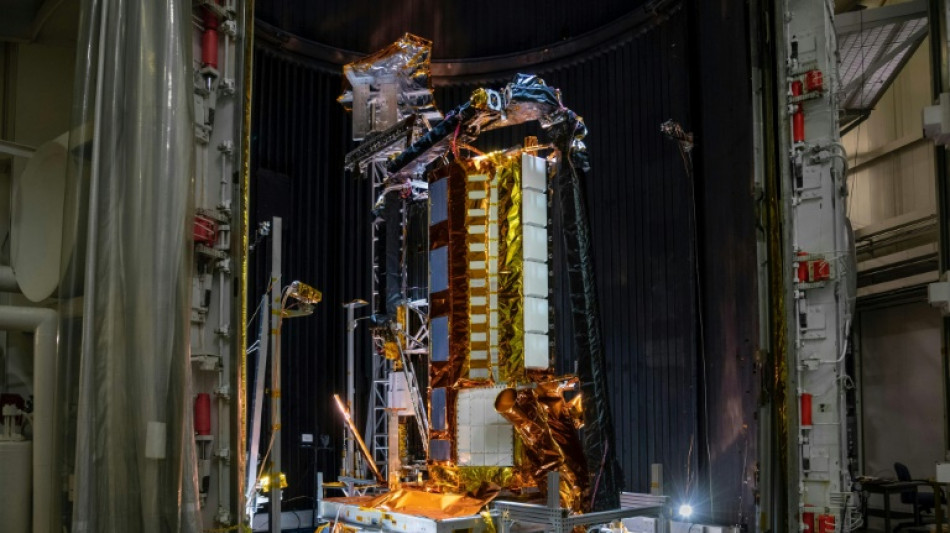
US, India to launch powerful Earth-monitoring satellite / Photo: - - NASA/AFP

US, India to launch powerful Earth-monitoring satellite

A formidable new radar satellite jointly developed by the United States and India is set to launch Wednesday, designed to track subtle changes in Earth's land and ice surfaces and help predict both natural and human-caused hazards.

Text size:

Dubbed NISAR (NASA-ISRO Synthetic Aperture Radar), the pickup truck-sized spacecraft is scheduled to lift off at 5:40 pm (1210 GMT) from the Satish Dhawan Space Centre on India's southeastern coast, riding an ISRO Geosynchronous Satellite Launch Vehicle rocket.

Highly anticipated by scientists, the mission has also been hailed as a milestone in growing US-India cooperation between President Donald Trump and Prime Minister Narendra Modi.

"Our planet surface undergoes constant and meaningful change," Karen St Germain, director of NASA's Earth Science division, told reporters.

"Some change happens slowly. Some happens abruptly. Some changes are large, while some are subtle."

By picking up on tiny changes in the vertical movement of the Earth's surface -- as little as one centimeter (0.4 inches) -- scientists will be able to detect the precusors for natural and human-caused disasters, from earthquakes, landsides and volcanoes to aging infrastructure like dams and bridges.

"We'll see land substance and swelling, movement, deformation and melting of mountain glaciers and ice sheets covering both Greenland and Antarctica, and of course, we'll see wildfires," added St Germain, calling NISAR "the most sophisticated radar we've ever built."

Equipped with a 12-meter dish that will unfold in space, NISAR will record nearly all of Earth's land and ice twice every 12 days from an altitude of 464 miles (747 kilometers).

- Microwave frequencies -

As it orbits, the satellite will continuously transmit microwaves and receive echoes from the surface.

Because the spacecraft is moving, the returning signals are distorted -- but computer processing will reassemble them to produce detailed, high-resolution images.

Achieving similar results with traditional radar would require an impractically large 12-mile-wide dish.

NISAR will operate on two radar frequencies: L-band and S-band. The L-band is ideal for sensing taller vegetation like trees, while the S-band enables more accurate readings of shorter plants such as bushes and shrubs.

NASA's Jet Propulsion Laboratory and India's ISRO shared the workload, each building components on opposite sides of the planet before integrating and testing the spacecraft at ISRO's Satellite Integration & Testing Establishment in the southern Indian city of Bengaluru.

NASA's contribution came to just under $1.2 billion, while ISRO's costs were around $90 million.

India's space program has made major strides in recent years, including placing a probe in Mars orbit in 2014 and landing a robot and rover on the Moon in 2023.

Shubhanshu Shukla, a test pilot with the Indian Air Force, recently became the second Indian to travel to space and the first to reach the International Space Station -- a key step toward India's own indigenous crewed mission planned for 2027 under the Gaganyaan ("sky craft") program.

X.Blaser--NZN