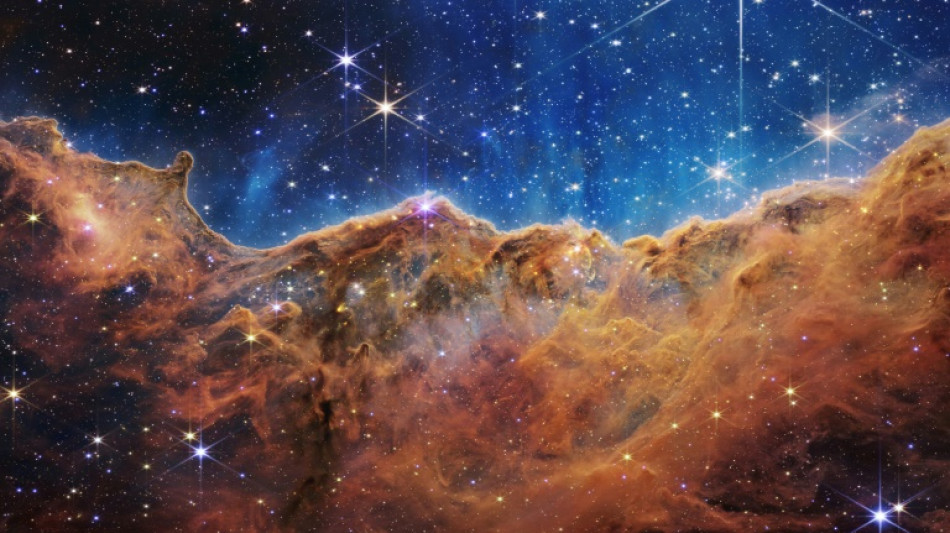
Cosmic cliffs and dancing galaxies: Webb begins era of discovery / Photo: Handout - NASA/AFP
The cosmic cliffs of a stellar nursery and a quintet of galaxies bound in a celestial dance: NASA released the next wave of images from the James Webb Space Telescope Tuesday, heralding a new era of astronomy.
"Every image is a new discovery," said NASA administrator Bill Nelson. "Each will give humanity a view of the universe that we've never seen before."
Released one by one starting from 10:30 am Eastern (1430 GMT) at the Goddard Space Flight Center, the new images demonstrated the full power of the $10 billion observatory, which uses infrared cameras to gaze into the distant universe with unprecedented clarity.
"They're beautiful and they're full of wonderful discoveries and science, and lots of things we haven't identified are in there," Nobel-winning cosmologist and Webb senior project scientist John Mather told AFP.
On Monday, Webb revealed the sharpest image to date of the early universe, teeming with thousands of galaxies going back more than 13 billion years.
The latest tranche included the "mountains" and "valleys" of a star-forming region called NGC 3324 in the Carina Nebula, dubbed the "Cosmic Cliffs," 7,600 light years away.
"For the first time we're seeing brand new stars that were previously completely hidden from our view," said NASA astrophysicist Amber Straughn.
- Stellar nurseries and graveyards -
Webb also revealed never-before-seen details of Stephan's Quintet, a grouping of five galaxies including four that experience repeated close encounters, which provide insights into how early galaxies formed at the start of the universe.
At the center of the cluster is a black hole called an active galactic nucleus, "which means stuff is flowing in, it gets cooked to high temperatures, and some of it gets spit back out again," explained Mather.
Studying the black hole will allow scientists to better understand the one at the center of our own Milky Way, called Sagittarius A*.
A dim star at the center of the Southern Ring Nebula was found for the first time to be cloaked in dust, as it spews out rings of gas and dust in its death throes.
Understanding the molecules present in such stellar graveyards can help scientists learn more about the process of stellar death.
The telescope also detailed water vapor in the atmosphere of a faraway giant gas planet.
The spectroscopy -- an analysis of light that reveals detailed information -- was of planet WASP-96 b, which was discovered in 2014.
Scientists will next hope to train the spectrographic instruments on small rocky worlds such as our own, to search for signs of habitability.
- Fundamental discoveries expected -
Webb's first images have set the space community alight, and will also be shown on giant screens in New York City's Times Square and in London.
Launched in December 2021 from French Guiana on an Ariane 5 rocket, Webb is orbiting the Sun at a distance of a million miles (1.6 million kilometers) from Earth, in a region of space called the second Lagrange point.
It remains in a fixed position relative to the Earth and Sun, with minimal fuel required for course corrections and maneuvering its instruments.
A wonder of engineering, Webb is one of the most expensive scientific platforms to date, comparable to the Large Hadron Collider at CERN, and also among the most complex machines ever built.
Webb's primary mirror is over 21 feet (6.5 meters) wide and is made up of 18 gold-coated mirror segments. Like a camera held in one's hand, the structure has to remain very still for the best shots, with Webb's engineers minimizing its wobble to just 17 millionths of a millimeter.
Its pointing accuracy is equivalent to firing a bullet from Washington and hitting a coin on top of a tower in Los Angeles, Charlie Atkinson, chief engineer for its main builder Northrop Grumman, told AFP.
After the first images, astronomers around the globe will get shares of time on the telescope, with projects selected competitively through a process in which applicants and selectors don't know each other's identities, to minimize bias.
Thanks to an efficient launch, NASA estimates Webb has enough propellant for a 20-year life, as it works in concert with the Hubble and Spitzer space telescopes to answer fundamental questions about the cosmos -- including those scientists don't yet know to ask.
"We don't know what we don't know yet," said Straughn.
Hubble played a key role in discovering that dark energy is causing the universe to expand at an ever-growing rate, "so it's hard to imagine what we might learn with this 100 times more powerful instrument."
B.Brunner--NZN