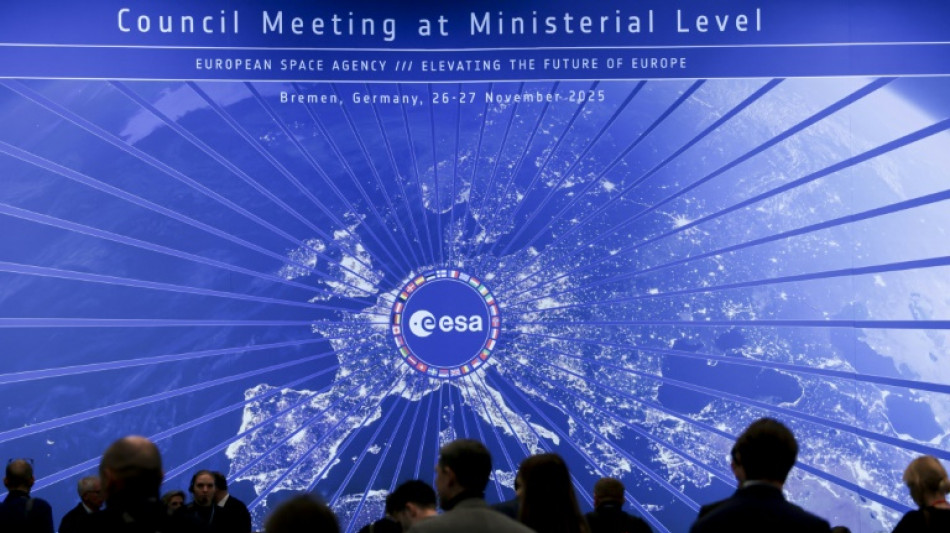
Europe secures record space budget to boost indepedence / Photo: FOCKE STRANGMANN - AFP
The European Space Agency announced Thursday it had secured a record budget of 22.1 billion euros to fund its programmes for the next three years, as the continent seeks greater independence in space.
The ESA also approved a plan to bolster security and defence cooperation and laid out future plans for scientific space missions at a ministerial council meeting in the German city of Bremen.
The agency's 23 member states committed five billion euros more than 2022's budget, with the total representing almost all of the 22.2-billion-euro ($25.7 billion) funding sought by the agency.
"This has never happened before," ESA director general Josef Aschbacher told the meeting. "You have written history."
Ahead of the meeting, experts had expected a budget of around 20 billion euros.
The new pledges demonstrate that space is an "economic sector that is growing very fast," Aschbacher emphasised.
"It is also more and more important for security and defence, and it is a domain where Europe has to catch up," he added.
At the heart of the discussions in Bremen was the European Resilience from Space programme, which includes Earth observation, navigation and telecommunications.
The programme, with an estimated 1.35-billion-euro budget, has both civilian and military applications and aims to strengthen European security.
Germany was the biggest contributor to the total budget with more than five billion euros, while France put in 3.7 billion euros.
- Rockets and telescopes -
The space industry has changed significantly in recent years as billionaire Elon Musk's SpaceX has risen to dominate the space launch sector.
Europe meanwhile lost an independent way to launch its projects into space after Russia pulled its rockets following Moscow's invasion of Ukraine in 2022.
After repeated delays, Europe's new heavy lift Ariane 6 rocket finally blasted off last year. However the rocket is not reusable, unlike SpaceX's Falcon 9 workhorse.
So the ESA is planning to contract out the job of developing the continent's first reusable rocket, having named a shortlist of potential companies.
In Bremen, the European Launcher Challenge received more than 900 million euros in contributions -- twice what had been proposed, Aschbacher said.
The funding boost for the ESA comes as US space agency NASA faces stiff budget cuts under President Donald Trump.
However, the ESA said this week that NASA has confirmed it will contribute to Europe's Martian rover Rosalind Franklin. The mission is scheduled to launch in 2028 aiming to probe the surface of Mars for signs of extraterrestrial life.
Among the scientific projects the ESA has proposed for the future -- but have not yet been approved -- is the first space-based laser observatory called LISA aimed at studying gravitational waves, which are ripples in spacetime first predicted by Albert Einstein.
Another is the X-ray telescope NewAthena, which would study extreme events in the universe such as supermassive black holes.
There is also a plan to send a spacecraft to Saturn's moon Enceladus, which scientists suspect could have a liquid ocean under its icy shell that might even have the ability to host life.
The ESA also has a joint proposal with Japan to send a spacecraft called Ramses to study the asteroid Apophis as it zings past Earth in 2029, hoping to learn more about how to fend off dangerous space rocks in the future.
E.Schneyder--NZN