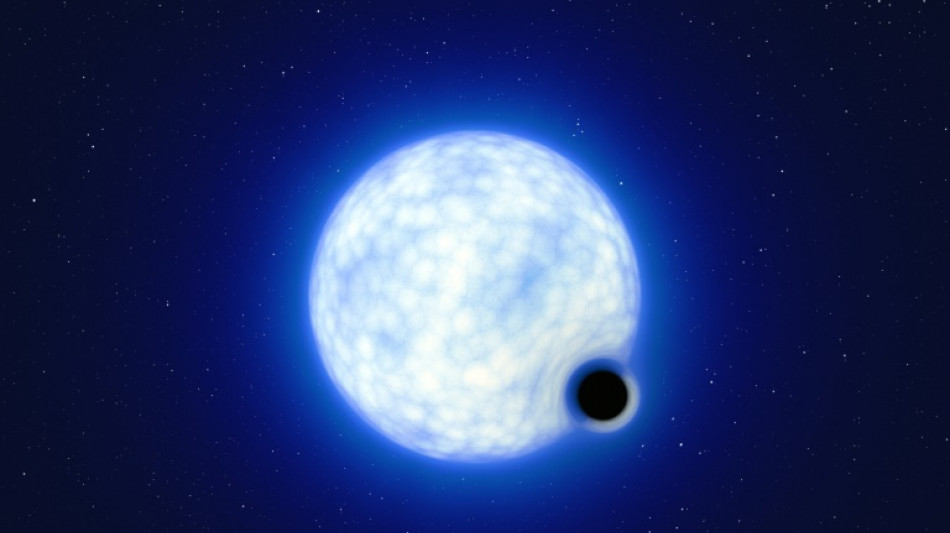
First 'dormant' stellar black hole discovered by debunking team / Photo: - - European Southern Observatory/AFP/File
A team of astrophysicists known for debunking previous supposed black holes announced a discovery of their own on Monday: the first "dormant" stellar-mass black hole spotted orbiting a star in a nearby galaxy.
While these black holes are thought to be common throughout the universe, they have proved difficult to find, and they have themselves rejected several possible candidates in recent years.
Now the international team has found a "needle in a haystack," said Tomer Shenar, an astrophysicist at the University of Amsterdam and lead author of a new study in the Nature Astronomy journal.
The team was searching the skies for something that could eventually become a binary black hole, in which two black holes orbit each other after swallowing their stars in a supernovae explosion.
"We found a quite massive star, that weighs 25 times the mass of our Sun, that is orbiting around something that we do not see," Shenar told AFP.
They believe the blue star, which is in the Large Magellanic Cloud galaxy that neighbours our Milky Way, is locked in a death dance with a black hole that has nine times the mass of our Sun.
These kinds of black holes are normally detected by the X-ray radiation they emit as they collect material from their companion star.
But this binary system, known as VFTS 243, is called dormant because it does not emit X-rays -- it is not close enough to suck matter from its star.
- 'Black hole destroyer' -
Hugues Sana, astrophysicist at the KU Leuven University in Belgium, said the Milky Way alone is thought to have around 100 million stellar-mass black holes, which are far smaller than their supermassive big brothers.
However only 10 have been found, said Sana, a co-author of the study.
This could be because many are laying dormant, biding their time to eventually swallow their companion star.
Sana said observing them was like watching two people dance in a dark room, one dressed in white and the other in black. You might only see one dancer, but you know the other one is there.
"We've never really detected such systems before," Shenar told AFP. "There have been a few claims in the last years, but they have all more or less been refuted," Shenar told AFP.
Indeed, members of his team were among those rejecting previous discoveries, by laying out alternatives for what the data could indicate.
Because of this, Shenar said they expected extra scrutiny.
So they went about meticulously eliminating all the other possibilities, Shenar said, until they were satisfied that "it's either a fat, invisible alien -- or a black hole".
Then they called the most famous black hole debunker they knew.
Kareem El-Badry of the Harvard-Smithsonian Center for Astrophysics has been "debunking black holes one after another" over the last couple of years, Tomer said, dubbing him the "black hole destroyer".
"I sent him the data and I told him, listen, we found this object -- prove me wrong," Tomer said.
"I had my doubts," said El-Badry, who joined the team and ran his own simulations.
"But I could not find a plausible explanation for the data that did not involve a black hole."
- Not with a bang, but a whimper -
The discovery could also give an insight into how black holes are formed.
Stellar-mass black holes are believed to be born during the death of a large star, in a massive supernovae explosion.
The force of the blast knocks black holes in a binary system into an elliptical, rather than circular orbit.
However, VFTS 243 has an orbit that is also perfectly circular.
"That means that the star immediately vanished into the black hole," Shenar said.
"This has a lot of implications as to how these black hole pairs form," he said, adding that VFTS 243's star could eventually collapse in a similar way.
Andrew Norton, an astrophysicist at Britain's Open University who was not involved in the study, said "this is important evidence that all such stars may not end their lives in supernovae explosions".
Shenar said he welcomed other scientists trying to debunk the debunkers.
"If someone comes and debunks this as well, I'm sure they will have a pretty fantastic explanation -- like the fat alien."
W.Vogt--NZN