Zürcher Nachrichten - Strange 'inside-out' planetary system baffles astronomers

EUR -
AED 4.241693
AFN 76.805773
ALL 93.136094
AMD 422.587282
AOA 1059.12378
ARS 1730.666463
AUD 1.63523
AWG 2.080421
AZN 1.961432
BAM 1.955449
BBD 2.326982
BDT 142.754359
BHD 0.435716
BIF 3450.980152
BMD 1.154988
BND 1.478441
BOB 13.74859
BRL 5.890786
BSD 1.155292
BTN 110.04771
BWP 15.564676
BYN 3.434798
BYR 22637.755918
BZD 2.323593
CAD 1.609954
CDF 2613.156668
CHF 0.934391
CLF 0.026837
CLP 1056.166643
CNY 7.793396
CNH 7.791281
COP 3606.852861
CRC 524.508061
CUC 1.154988
CUP 30.60717
CVE 110.245675
CZK 24.246882
DJF 205.7375
DKK 7.475472
DOP 67.357902
DZD 153.34492
EGP 57.608117
ERN 17.324813
ETB 186.815754
FJD 2.551945
FKP 0.856714
GBP 0.85435
GEL 3.014554
GGP 0.856714
GHS 13.563622
GIP 0.856714
GMD 84.889615
GNF 10146.221509
GTQ 8.81534
GYD 241.961777
HKD 9.061663
HNL 30.968438
HRK 7.533057
HTG 151.062867
HUF 364.25883
IDR 20546.073471
ILS 3.462826
IMP 0.856714
INR 110.132278
IQD 1513.528148
IRR 1588743.120086
ISK 142.202764
JEP 0.856714
JMD 183.477045
JOD 0.818874
JPY 183.628014
KES 149.454013
KGS 101.003783
KHR 4684.178929
KMF 492.024152
KRW 1637.564316
KWD 0.356821
KYD 0.962831
KZT 538.626259
LAK 26092.426363
LBP 103460.264862
LKR 387.210451
LRD 208.537057
LSL 18.69368
LTL 3.410378
LVL 0.698641
LYD 7.362678
MAD 10.773812
MDL 20.080002
MGA 4948.132662
MKD 61.508952
MMK 2424.953631
MNT 4151.31804
MOP 9.336606
MRU 46.339677
MUR 54.284215
MVR 17.844844
MWK 2003.383526
MXN 19.798323
MYR 4.724827
MZN 73.809446
NAD 18.69368
NGN 1572.804477
NIO 42.512364
NOK 10.956562
NPR 176.075374
NZD 1.961244
OMR 0.444092
PAB 1.155297
PEN 3.902499
PGK 5.108105
PHP 70.323147
PKR 320.748489
PLN 4.300515
PYG 6876.764829
QAR 4.211644
RON 5.240755
RSD 117.324205
RUB 95.401171
RWF 1697.202504
SAR 4.325147
SBD 9.315779
SCR 16.99941
SDG 693.567891
SEK 10.961461
SGD 1.478321
SLE 28.431449
SOS 660.27283
SRD 43.601358
STD 23905.910309
STN 24.4956
SVC 10.109228
SZL 18.690643
THB 38.130746
TJS 10.669715
TMT 4.054006
TND 3.386692
TRY 55.105986
TTD 7.836626
TWD 37.272649
TZS 3060.714712
UAH 51.825416
UGX 4303.227076
USD 1.154988
UYU 46.541842
UZS 13785.523912
VES 872.896156
VND 30208.699287
VUV 137.866719
WST 3.157409
XAF 655.84204
XAG 0.017838
XAU 0.000265
XCD 3.121412
XCG 2.082226
XDR 0.815219
XOF 655.84204
XPF 119.331742
YER 275.346755
ZAR 18.670201
ZMK 10396.276474
ZMW 21.610212
ZWL 371.905519
  • CMSD

    -0.0850

    21.735

    -0.39%

  • CMSC

    -0.1801

    21.5637

    -0.84%

  • BCC

    -1.8900

    84.71

    -2.23%

  • GSK

    -0.8900

    52.07

    -1.71%

  • NGG

    -1.5230

    79.357

    -1.92%

  • RIO

    0.7800

    101.88

    +0.77%

  • BCE

    -0.2100

    22.54

    -0.93%

  • RYCEF

    -0.0300

    20.97

    -0.14%

  • AZN

    0.7400

    162.16

    +0.46%

  • VOD

    -0.4250

    15.765

    -2.7%

  • RELX

    0.1650

    35.685

    +0.46%

  • BP

    0.9450

    42.575

    +2.22%

  • JRI

    -0.0050

    12.805

    -0.04%

  • RBGPF

    0.8600

    70.6

    +1.22%

  • BTI

    -2.2400

    57.09

    -3.92%

Strange 'inside-out' planetary system baffles astronomers
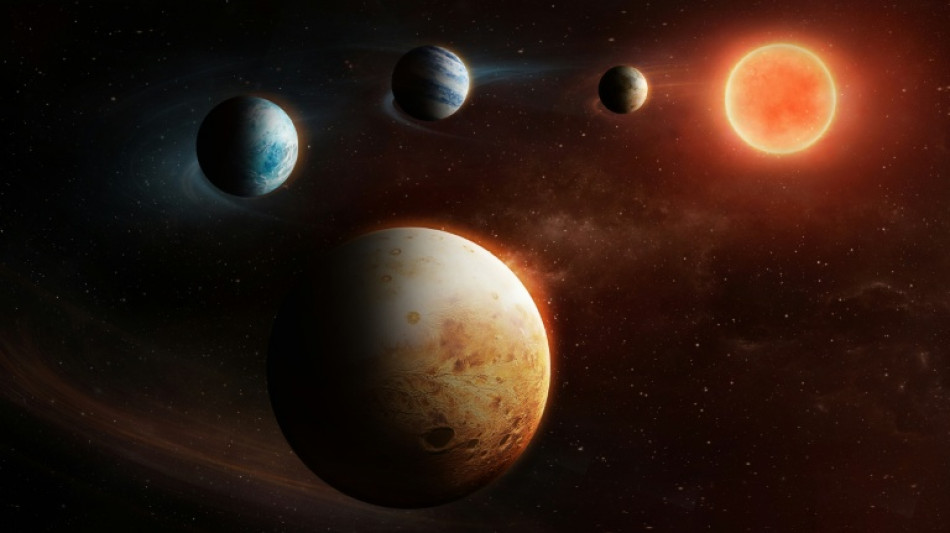
Strange 'inside-out' planetary system baffles astronomers / Photo: Handout - ESA/AFP

Strange 'inside-out' planetary system baffles astronomers

Surprised astronomers said Thursday they have discovered a star with planets in a bizarre order that defies scientific expectations -- and suggests these faraway worlds formed in a manner never seen before.

Text size:

In our Solar System, the four planets closest to the Sun are small and rocky, while the four farther out are gas giants.

Scientists had thought this planetary order -- rocky first, then gaseous -- was consistent across the universe.

However, a star called LHS 1903 discovered in the Milky Way's thick disc suggests otherwise.

An international team of astronomers analysing data from several different telescopes had already spotted three planets orbiting the red dwarf star, which is cooler and less bright than our Sun.

The closest planet to the star was rocky, followed by two gas giants. That is the order scientists expect.

But digging into observations made by Europe's exoplanet-probing Cheops space telescope revealed a fourth planet farther out in the system -- and it is rocky.

"That makes this an inside-out system, with a planet order of rocky-gaseous-gaseous-and then rocky again," explained Thomas Wilson, the lead author of a new study describing the discovery in the journal Science.

"Rocky planets don't usually form so far away from their home star," the planetary astrophysicist from University of Warwick in the UK said in a statement.

- One planet after another -

Inner planets are expected to be small and rocky because intense radiation from the nearby star blasts most of the gas away from their rocky core.

But farther out in the cold reaches of the system, a thick atmosphere can form around cores, creating gas giants.

Puzzled by the weird LHS 1903 planetary system, the team of astronomers tried to figure out what could have happened.

After ruling out several possibilities, they came up with a scenario: what if the planets formed one at a time?

According to the most widely accepted theory, planets form simultaneously in a massive ring of gas and dust called a protoplanetary disc. This involves tiny dust grains clumping together then snowballing into cores that eventually evolve into mighty planets.

However, by the time the fourth planet orbiting LHS 1903 formed, "the system may have already run out of gas," Wilson said.

"Yet here is a small, rocky world, defying expectations," he added.

"It seems that we have found first evidence for a planet which formed in what we call a gas-depleted environment."

Since the 1990s, astronomers have discovered more than 6,000 planets outside our Solar System -- called exoplanets -- mostly by spotting slight changes in brightness as they cross in front of their star.

"Historically, our planet formation theories are based on what we see and know about our Solar System," said Isabel Rebollido, a planetary disc researcher at the European Space Agency.

"As we are seeing more and more different exoplanet systems, we are starting to revisit these theories."

F.Schneider--NZN