Zürcher Nachrichten - Scientists discover giant bird-like dinosaur in Niger desert

EUR -
AED 4.243163
AFN 76.836825
ALL 93.168392
AMD 422.683441
AOA 1059.490664
ARS 1731.895657
AUD 1.635936
AWG 2.081143
AZN 1.964472
BAM 1.956127
BBD 2.327789
BDT 142.803865
BHD 0.435867
BIF 3452.176908
BMD 1.155388
BND 1.478954
BOB 13.753358
BRL 5.87804
BSD 1.155693
BTN 110.085873
BWP 15.570074
BYN 3.435989
BYR 22645.606405
BZD 2.324398
CAD 1.610755
CDF 2614.066317
CHF 0.933808
CLF 0.026824
CLP 1055.723909
CNY 7.7961
CNH 7.793635
COP 3642.60356
CRC 524.689954
CUC 1.155388
CUP 30.617784
CVE 110.283907
CZK 24.250092
DJF 205.808847
DKK 7.47569
DOP 67.38126
DZD 153.592261
EGP 57.747336
ERN 17.330821
ETB 186.880539
FJD 2.553243
FKP 0.857011
GBP 0.85579
GEL 3.016025
GGP 0.857011
GHS 13.568326
GIP 0.857011
GMD 84.917311
GNF 10149.74009
GTQ 8.818397
GYD 242.045687
HKD 9.064453
HNL 30.979177
HRK 7.536369
HTG 151.115254
HUF 363.604111
IDR 20498.202116
ILS 3.466245
IMP 0.857011
INR 110.109235
IQD 1514.05302
IRR 1589294.076063
ISK 142.216689
JEP 0.857011
JMD 183.540672
JOD 0.819128
JPY 183.187355
KES 149.507516
KGS 101.038588
KHR 4685.803343
KMF 492.195074
KRW 1637.520047
KWD 0.3569
KYD 0.963165
KZT 538.813048
LAK 26101.474886
LBP 103496.143572
LKR 387.344731
LRD 208.609375
LSL 18.700163
LTL 3.411561
LVL 0.698883
LYD 7.365231
MAD 10.777548
MDL 20.086965
MGA 4949.848611
MKD 61.530283
MMK 2425.794575
MNT 4152.757665
MOP 9.339844
MRU 46.355747
MUR 54.303359
MVR 17.850882
MWK 2004.078274
MXN 19.818137
MYR 4.726342
MZN 73.835072
NAD 18.700163
NGN 1573.280637
NIO 42.527107
NOK 10.987336
NPR 176.136435
NZD 1.961554
OMR 0.444245
PAB 1.155698
PEN 3.903852
PGK 5.109876
PHP 70.211802
PKR 320.85972
PLN 4.299164
PYG 6879.149604
QAR 4.213104
RON 5.244535
RSD 117.352589
RUB 95.451742
RWF 1697.791072
SAR 4.326647
SBD 9.319009
SCR 17.004638
SDG 693.805905
SEK 10.965222
SGD 1.478256
SLE 28.420632
SOS 660.501804
SRD 43.750504
STD 23914.200576
STN 24.504095
SVC 10.112734
SZL 18.697125
THB 38.145135
TJS 10.673415
TMT 4.055412
TND 3.387866
TRY 55.125778
TTD 7.839344
TWD 37.238734
TZS 3058.893435
UAH 51.843388
UGX 4304.71938
USD 1.155388
UYU 46.557982
UZS 13790.304557
VES 873.198868
VND 30219.175282
VUV 137.91453
WST 3.158504
XAF 656.069478
XAG 0.018024
XAU 0.000266
XCD 3.122494
XCG 2.082948
XDR 0.815502
XOF 656.069478
XPF 119.331742
YER 275.449418
ZAR 18.687033
ZMK 10399.872862
ZMW 21.617706
ZWL 372.034491
  • NGG

    -1.1200

    79.76

    -1.4%

  • BCC

    -1.7000

    84.9

    -2%

  • GSK

    -1.0800

    51.88

    -2.08%

  • RIO

    0.3650

    101.465

    +0.36%

  • BTI

    -1.6600

    57.67

    -2.88%

  • JRI

    -0.0400

    12.77

    -0.31%

  • BP

    0.9400

    42.57

    +2.21%

  • BCE

    -0.2550

    22.495

    -1.13%

  • RYCEF

    -0.0300

    20.97

    -0.14%

  • RBGPF

    0.8600

    70.6

    +1.22%

  • CMSD

    -0.0500

    21.77

    -0.23%

  • CMSC

    -0.2037

    21.5401

    -0.95%

  • RELX

    0.1050

    35.625

    +0.29%

  • AZN

    0.2200

    161.64

    +0.14%

  • VOD

    -0.3750

    15.815

    -2.37%

Scientists discover giant bird-like dinosaur in Niger desert
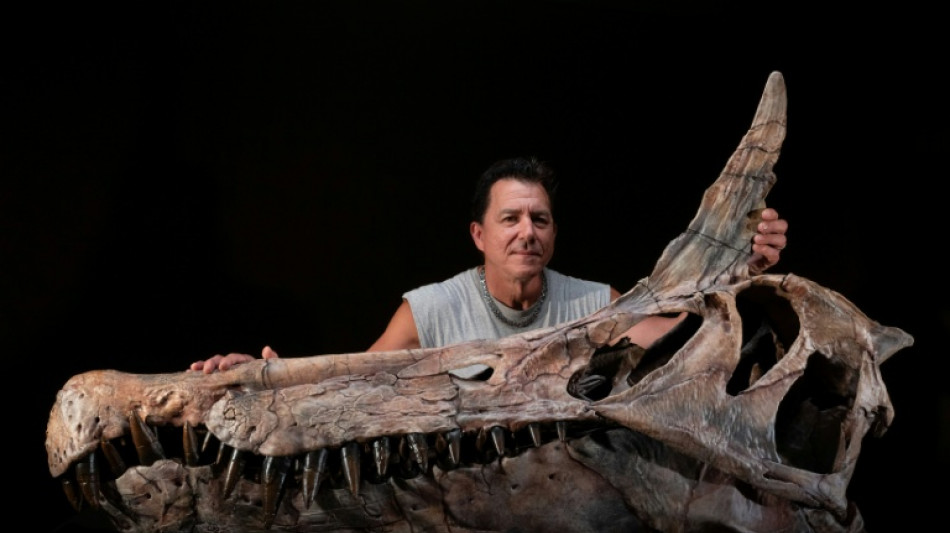
Scientists discover giant bird-like dinosaur in Niger desert / Photo: Keith Ladzinski - Fossil Lab, University of Chicago/AFP

Scientists discover giant bird-like dinosaur in Niger desert

Deep in the desert of Niger, scientists have unearthed an unknown species of dinosaur, a giant fissvery of its kind in more than a century.

Text size:

Around 95 million years ago, the Spinosaurus -- a massive beast with a blade-shaped head crest and interlocking teeth -- roamed the African continent.

Scientists believe it rivalled the fearsome Tyrannosaurus rex in size, measuring around 40 feet long with a 20-inch sword-like crest on its head.

Researchers dug up fossils that belonged to the Spinosaurus mirabilis -- or "hell heron", in the words of Paul Sereno, the University of Chicago palaeontologist and lead author of the research published in the journal Science.

"Look at the length of the skull, the length of the neck, and the length of the hind limb -- you're in heron territory."

Spinosaurus mirabilis lived when forests and rivers covered the now-barren Sahara. Previously, most spinosaurid fossils had been found near coastlines in North Africa.

Some scientists thought these fish-eating creatures may have been fully aquatic, gliding through deep waters to snare prey.

But this time, the fossils were discovered further inland, hundreds of miles from what would have been the nearest ocean.

"I think it was an animal that could have waded easily into the water," Sereno said.

"But I do not think it was a diver, I do not think it was a good swimmer."

- 'Earth-shattering site' -

The search began in 2019 in the Sahara Desert, where French geologist Hugues Faure had said he found a tooth belonging to the giant predator Carcharodontosaurus in the 1950s.

"We've got a couple of things that Faure could never dream of. We have GPS coordinates, we have drones and better vehicles," said Sereno.

The barren sands yielded nothing and the team, disheartened, headed back to their camp.

But a Tuareg man in a black trench coat approached Sereno's team on a motorcycle, claiming to know where "big bones" lay.

After a long journey through the desert, Sereno worried they "had made a mistake".

"We jokingly said, are we still in Niger? I mean, we drove for a day and a half until we had no more gas to spare because we wouldn't get back."

But eventually they reached a remote site where the "biggest bones... I have ever seen in my life" emerged from the ground.

Far out in the desert, the researchers gaped at the six-foot-long femur, the jaw, teeth, and base of the crest.

In 2022, Sereno returned with a 100-person team and 64 Nigerien guards to excavate the "earth-shattering site".

They unearthed a skull, fragments of the hind legs and several crests.

"The crest was like nothing we'd ever seen before," said Sereno.

Some were brought to tears, he said, by the "overwhelming" experience.

"It's actually like looking at a digital image of your new dinosaur and gawking over it in the tent in the middle of the Sahara."

The team realised "it was a new species... and it was going to be a landmark discovery."

"That's your Jurassic Park moment... one to remember for a lifetime."

B.Brunner--NZN