Zürcher Nachrichten - New particle discovered by Large Hadron Collider

EUR -
AED 4.330578
AFN 75.468553
ALL 95.370831
AMD 434.26718
ANG 2.110613
AOA 1082.496254
ARS 1649.279971
AUD 1.625347
AWG 2.125489
AZN 2.009303
BAM 1.955202
BBD 2.368676
BDT 144.305864
BGN 1.967008
BHD 0.444064
BIF 3500.4294
BMD 1.179189
BND 1.491244
BOB 8.126515
BRL 5.795828
BSD 1.17604
BTN 111.057033
BWP 15.789171
BYN 3.323484
BYR 23112.111202
BZD 2.365277
CAD 1.612129
CDF 2670.864298
CHF 0.916177
CLF 0.026704
CLP 1050.508704
CNY 8.019372
CNH 8.014083
COP 4394.855841
CRC 540.634648
CUC 1.179189
CUP 31.248518
CVE 110.231286
CZK 24.334582
DJF 209.425947
DKK 7.476537
DOP 69.938609
DZD 156.038276
EGP 62.195977
ERN 17.68784
ETB 183.631137
FJD 2.574218
FKP 0.865474
GBP 0.864889
GEL 3.154379
GGP 0.865474
GHS 13.247948
GIP 0.865474
GMD 86.674958
GNF 10318.844
GTQ 8.979254
GYD 246.064742
HKD 9.234999
HNL 31.264438
HRK 7.538916
HTG 153.972908
HUF 353.981307
IDR 20491.303919
ILS 3.421187
IMP 0.865474
INR 111.345548
IQD 1540.628801
IRR 1546506.829043
ISK 143.873347
JEP 0.865474
JMD 185.35331
JOD 0.836092
JPY 184.753623
KES 151.883547
KGS 103.085327
KHR 4718.556838
KMF 492.90156
KPW 1061.251335
KRW 1723.880942
KWD 0.36279
KYD 0.9801
KZT 543.543758
LAK 25791.111834
LBP 105315.489444
LKR 378.634195
LRD 215.803997
LSL 19.293799
LTL 3.48184
LVL 0.71328
LYD 7.436725
MAD 10.75591
MDL 20.110849
MGA 4912.497521
MKD 61.621153
MMK 2476.100645
MNT 4223.124889
MOP 9.4824
MRU 47.006623
MUR 55.210091
MVR 18.163925
MWK 2038.876413
MXN 20.255648
MYR 4.623647
MZN 75.362436
NAD 19.293799
NGN 1609.593864
NIO 43.276764
NOK 10.859513
NPR 177.691653
NZD 1.976185
OMR 0.453611
PAB 1.17604
PEN 4.066156
PGK 5.193412
PHP 71.358689
PKR 327.765953
PLN 4.239717
PYG 7183.802847
QAR 4.298685
RON 5.21945
RSD 117.334114
RUB 87.543025
RWF 1724.072695
SAR 4.44258
SBD 9.456429
SCR 17.539736
SDG 708.107537
SEK 10.86706
SGD 1.494509
SHP 0.880384
SLE 29.067455
SLL 24727.006491
SOS 672.094441
SRD 44.100547
STD 24406.83871
STN 24.492509
SVC 10.290853
SYP 130.375396
SZL 19.281103
THB 37.973479
TJS 10.972544
TMT 4.127163
TND 3.415955
TOP 2.839205
TRY 53.473293
TTD 7.970562
TWD 36.927538
TZS 3063.662984
UAH 51.6595
UGX 4406.652233
USD 1.179189
UYU 46.905654
UZS 14265.63688
VES 588.693738
VND 31022.113342
VUV 139.685143
WST 3.192143
XAF 655.756438
XAG 0.014675
XAU 0.00025
XCD 3.186819
XCG 2.119552
XDR 0.815551
XOF 655.756438
XPF 119.331742
YER 281.384102
ZAR 19.315959
ZMK 10614.123377
ZMW 22.390152
ZWL 379.698489
  • CMSD

    0.1140

    23.534

    +0.48%

  • RELX

    0.0759

    33.58

    +0.23%

  • RBGPF

    0.7000

    63.61

    +1.1%

  • RIO

    2.2700

    105.38

    +2.15%

  • BCE

    -0.4300

    24.14

    -1.78%

  • VOD

    0.5100

    16.2

    +3.15%

  • RYCEF

    -0.4100

    16.37

    -2.5%

  • GSK

    -0.0900

    50.41

    -0.18%

  • NGG

    0.9800

    86.89

    +1.13%

  • CMSC

    0.1400

    23.11

    +0.61%

  • JRI

    0.0000

    13.15

    0%

  • BTI

    0.2000

    58.28

    +0.34%

  • BCC

    -2.0900

    70.67

    -2.96%

  • AZN

    0.3300

    182.85

    +0.18%

  • BP

    -0.4700

    43.34

    -1.08%

New particle discovered by Large Hadron Collider
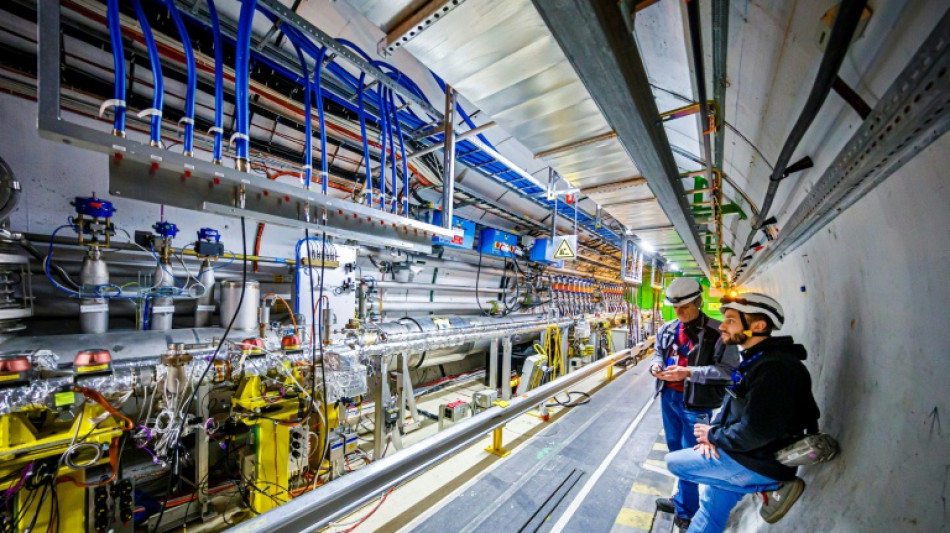
New particle discovered by Large Hadron Collider / Photo: VALENTIN FLAURAUD - AFP/File

New particle discovered by Large Hadron Collider

The Large Hadron Collider has discovered a new particle, the 80th identified so far by the world's most powerful particle smasher, Europe's CERN physics laboratory announced Tuesday.

Text size:

The new particle has been named "Xi-cc-plus". Scientists hope the particle -- which is similar to a proton but four times heavier -- will reveal more about the strange behaviour of quantum mechanics.

All the matter around us -- including the protons and neutrons that make up the nucleus of atoms -- are made of baryons.

These common particles are composed of three quarks, which are fundamental building blocks of matter.

Quarks come in six "flavours": up, down, charm, strange, top and bottom. Each has varying mass, electric charge and quantum properties.

In theory, there could be many different types of baryons that mix these flavours -- however most are extremely difficult to observe.

To chase them down, the Large Hadron Collider sends particles whizzing around an underground ring at phenomenal speeds until they smash into each other.

This gives scientists a brief chance to measure how the more stable elements decay, then deduce the properties of the original particle.

The newly discovered "Xi-cc-plus" contains two "charm" quarks and one "down" quark.

Normal protons have two "up" quarks and one "down" quark. Because the new particle has two heavier "charm" quarks instead of "up" ones, it has a much greater mass.

Vincenzo Vagnoni, spokesman for the Large Hadron Collider beauty (LHCb) experiment, said it was "only the second time a baryon with two heavy quarks has been observed".

It is also "the first new particle identified after the upgrades to the LHCb detector that were completed in 2023," he said in a statement.

"The result will help theorists test models of quantum chromodynamics, the theory of the strong force that binds quarks into not only conventional baryons and mesons but also more exotic hadrons such as tetraquarks and pentaquarks."

In 2017, the LHCb experiment announced that it had discovered a similar particle, made of two "charmed" quarks and one "up" quark.

The new particle has an expected lifetime six times shorter than this earlier one, making it far more tricky to spot, CERN said.

The Large Hadron Collider is a 27-kilometre (17 mile) long proton-smashing ring running about 100 metres below France and Switzerland. Mostly famously, it proved the existence of the Higgs boson -- known as the "God particle" -- in 2012.

The latest discovery comes as CERN plans to build an even bigger particle smasher, the Future Circular Collider, to continue probing the mysteries of the universe.

N.Zaugg--NZN