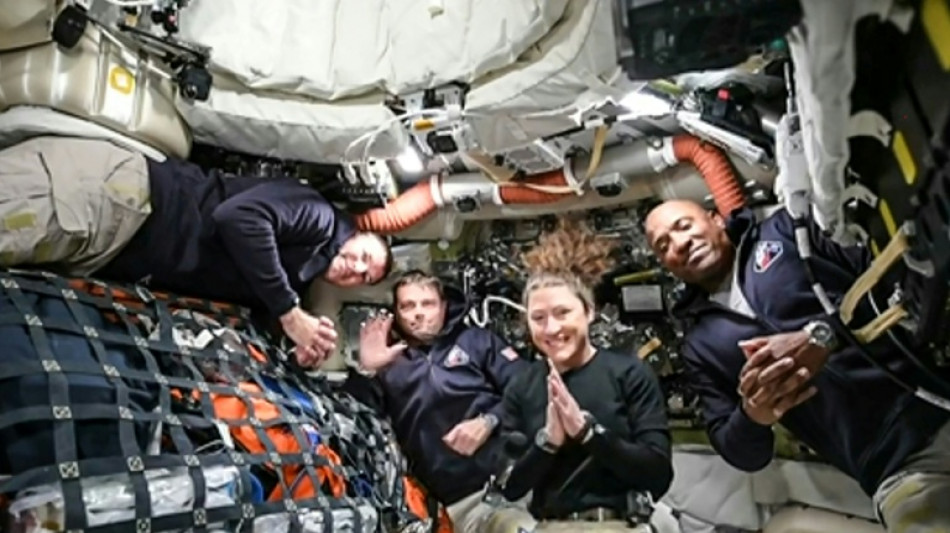
Artemis mission approaches lunar loop for first flyby since 1972 / Photo: Handout - NASA TV/AFP
The Artemis astronauts entered the final phase of their run-up to a lunar loop on Monday, a tipping point of sorts that means the Moon's gravity is now having a stronger pull on the spacecraft than Earth's.
The Orion capsule will now whip around the Moon, setting the crew up to travel farther from our home planet than any human before.
The astronauts entered what NASA calls the lunar sphere of influence about 0442 GMT Monday and will soon record the first lunar flyby since 1972.
As they entered the Moon's gravitational influence, the crew was about 39,000 miles (63,000 kilometers) from the Moon and about 232,000 miles from Earth, a NASA official said on the agency's livestream of the event.
The historic occasion comes alongside a constellation of firsts for the crew of three Americans and one Canadian. Victor Glover will go down in the books as the first person of color to ever fly around the Moon, and Christina Koch will be the first woman.
Canadian Jeremy Hansen, meanwhile, will become the first non-American to accomplish the feat.
Those three, along with mission commander Reid Wiseman, will spend much of their lunar flyby documenting the Moon.
- 'Far side of the Moon' -
The astronauts have already started seeing features of the celestial body never before viewed with a naked human eye.
In the wee hours of Sunday, NASA published an image taken by the Artemis crew that showed a distant Moon with the Orientale basin visible.
"This mission marks the first time the entire basin has been seen with human eyes," the US space agency said.
The massive crater, which resembles a bullseye, had been photographed before by orbiting cameras.
Koch, speaking to Canadian children live from space, said the crew was most excited to see the basin -- sometimes known as the Moon's "Grand Canyon."
"It's very distinctive and no human eyes previously had seen this crater until today, really, when we were privileged enough to see it," Koch said during the question-and-answer session hosted by the Canadian Space Agency.
Near the end of their flyby, the astronauts will witness a solar eclipse, when the Sun will be behind the Moon and hidden from view aside from its outermost atmosphere, the solar corona.
The four astronauts will also spend some time testing their "Orion crew survival system" spacesuits.
The orange suits protect the crewmembers during launch and reentry, but are also available for emergency use -- they can provide up to six days of breathable air.
The astronauts are the first to ever wear the OCSS suits in space, and will test their functions, including how quickly they can put them on and pressurize them.
While the four astronauts will not touch down on the lunar surface, they are expected to break the record for the farthest distance from Earth during their pass around the Moon.
Over the next day, "they will be on the far side of the Moon, they will eclipse that record, and we're going to learn an awful lot about the spacecraft," NASA administrator Jared Isaacman said Sunday during a televised interview with CNN.
The information will be "pretty paramount to set up for subsequent missions like Artemis 3 in 2027 and, of course, the lunar landing itself on Artemis 4 in 2028," he added.
NASA said the Artemis crew has completed a manual piloting demonstration and reviewed their lunar flyby plan, including reviewing the surface features they must analyze and photograph during their time circling the Moon.
"We're focusing very much on the ecosystem, the life support system of the spacecraft," Isaacman told CNN.
"This is the first time astronauts have ever flown on this spacecraft before," he said. "That's what we're most interested in getting data from."
W.F.Portman--NZN