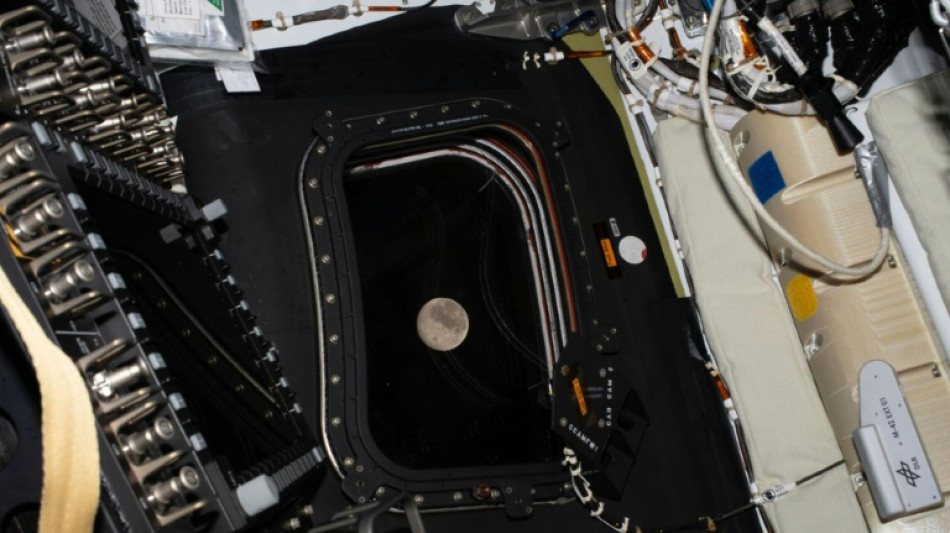
New frontier: Artemis astronauts break space distance record / Photo: Handout - NASA/AFP
The four astronauts embarking on NASA's lunar flyby became on Monday the humans to travel furthest from our planet, as they begin documenting areas of the Moon never before seen by the naked eye.
The Artemis II team broke the record set by the 1970's Apollo 13 mission, which they are expected to surpass by 4,105 miles (6,606 kilometers) when they reach this journey's anticipated furthest distance from Earth -- 252,760 miles (406,778 kilometers) -- later today.
"Today, for all humanity, you're pushing beyond that frontier," said Jenni Gibbons in Houston's mission control.
It was one of the voyage's most notable achievements yet.
Astronaut Jeremy Hansen said the moment was set "to challenge this generation and the next, to make sure this record is not long-lived."
The crew proposed designating two previously unnamed craters: one in honor of their nickname for their spacecraft, "Integrity."
They offered a second name, "Carroll," for another crater, which they requested be named after the late wife of mission commander Reid Wiseman, who died of cancer.
"It's a bright spot on the Moon," said Hansen, his voice breaking with emotion. "And we would like to call it Carroll."
The astronauts embraced, and mission control in Houston held a moment of silence.
"Integrity and Carroll crater, loud and clear. Thank you," said Gibbons.
- Lunar observations begin -
The crew members are now beginning in earnest their lunar observation period, in which they'll spend more than six hours analyzing and documenting lunar surface features.
The Orion capsule is zipping around the Moon before U-turning and heading back to Earth in a so-called "free-return trajectory," a return-trip that will take about four days.
The astronauts received encouragement from the late Jim Lovell, who took part in the Apollo 8 and 13 missions and recorded the message shortly before his death.
"It's a historic day, and I know how busy you'll be, but don't forget to enjoy the view," the Artemis astronauts heard from Lovell.
Swooping around the far side of the Moon, the crew will witness previously hidden lunar territory -- the sphere looming large through their capsule windows.
Adding to the historic nature of the mission led by Reid Wiseman, the Artemis II crew includes several firsts.
Victor Glover will be the first person of color to fly around the Moon, Christina Koch will be the first woman, and Canadian Jeremy Hansen the first non-American.
There will be a period of around 40 minutes during the flyby where all communication with Artemis II will be cut off, as the astronauts pass behind the Moon.
"It'll be exciting, you know, in a slightly scary way, when they go behind the Moon," Derek Buzasi, a professor of astronomy and astrophysics at the University of Chicago, told AFP.
- Human eye vs camera -
The astronauts have already started seeing features never previously glimpsed directly.
An image sent back by the crew showed the Moon's Orientale basin visible, a massive crater that before had only been viewed by orbiting, uncrewed cameras.
Near the end of their flyby, the astronauts will witness a solar eclipse, when the Sun will be behind the Moon.
Despite the technological advancements since the Apollo era, NASA still relies on the eyesight of its astronauts to learn more about the Moon.
"The human eye is basically the best camera that could ever or will ever exist," Kelsey Young, the lead scientist for the Artemis II mission, told AFP. "The number of receptors in the human eye far outweighs what a camera is able to do."
G.Kuhn--NZN