Zürcher Nachrichten - Drivers help study road-trip mystery: what became of bug splats?

EUR -
AED 4.175552
AFN 72.766476
ALL 94.162098
AMD 417.226554
ANG 2.035648
AOA 1043.169984
ARS 1679.636802
AUD 1.644928
AWG 2.046559
AZN 1.92839
BAM 1.955047
BBD 2.284181
BDT 139.496304
BGN 1.922493
BHD 0.428616
BIF 3388.19249
BMD 1.136977
BND 1.471414
BOB 7.836708
BRL 5.905231
BSD 1.134143
BTN 107.003929
BWP 15.475839
BYN 3.227601
BYR 22284.755976
BZD 2.280982
CAD 1.614792
CDF 2580.938264
CHF 0.920495
CLF 0.026587
CLP 1046.394248
CNY 7.720645
CNH 7.732367
COP 3919.547483
CRC 516.189954
CUC 1.136977
CUP 30.1299
CVE 110.218696
CZK 24.259115
DJF 201.961371
DKK 7.474711
DOP 66.832805
DZD 151.71364
EGP 56.316417
ERN 17.05466
ETB 180.381436
FJD 2.576502
FKP 0.864046
GBP 0.861095
GEL 3.00102
GGP 0.864046
GHS 12.755641
GIP 0.864046
GMD 82.430365
GNF 9938.043459
GTQ 8.652403
GYD 237.290312
HKD 8.914414
HNL 30.380123
HRK 7.530884
HTG 148.229683
HUF 354.486503
IDR 20428.071971
ILS 3.391518
IMP 0.864046
INR 107.9276
IQD 1489.440323
IRR 1563400.698685
ISK 143.986411
JEP 0.864046
JMD 178.749622
JOD 0.806128
JPY 183.939063
KES 147.307059
KGS 99.429036
KHR 4559.279095
KMF 493.447827
KPW 1023.280009
KRW 1756.368857
KWD 0.352043
KYD 0.94512
KZT 549.658752
LAK 25087.404586
LBP 101564.518415
LKR 382.216151
LRD 206.406917
LSL 18.862653
LTL 3.357198
LVL 0.687746
LYD 7.283164
MAD 10.705207
MDL 20.130897
MGA 4835.075056
MKD 61.614805
MMK 2387.123574
MNT 4074.725728
MOP 9.158813
MRU 45.55903
MUR 54.790635
MVR 17.566605
MWK 1974.929588
MXN 19.897422
MYR 4.684233
MZN 72.659519
NAD 18.862627
NGN 1564.706343
NIO 41.624902
NOK 11.202746
NPR 171.205334
NZD 2.014667
OMR 0.437174
PAB 1.134124
PEN 3.890724
PGK 4.977128
PHP 69.735371
PKR 315.618218
PLN 4.285677
PYG 6930.301857
QAR 4.144273
RON 5.233052
RSD 117.356435
RUB 86.07175
RWF 1666.643804
SAR 4.269367
SBD 9.154888
SCR 15.49385
SDG 682.186179
SEK 11.066313
SGD 1.474626
SHP 0.848868
SLE 28.197192
SLL 23841.850618
SOS 648.14481
SRD 42.431636
STD 23533.135508
STN 24.490788
SVC 9.924005
SYP 125.672491
SZL 18.779028
THB 37.917899
TJS 10.48488
TMT 3.979421
TND 3.33987
TOP 2.737569
TRY 52.900029
TTD 7.702899
TWD 36.186007
TZS 2978.119975
UAH 50.996697
UGX 4196.237124
USD 1.136977
UYU 45.501085
UZS 13623.516284
VES 705.782081
VND 29925.24374
VUV 136.233463
WST 3.158268
XAF 655.684425
XAG 0.019648
XAU 0.000282
XCD 3.072738
XCG 2.043977
XDR 0.815475
XOF 655.693071
XPF 119.331742
YER 271.311222
ZAR 18.725679
ZMK 10234.145868
ZMW 20.47076
ZWL 366.106241
  • GSK

    0.8000

    51.89

    +1.54%

  • CMSC

    -0.0190

    22.046

    -0.09%

  • CMSD

    -0.0900

    21.93

    -0.41%

  • NGG

    0.5900

    83.42

    +0.71%

  • JRI

    0.0100

    12.58

    +0.08%

  • BCC

    2.1000

    79.76

    +2.63%

  • BTI

    1.0900

    62.48

    +1.74%

  • RIO

    1.0800

    95.11

    +1.14%

  • BCE

    0.0000

    23.2

    0%

  • RBGPF

    0.0000

    61.3

    0%

  • RYCEF

    -0.1600

    18

    -0.89%

  • AZN

    2.6600

    185.68

    +1.43%

  • RELX

    -0.2300

    30.92

    -0.74%

  • BP

    -0.1400

    37.72

    -0.37%

  • VOD

    0.0500

    13.86

    +0.36%

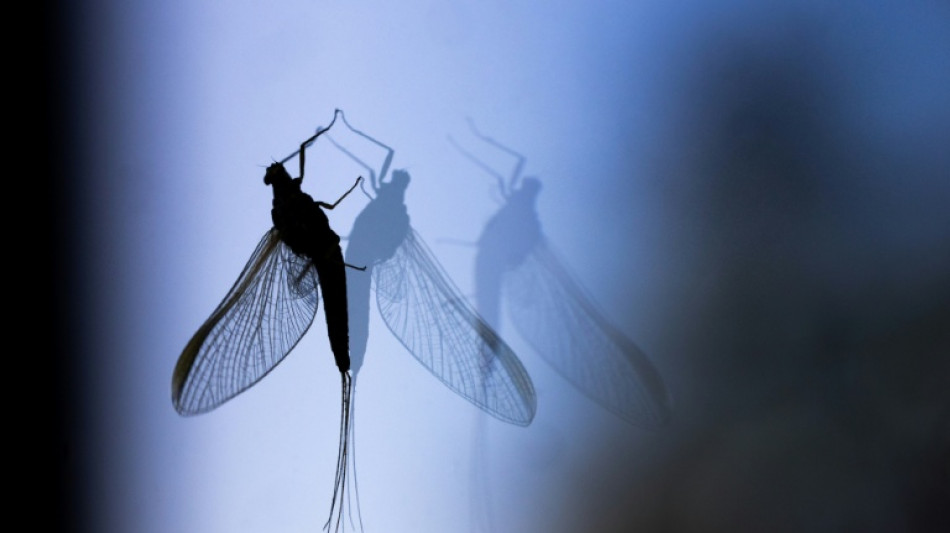
Drivers help study road-trip mystery: what became of bug splats?
Drivers help study road-trip mystery: what became of bug splats? / Photo: JOEL SAGET - AFP

Drivers help study road-trip mystery: what became of bug splats?

Long an emblem of the summer road trip, squashed bugs on the car have become less numerous over the years, many people say -- causing concern about the health of the world's insect populations.

Text size:

While drivers may be happy to have less yuckiness to clean from their windscreens, a perceived decline in flying insects hit by vehicles has some experts worried about the creatures, which play a vital role in the environment as pollinators, ecosystem balancers and food sources for other species.

But anecdotal evidence is one thing. Studying the so-called "windshield phenomenon" is another.

So scientists in France have launched an app-based study that enlists drivers as volunteer researchers.

Users download the free app, Bugs Matter, count the number of squished bugs on their number plates at the end of a trip, and send the results to be compiled as part of what the programme's creators hope will be a massive citizen science project.

The study is being run by the National Museum of Natural History (MNHN), the environmental groups OPIE and Noe and the French Biodiversity Office.

One app user, Marjorie, brought AFP on a car trip with her to Enghien-les-Bains, north of Paris, to take the app for a test drive before using it on a long road trip.

Step one: wipe the licence plate clean. Step two: enter geolocation data. Step three: drive.

"I'm 53, and I remember how as a kid, on long car trips when we stopped to fill the tank, there was always the obligatory clean-the-windscreen stage," said Marjorie.

"We hardly do that anymore."

- 'Pretty incredible' -

The study follows others around the world that have found declining insect numbers, including previous car-based studies in Denmark and the United Kingdom that both found sharp reductions in splats.

The two-decade-long Danish study, which ran until 2017, found reductions of 80 and 97 percent on two stretches of road in Denmark, while the UK study -- which also used the Bugs Matter app and is still ongoing -- found a decline of nearly 63 percent from 2021 to 2024.

A German study published in 2017 found a "dramatic decline" of more than 75 percent in the average biomass of flying insects in protected nature reserves.

"It's pretty incredible. Imagine going into the supermarket and finding only two out of every 10 products are in stock," said MNHN's Gregoire Lois.

Scientists say the decline is driven by human activity, including habitat loss, pesticide use, pollution and climate change.

But part of the study's goal is to understand the exact mechanisms behind the decline, and whether the results vary between urban areas, agricultural regions and forest land, Lois said.

Researchers hope to eventually expand the project to collect the insects' DNA and identify which species are being hit, he said.

Why use number plates as a reference?

"It's the only shared, standardised thing on every car, in both size and position: facing the road, perpendicular to the ground and travelling forward," said Lois.

After making her test trip, Marjorie parked her car, went to count her specimens and found a troubling data point.

"We just drove 22 kilometres" (14 miles), she said, "and there are absolutely no insects."

T.L.Marti--NZN