Zürcher Nachrichten - EU-China spacecraft takes off on mission to probe solar winds

EUR -
AED 4.275144
AFN 72.745556
ALL 95.457948
AMD 426.635522
ANG 2.084269
AOA 1068.640686
ARS 1631.971778
AUD 1.626307
AWG 2.095374
AZN 1.976602
BAM 1.955963
BBD 2.336195
BDT 142.56187
BGN 1.943949
BHD 0.437436
BIF 3453.971119
BMD 1.164097
BND 1.485662
BOB 8.014667
BRL 5.860529
BSD 1.159897
BTN 110.931236
BWP 15.687306
BYN 3.184665
BYR 22816.299685
BZD 2.332794
CAD 1.60735
CDF 2625.038955
CHF 0.913199
CLF 0.026489
CLP 1042.544593
CNY 7.909748
CNH 7.903351
COP 4272.75575
CRC 524.943707
CUC 1.164097
CUP 30.848568
CVE 110.274181
CZK 24.290634
DJF 206.547197
DKK 7.47313
DOP 68.365692
DZD 155.019907
EGP 61.644132
ERN 17.461454
ETB 186.991569
FJD 2.568115
FKP 0.866187
GBP 0.864825
GEL 3.096267
GGP 0.866187
GHS 13.467121
GIP 0.866187
GMD 84.400611
GNF 10170.215057
GTQ 8.844736
GYD 242.630201
HKD 9.120571
HNL 30.859569
HRK 7.559528
HTG 151.957921
HUF 358.799094
IDR 20602.885796
ILS 3.365381
IMP 0.866187
INR 111.404655
IQD 1519.426507
IRR 1540565.867654
ISK 144.068241
JEP 0.866187
JMD 183.105245
JOD 0.825375
JPY 184.84404
KES 150.552535
KGS 101.8002
KHR 4650.384613
KMF 494.741022
KPW 1047.688444
KRW 1769.834184
KWD 0.3603
KYD 0.96658
KZT 547.755606
LAK 25420.116479
LBP 103893.850202
LKR 387.972303
LRD 212.257673
LSL 19.132093
LTL 3.437276
LVL 0.704151
LYD 7.391615
MAD 10.700491
MDL 20.118675
MGA 4873.40576
MKD 61.645133
MMK 2443.983394
MNT 4167.358107
MOP 9.361879
MRU 46.349859
MUR 55.154755
MVR 17.922958
MWK 2011.267458
MXN 20.121223
MYR 4.619019
MZN 74.383855
NAD 19.132093
NGN 1597.431838
NIO 42.701897
NOK 10.724586
NPR 177.489778
NZD 1.980088
OMR 0.447887
PAB 1.159897
PEN 3.954629
PGK 5.058421
PHP 71.561748
PKR 322.930287
PLN 4.239391
PYG 7068.588531
QAR 4.240753
RON 5.266836
RSD 117.419776
RUB 82.63688
RWF 1695.741187
SAR 4.353762
SBD 9.365372
SCR 15.937327
SDG 699.038816
SEK 10.850361
SGD 1.488705
SHP 0.869116
SLE 28.639035
SLL 24410.532871
SOS 662.855189
SRD 43.250815
STD 24094.455998
STN 24.512569
SVC 10.148845
SYP 128.661922
SZL 19.127593
THB 38.066138
TJS 10.775497
TMT 4.074339
TND 3.395483
TOP 2.802866
TRY 53.206319
TTD 7.872655
TWD 36.616086
TZS 3033.252549
UAH 51.335374
UGX 4392.365708
USD 1.164097
UYU 46.433866
UZS 13916.158659
VES 612.560026
VND 30691.415367
VUV 136.726161
WST 3.171929
XAF 656.01162
XAG 0.015416
XAU 0.000258
XCD 3.14603
XCG 2.090474
XDR 0.815868
XOF 656.01162
XPF 119.331742
YER 277.811761
ZAR 19.062029
ZMK 10478.273203
ZMW 21.834818
ZWL 374.838734
  • CMSD

    0.0100

    22.73

    +0.04%

  • JRI

    0.0500

    12.87

    +0.39%

  • BCC

    0.0500

    67.16

    +0.07%

  • NGG

    0.1900

    86.61

    +0.22%

  • RBGPF

    0.0000

    63.5

    0%

  • GSK

    -0.1500

    51.38

    -0.29%

  • CMSC

    0.0100

    22.66

    +0.04%

  • BCE

    0.2100

    24.6

    +0.85%

  • RELX

    -0.3300

    33.01

    -1%

  • RIO

    -0.5300

    104.23

    -0.51%

  • BTI

    -0.3700

    65.36

    -0.57%

  • VOD

    -0.1700

    14.94

    -1.14%

  • AZN

    -2.7200

    187.03

    -1.45%

  • RYCEF

    0.1600

    16.64

    +0.96%

  • BP

    -0.5100

    44.36

    -1.15%

EU-China spacecraft takes off on mission to probe solar winds
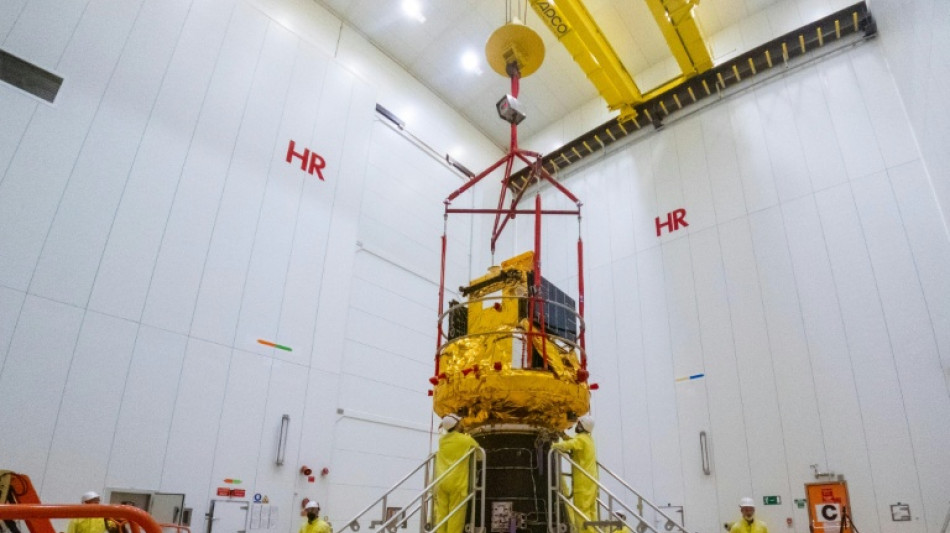
EU-China spacecraft takes off on mission to probe solar winds / Photo: M. Pédoussaut - ESA/AFP

EU-China spacecraft takes off on mission to probe solar winds

A joint European-Chinese spacecraft blasted off into orbit Tuesday to investigate what happens when extreme winds and giant explosions of plasma shot out from the Sun slam into Earth's magnetic shield.

Text size:

Particularly fierce solar storms can knock out satellites, threaten astronauts -- and create dazzling auroras in the skies known as the northern or southern lights.

To find out more about this little-understood space weather, the van-sized SMILE spacecraft is tasked with making the first-ever X-ray observations of the Earth's magnetic field.

The spacecraft achieved lift-off on a Vega-C rocket at 0352 GMT on Tuesday from Europe's spaceport in Kourou, French Guiana, on the northeastern coast of South America.

Fifty-five minutes later, SMILE detached at 700 kilometres (435 miles) of altitude to make its own way onwards to an extremely elliptical orbit thousands of kilometres above the surface of our planet.

SMILE will be at an altitude of 5,000 kilometres when it flies over the South Pole, allowing it to transmit data to the Bernardo O'Higgins research station in Antarctica.

But the spacecraft will be 121,000 kilometres above the Earth when it swings over the North Pole -- an orbit which the European Space Agency (ESA) says will allow the mission to "observe the northern lights non-stop for 45 hours at a time for the first time ever".

SMILE -- or the Solar Wind Magnetosphere Ionosphere Link Explorer -- is a joint mission between the ESA and the Chinese Academy of Sciences.

- Dazzling auroras -

Solar wind is a stream of charged particles shot out from the Sun.

Sometimes this wind is kicked up into a huge storm by massive eruptions of plasma called coronal mass ejections. Hurtling at around two million kilometres an hour, these powerful blasts take a day or two to reach the Earth.

When they arrive, the Earth's magnetic field acts as a shield, deflecting most of the charged particles.

However, during particularly intense events, some particles can penetrate our atmosphere, where they have the potential to take out power grids or communication networks.

During the worst geomagnetic storm on record, in 1859, bright auroras were seen as far south as Panama -- and telegraph operators around the world were given electric shocks.

Solar winds can now also pose a danger to satellites orbiting the Earth, as well as astronauts sheltering inside space stations.

Given these threats, scientists want to learn more about space weather, so the world can better forecast and prepare for big blasts in the future.

To help with this endeavour, the SMILE mission plans to detect the X-rays emitted when charged particles from the Sun interact with the neutral particles of the Earth's upper atmosphere.

SMILE is expected to start collecting data just an hour after it is put into orbit.

The mission is designed to run for three years, but could be extended if all goes well.

Lift-off was originally planned for April 9, but was postponed due to a technical issue.

M.Hug--NZN