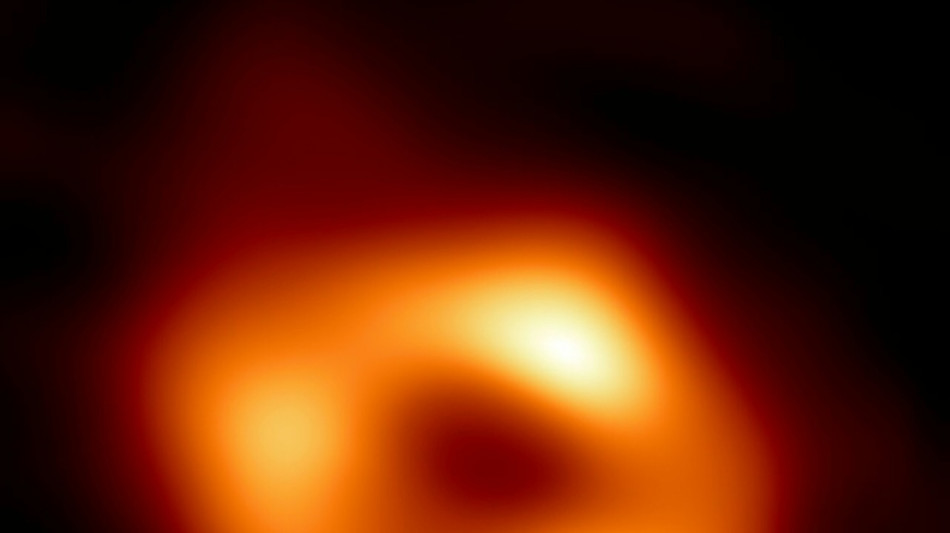
'Fingerprints' of black hole's event horizon detected for first time / Photo: Handout - European Southern Observatory/AFP/File
Scientists have detected the "fingerprints" of a black hole's event horizon -- the boundary from which nothing can escape -- for the first time, according to research published on Wednesday.
The discovery was made by studying ripples in space-time called gravitational waves that were created when two black holes violently smashed into each other.
A black hole's event horizon is known as the "point of no return" because not even light can avoid being swallowed into its darkness.
This has made them incredibly difficult to learn anything about.
However there is one event of such cataclysmic violence that it could offer a chance to glimpse this extreme phenomenon -- when two black holes merge into one.
When this cosmic death spiral occurs, it shoots gravitational waves across the universe which scientists have been detecting for the last decade.
For the new research published in Nature, an international team of researchers analysed data from the strongest gravitational wave ever recorded, known as GW250114, detected by the LIGO observatory in January 2025.
By isolating the last burst of waves -- known as "direct waves" -- from this black hole merger, the scientists said they were able to extract information from closer to an event horizon than ever before.
"This black hole horizon concept normally appears in science fiction," lead study author Sizheng Ma of the Perimeter Institute for Theoretical Physics in Canada told AFP.
"But now we are really able to touch the region around the horizon with gravitational data," he added.
"Sometimes I cannot believe this is really happening."
- Causing a stir -
The last stage of two black holes merging is like a spoon stirring a glass of water, Sizheng Ma explained.
The resulting swirl in space creates the ripple of gravitational waves that travel at the speed of light in all directions.
If the metaphorical spoon is stirring close enough to the black hole's event horizon, "this offers us a chance to decode the physics around that region", Sizheng Ma said.
By supporting the theory of general relativity, the results "proved that Einstein was correct again," he added.
The scientists emphasised that more research was needed to decipher what can be gleaned about event horizons using this method.
But they did detect information about how black holes twist space around themselves as they rotate -- a phenomenon known as "frame dragging".
"This is similar to pushing a glass into a table and twisting it, so that the tablecloth winds up around it," Maximiliano Isi, a gravitational wave astrophysicist at Columbia University, told AFP.
In the future, the team of scientists hope to find signs of tiny changes known as quantum fluctuation.
"In this way, we can really probe this near horizon region to look for a new physics," including searching for a deviation from general relativity, Sizheng Ma said.
- Reaction mixed -
Experts not involved in the study urged caution.
Francesco Sannino, an Italian theoretical physicist who studies black holes, told AFP it was "compelling analysis" but needed to be checked by other researchers.
Still, it was "striking" that the scientists were able to show that gravitational waves carried the event horizon's "fingerprints," he said.
The astrophysicist Isi described the work as "tantalising".
"More generally, understanding the physics of black holes and their mergers is important as it might shed light on how space and time are woven together at a more fundamental level," he told AFP.
Sean McWilliams, an astrophysicist at West Virginia University, was sceptical that the gravitational wave frequency analysed by the scientists was actually "dictated" by the event horizon.
For this reason, "the actual observed signal doesn't really tell us anything about the horizon or the other properties directly related to it", he told AFP.
Sizheng Ma said McWilliams's statement was "not correct," suggesting he had conflated two different aspects in the paper.
"There is often considerable resistance and criticism in the early stages of promoting a new concept," he said, adding he is working on another paper to "clarify these confusions and possible misinterpretations".
F.Carpenteri--NZN