Zürcher Nachrichten - Oldest quasars ever discovered add to 'perplexing' space mystery

EUR -
AED 4.200704
AFN 73.195751
ALL 93.996917
AMD 420.26816
ANG 2.04765
AOA 1049.340244
ARS 1699.230561
AUD 1.64491
AWG 2.058626
AZN 1.9461
BAM 1.959176
BBD 2.30394
BDT 140.99174
BGN 1.933828
BHD 0.43111
BIF 3408.169142
BMD 1.143681
BND 1.479831
BOB 7.933707
BRL 5.887894
BSD 1.143956
BTN 109.062996
BWP 15.453442
BYN 3.313467
BYR 22416.146034
BZD 2.300655
CAD 1.625571
CDF 2579.000393
CHF 0.921195
CLF 0.026966
CLP 1061.347159
CNY 7.772911
CNH 7.771255
COP 3837.838627
CRC 521.195905
CUC 1.143681
CUP 30.307544
CVE 110.81169
CZK 24.163348
DJF 203.254979
DKK 7.474207
DOP 67.306006
DZD 152.279805
EGP 55.815178
ERN 17.155214
ETB 184.636179
FJD 2.559213
FKP 0.856562
GBP 0.854625
GEL 3.013581
GGP 0.856562
GHS 13.032266
GIP 0.856562
GMD 84.059967
GNF 10038.651759
GTQ 8.729005
GYD 239.293424
HKD 8.969603
HNL 30.618498
HRK 7.53423
HTG 149.48565
HUF 353.441437
IDR 20596.54969
ILS 3.428181
IMP 0.856562
INR 109.043743
IQD 1498.569401
IRR 1573361.841434
ISK 144.012276
JEP 0.856562
JMD 180.921785
JOD 0.810852
JPY 185.471303
KES 147.832444
KGS 100.014771
KHR 4583.330305
KMF 492.927072
KPW 1029.313228
KRW 1749.997661
KWD 0.354701
KYD 0.953393
KZT 540.717097
LAK 25795.34067
LBP 102438.786235
LKR 383.156949
LRD 207.63872
LSL 18.560805
LTL 3.376993
LVL 0.691801
LYD 7.339552
MAD 10.710257
MDL 20.168815
MGA 4858.351219
MKD 61.630469
MMK 2401.449332
MNT 4097.085473
MOP 9.242312
MRU 45.656681
MUR 53.832637
MVR 17.681384
MWK 1983.22639
MXN 19.899407
MYR 4.672048
MZN 73.092486
NAD 18.560724
NGN 1566.465274
NIO 42.09217
NOK 11.208891
NPR 174.503487
NZD 2.006577
OMR 0.43975
PAB 1.143966
PEN 3.895279
PGK 5.026596
PHP 70.240885
PKR 318.039401
PLN 4.288975
PYG 6938.957996
QAR 4.182007
RON 5.230169
RSD 117.357016
RUB 88.052682
RWF 1676.477046
SAR 4.298482
SBD 9.2164
SCR 16.106745
SDG 686.786497
SEK 11.014836
SGD 1.477641
SHP 0.853873
SLE 27.848191
SLL 23982.421245
SOS 653.760932
SRD 43.108734
STD 23671.885963
STN 24.542187
SVC 10.009118
SYP 126.413451
SZL 18.556817
THB 38.066285
TJS 10.581481
TMT 4.01432
TND 3.384032
TOP 2.75371
TRY 53.541649
TTD 7.746315
TWD 36.614935
TZS 3002.165802
UAH 51.008735
UGX 4179.147166
USD 1.143681
UYU 46.019306
UZS 13778.745089
VES 730.70148
VND 30078.808198
VUV 136.091144
WST 3.171641
XAF 657.092248
XAG 0.018463
XAU 0.000275
XCD 3.090855
XCG 2.061635
XDR 0.815697
XOF 657.080738
XPF 119.331742
YER 271.109356
ZAR 18.537409
ZMK 10294.500311
ZMW 21.077231
ZWL 368.26479
  • RBGPF

    -4.1100

    61.5

    -6.68%

  • CMSC

    0.0700

    22.06

    +0.32%

  • RYCEF

    0.3400

    20.09

    +1.69%

  • RELX

    0.3400

    32.27

    +1.05%

  • BP

    -0.0100

    37.39

    -0.03%

  • NGG

    -0.2600

    82.59

    -0.31%

  • RIO

    -0.8400

    93.58

    -0.9%

  • AZN

    -4.9900

    190.16

    -2.62%

  • GSK

    -0.5700

    53.09

    -1.07%

  • VOD

    -0.0700

    13.08

    -0.54%

  • BTI

    -0.3100

    61.46

    -0.5%

  • CMSD

    0.0800

    22.23

    +0.36%

  • JRI

    0.1100

    13.11

    +0.84%

  • BCE

    -0.5500

    20.87

    -2.64%

  • BCC

    -0.6500

    75.28

    -0.86%

Oldest quasars ever discovered add to 'perplexing' space mystery
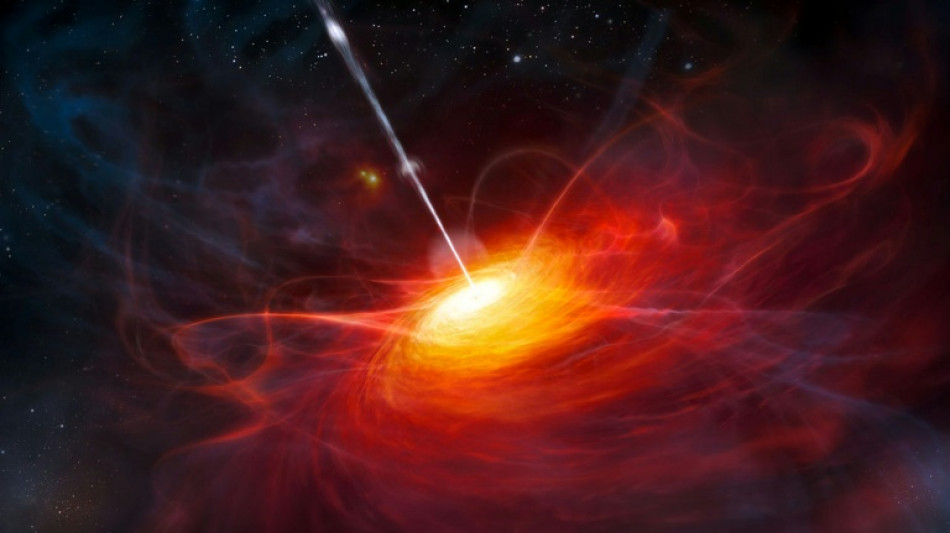
Oldest quasars ever discovered add to 'perplexing' space mystery / Photo: M. KORNMESSER - ESO/AFP/File

Oldest quasars ever discovered add to 'perplexing' space mystery

The Euclid space telescope has spotted the oldest quasars -- the brightest objects in the universe -- ever discovered, deepening a cosmic mystery that has been puzzling scientists.

Text size:

Quasars are powered by supermassive black holes at the heart of early galaxies gobbling up surrounding matter in a colossal feeding frenzy that can shine trillions of times brighter than the Sun.

Because they are so incredibly bright -- and looking deep into space also means looking back in time -- scientists have been hunting for ancient quasars to learn more about the little-understood infancy of the universe.

In a study published on Monday, an international team of astronomers announced they had discovered 31 quasars, including the two oldest observed yet, using the European Space Agency's Euclid telescope, which is at a stable hovering spot around 1.5 million kilometres from Earth.

The light from the oldest pair comes from when the universe was roughly 670 million years old, just five percent of its current age of 13.8 billion years.

This beats the team's previous record for oldest -- and therefore most distant -- quasar announced in 2021 by around 20 million years.

Previous quasar hunts were mostly carried out with ground-based telescopes, but the launch of Euclid in 2023 "has transformed this field," Daming Yang, the lead author of the study in Astronomy & Astrophysics, told AFP.

In just two years, Euclid has doubled the number of ancient quasars known to science, added Yang, a PhD student at Leiden University in the Netherlands.

- Cosmic quandary -

The newly discovered quasars date back to what is known as the epoch of reionisation. This when the first stars and galaxies began to form, bringing an end to the cosmic dark ages.

"We can use quasars as a lighthouse to study the gas between us and them, so that we can trace how the universe was reionised through this cosmic history," Daming Yang said.

The quasars are also the latest example of a problem that has been increasingly baffling scientists.

As more powerful telescopes allow us to see further back in time, galaxies and other cosmic objects have turned out to be far bigger than had been thought possible at such an early age.

"Every step further back in time makes the puzzle more perplexing," study co-author Joseph Hennawi said in a statement about the newly discovered quasars.

"These monsters -- weighing billions of times the mass of our Sun -- somehow already existed when the universe was in its infancy," he said.

"We don't yet have a good understanding of how they grew so massive, so fast."

Hoping to find an answer, the scientists are searching for even older quasars.

The far-seeing James Webb space telescope also recently observed the newly announced quasars, Daming said, and the team will soon begin sifting through the data it collected.

The team eventually hope to stitch together "a quasar chronicle of the first billion years," Hennawi said.

F.E.Ackermann--NZN