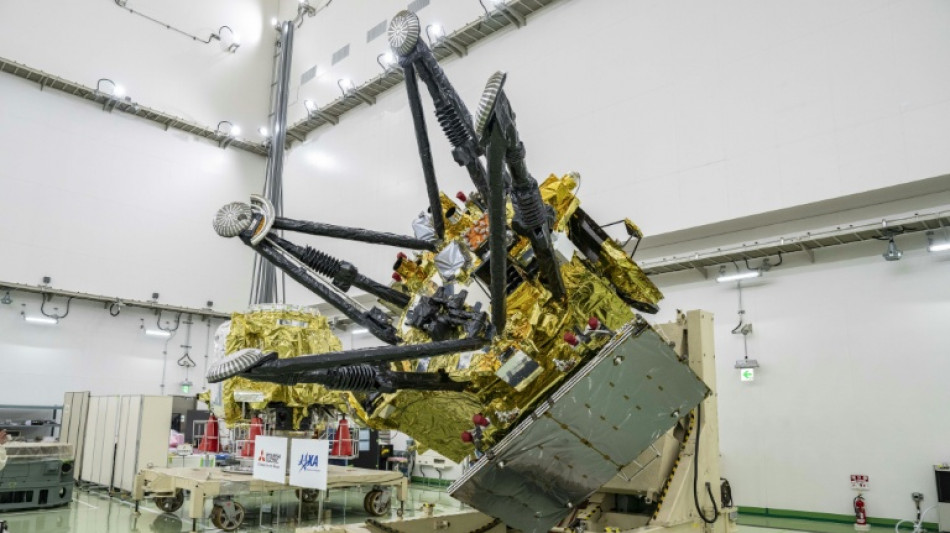
Japan aims for the moons of Mars / Photo: Yuichi YAMAZAKI - AFP
Japanese scientists are readying a mission to Mars' moons to retrieve samples that may unlock the origins of the Solar System and life on Earth, although a rival Chinese mission aims to make it back first.
The unmanned Martian Moons eXploration (MMX), set to blast off from Tanegashima Space Center in the coming months, could also lay the groundwork for humans visiting the red planet.
The spacecraft, revealed to media last Thursday, will stay in Mars' orbit for around three years and will attempt to land on Phobos.
It will collect at least 10 grams (0.35 ounces) of material from the surface of Phobos, while the IDEFIX rover -- the French name for comic hero Asterix's dog -- will conduct surface observations.
The spacecraft will also observe Demios, the other of Mars' moons -- but without landing -- before a return capsule heads back to Earth to land in Australia in around 2031.
- Impact or capture -
The Japan Aerospace Exploration Agency (JAXA) hopes that the mission will reveal how Mars and its moons formed, a key piece of knowledge in working out how the Solar System was born.
One theory for the origin of the Martian moons -- the "giant impact" hypothesis -- is that they formed after a celestial body collided with Mars.
The "capture" hypothesis meanwhile postulates that the moons are asteroids from the outer Solar System that were captured by Mars' gravity.
Determining which is right will help reveal "how a habitable environment for life might have arisen on the terrestrial planets", JAXA said, referring to the four rocky worlds closest to the Sun -- Mercury, Venus, Earth and Mars.
"MMX will shed light on the transport mechanisms that delivered water, volatiles, and organic compounds from the outer Solar System to the inner rocky planet region -- processes that may have played a key role in making these worlds habitable," said Patrick Michel, a French astrophysicist working on IDEFIX.
"If Phobos and Deimos are indeed remnants of these early delivery systems, they may hold clues to the origins of life itself, or to be more correct, to the transport of the materials that were key to the emergence of life on rocky planets," he told AFP.
JAXA said that the mission will also explore the possibility of using Phobos as a "natural space station" by establishing the technology required for a round trip to Mars -- something "essential for crewed Mars exploration".
- Martian legs -
MMX is a collaboration with France's National Centre for Space Studies (CNES), the German Aerospace Center (DLR), NASA and European Space Agency (ESA) as well as a score of universities and tech companies.
The development of the spacecraft's landing legs was particularly difficult as gravity on Phobos is extremely low, according to Akinari Uehara, a Mitsubishi Electric engineer.
"We have to prevent the (probe) from falling down, by having the legs cushion the impact of landing," Uehara said.
Japan's unmanned Smart Lander for Investigating Moon (SLIM) -- the "Moon Sniper" -- tipped over after touching down on Earth's Moon in 2024, but still transmitted data and survived several two-week lunar nights.
Japan also has experience in bringing back samples from space, including JAXA's unmanned Hayabusa-2 which returned 5.4 grams of rock and dust collected from an asteroid several hundred million kilometres from Earth in 2020.
- Perseverance -
But MMX is not the only Mars mission trying to bring back material.
NASA's Perseverance rover, which has been roaming the red planet since 2021, has already collected samples ready to be taken back to Earth.
However the mission has effectively been cancelled by the administration of President Donald Trump following a US Congress vote in January.
China has also announced its Tianwen-3 spacecraft is scheduled for launch around 2028 and will return Mars samples to Earth around 2031 -- potentially earlier than MMX's sample return.
China's Tianwen-1 mission already landed a rover named Zhurong on the surface of Mars in 2021, in one of the most spectacular successes of Beijing's space programme.
U.Ammann--NZN