Zürcher Nachrichten - Milky Way's fastest star discovered spinning around black hole

EUR -
AED 4.290357
AFN 75.935692
ALL 92.493993
AMD 426.709945
ANG 2.090892
AOA 1072.442065
ARS 1749.696213
AUD 1.639839
AWG 2.104288
AZN 1.915657
BAM 1.954583
BBD 2.354454
BDT 142.853499
BGN 1.981759
BHD 0.440739
BIF 3474.240878
BMD 1.168238
BND 1.485919
BOB 13.48495
BRL 6.058712
BSD 1.169007
BTN 111.821725
BWP 15.694698
BYN 3.555662
BYR 22897.457078
BZD 2.351107
CAD 1.609627
CDF 2655.404048
CHF 0.933136
CLF 0.027367
CLP 1077.080241
CNY 7.861947
CNH 7.855352
COP 3578.171599
CRC 529.681533
CUC 1.168238
CUP 30.958297
CVE 110.200158
CZK 24.116274
DJF 208.165733
DKK 7.475926
DOP 68.30893
DZD 155.153176
EGP 59.443085
ERN 17.523564
ETB 190.947811
FJD 2.56761
FKP 0.858672
GBP 0.856768
GEL 3.039295
GGP 0.858672
GHS 13.005236
GIP 0.858672
GMD 85.864904
GNF 10271.780208
GTQ 8.920598
GYD 244.474058
HKD 9.162377
HNL 31.345154
HRK 7.535949
HTG 152.939356
HUF 364.414206
IDR 20744.395171
ILS 3.501968
IMP 0.858672
INR 111.804782
IQD 1531.37927
IRR 1605859.413468
ISK 141.976131
JEP 0.858672
JMD 184.94801
JOD 0.828296
JPY 185.402225
KES 151.182051
KGS 102.161331
KHR 4700.214265
KMF 492.996492
KPW 1051.414189
KRW 1627.092096
KWD 0.360086
KYD 0.974223
KZT 532.719706
LAK 26334.279425
LBP 104684.107521
LKR 385.709746
LRD 212.174248
LSL 18.862401
LTL 3.449502
LVL 0.706656
LYD 7.403517
MAD 10.80867
MDL 20.072104
MGA 4996.017565
MKD 61.482771
MMK 2452.841478
MNT 4203.783987
MOP 9.444303
MRU 46.715512
MUR 54.6858
MVR 18.049225
MWK 2027.098574
MXN 19.802749
MYR 4.725756
MZN 74.644533
NAD 18.862159
NGN 1574.363179
NIO 43.024132
NOK 10.916643
NPR 178.914195
NZD 1.962616
OMR 0.4491
PAB 1.169002
PEN 3.914546
PGK 5.255817
PHP 72.156195
PKR 324.368864
PLN 4.316451
PYG 7038.767994
QAR 4.261411
RON 5.24994
RSD 117.358804
RUB 97.260373
RWF 1718.381545
SAR 4.38864
SBD 9.383586
SCR 16.132826
SDG 702.695236
SEK 11.082772
SGD 1.485619
SHP 0.865508
SLE 28.73445
SLL 24497.357577
SOS 668.095453
SRD 44.031421
STD 24180.159783
STN 24.485488
SVC 10.228981
SYP 15189.425244
SZL 18.857823
THB 38.371345
TJS 10.801552
TMT 4.088832
TND 3.400156
TOP 2.812836
TRY 56.022443
TTD 7.922237
TWD 37.255714
TZS 3090.576154
UAH 52.144026
UGX 4348.329768
USD 1.168238
UYU 46.852432
UZS 13840.856005
VES 907.071489
VND 30493.337993
VUV 138.104531
WST 3.188442
XAF 655.568456
XAG 0.01708
XAU 0.000258
XCD 3.157221
XCG 2.106833
XDR 0.826005
XOF 655.574064
XPF 119.331742
YER 276.959893
ZAR 18.830536
ZMK 10515.542589
ZMW 22.064451
ZWL 376.172033
  • CMSC

    -0.0264

    21.272

    -0.12%

  • CMSD

    -0.0500

    21.1

    -0.24%

  • RIO

    1.8350

    102.275

    +1.79%

  • RBGPF

    0.3500

    69.35

    +0.5%

  • BCE

    -0.1000

    23.6

    -0.42%

  • RYCEF

    -0.1900

    20.41

    -0.93%

  • JRI

    0.0500

    12.43

    +0.4%

  • NGG

    0.4450

    81.105

    +0.55%

  • VOD

    -0.1350

    16.035

    -0.84%

  • GSK

    -0.6000

    52.28

    -1.15%

  • BTI

    0.8450

    56.825

    +1.49%

  • BCC

    -1.5900

    81.54

    -1.95%

  • RELX

    0.4300

    35.53

    +1.21%

  • AZN

    0.2900

    165.24

    +0.18%

  • BP

    1.5550

    45.285

    +3.43%

Milky Way's fastest star discovered spinning around black hole
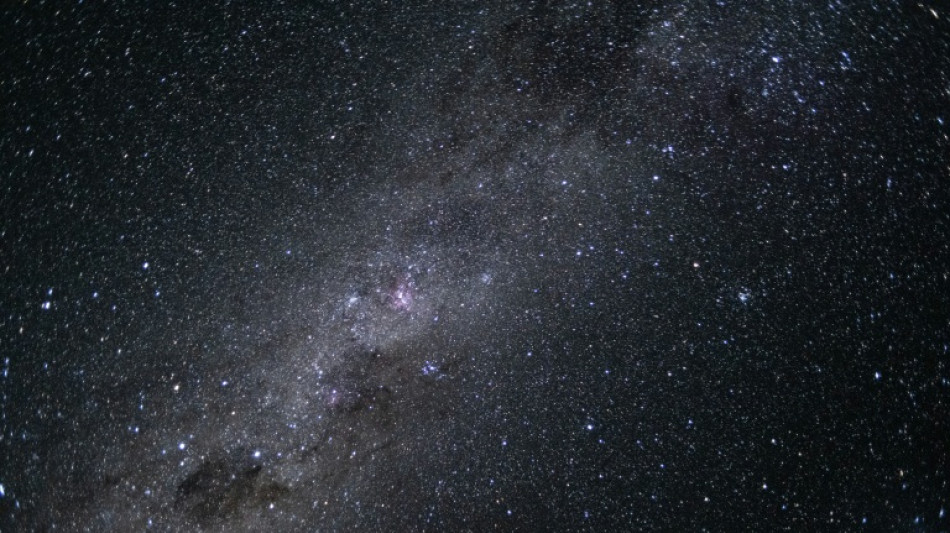
Milky Way's fastest star discovered spinning around black hole / Photo: Handout - NASA/AFP/File

Milky Way's fastest star discovered spinning around black hole

Astronomers have discovered the fastest star in the Milky Way zooming at 25,000 kilometres a second around the supermassive black hole at the centre of our galaxy.

Text size:

The star, named S301, orbits so dangerously close to the black hole that scientists believe it can shed light on this unimaginably powerful cosmic monster -- and test out Albert Einstein's theory of relativity.

"Decades carefully tracking stars orbiting our galaxy's central black hole, Sagittarius A*, have led to this breakthrough discovery," Reinhard Genzel of the Max Planck Institute for Extraterrestrial Physics in Germany said in a statement.

"Because it orbits so close to Sagittarius A*, S301 opens a new window to the fundamental properties of spacetime in this extreme black-hole environment," added Genzel, who shared a 2020 physics Nobel prize for discovering the black hole.

To spot S301 -- which is two billion times fainter than the star Betelgeuse in our sky -- the team of astronomers used the European Southern Observatory's Very Large Telescope in the Chilean desert.

They first noticed the star in 2023, and have been tracking its orbit since.

"What is special about this star is that it's orbiting Sagittarius A* on a very tight orbit, taking just 8.7 years to complete it," explained Felix Mang, a co-author of a new study describing the discovery.

The star gets roughly as close to the black hole as Saturn gets to our Sun, which is "unprecedented", the PhD student emphasised.

- Torn from its partner -

When the star gets closest to the immense suck of the black hole, it is travelling around 25,000 kilometres per second (15,500 miles per second).

That is 100,000 times faster than a commercial airplane, or more than eight percent of the speed of light, making it the fastest star ever detected in our galaxy.

Scientists believe that S301 was once part of a binary star system that was torn apart by the almighty pull of the black hole.

While S301 became trapped in the black hole's gravity, its partner star was blasted out with such force it likely left the galaxy entirely.

The astronomers will get another good look at the star when it makes its next closest approach to the black hole in 2031.

The team hopes that data from two complete orbits will allow them to determine the star's trajectory with enough precision they can also directly measure the black hole's rotation.

Like most objects in the universe, black holes are thought to spin.

Einstein's theory of general relativity predicted that a spinning black hole would drag spacetime along with it, twisting it in a way that changes the orbits of the surrounding stars.

Within the next 10 years, the astronomers hope to use S301 to measure the black hole's spin for the first time.

"Without this star, we would need to measure the motion of other stars for several more decades to get anywhere close to measuring the spin of the black hole," explained French astronomer and study co-author Juan Osorno.

The study was published in Nature on Wednesday.

T.Gerber--NZN