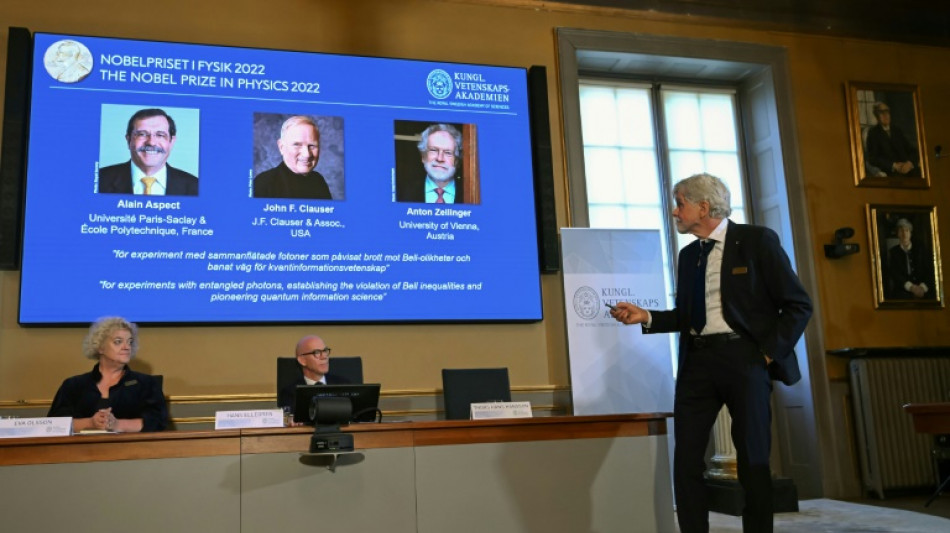
The Nobel winners who helped prove quantum 'spooky action' / Photo: Jonathan NACKSTRAND - AFP
Physicists Alain Aspect, John Clauser and Anton Zeilinger developed experimental tools that helped prove quantum entanglement -- a phenomenon Albert Einstein famously dismissed as "spooky action at a distance" -- is real, paving the way for its use in powerful computers.
Here are mini biographies of the three scientists.
- John Clauser -
Born in 1942, John Francis Clauser's earliest memories were of gaping in wonder at the equipment in the lab of his father, who created the aeronautics department for Johns Hopkins, he told the American Institute of Physics in a 2002 oral history.
An electronics buff who built some of the first computer-driven video games at high school, Clauser opted for physics at college.
In the mid-1960s, he grew interested in the ideas of quantum mechanics pioneer John Bell, who strove to better understand entanglement -- when two particles behave as one and can affect each other, even at vast distances.
"I thought this is one of the most amazing papers I've ever read in my own life, and I kept wondering, gee, where's the experimental evidence?" Clauser told PBS in 2018.
Clauser believed he could test Bell's ideas in a laboratory, but was met with widespread scorn by leading physicists of the time.
He proposed the test independently of his thesis work on radio astronomy, and carried it out with collaborators in 1972 while at UC Berkeley.
By shining lasers at calcium atoms to emit entangled photons and measuring their properties, he was able to prove with hard data that what had defied the imagination even of the great Einstein -- was true.
- Alain Aspect -
Like Clauser, Frenchman Alain Aspect was seduced by the "limpid clarity" of Bell's theorem.
"Quantum strangeness has dominated my whole life as a physicist," he told AFP in a 2010 interview.
As a doctoral student, Aspect built on the work of Clauser, refining the experiment to eliminate possible loopholes in its design -- publishing his work in 1982.
The son of a teacher, Aspect was born in 1947 in a village in Gascony, and is currently a professor at Institut d'Optique Graduate School (Augustin Fresnel chair), in University Paris-Saclay, and at Ecole Polytechnique.
But his interest in the quantum realm stemmed from a period in his life spent away from academia -- he had gone to Cameroon to complete three years of voluntary service as a teacher.
During his free time, he came across a book written by Claude Cohen-Tannoudji on the subject (Cohen-Tannoudji won the Nobel in 1997), which in turn led him to Bell.
In a phone interview with the Nobel Foundation on Tuesday, Aspect emphasized the international makeup of his co-winners -- an American and an Austrian -- was an important signal in the face of rising nationalism around the world.
"It's important that scientists keep their international community at a time when... nationalism is taking over in many countries," he said.
- Anton Zeilinger -
Nicknamed the "quantum pope", the physicist Anton Zeilinger, born in 1945 in Ried im Innkreis in Austria, became one of the most famous scientists in his country by succeeding for the first time in 1997 in quantum teleportation of light particles.
A success quickly compared to the "teleportation" of the television series "Star Trek."
Using the properties of quantum entanglement for cryptography, Professor Zeilinger encrypted the first banking transaction by this means in Vienna in 2004.
In 2007, his team created entangled pairs of photons and fired one of each pair over 144 kilometers (89 miles) between the Canary Islands La Palma and Tenerife, to generate a quantum cryptographic key.
His fame comes in part from his tireless didactic talents: always keen to popularize his knowledge to the general public, he even initiated the Dalai Lama in 2012 with infectious enthusiasm.
Attached to the University of Vienna, Zeilinger corresponds in all respects to the image of the scientist: gray hair, a full beard, and small round glasses.
He had already received countless awards and did not really believe that he would one day win the Nobel. "There are so many other candidates," he said a few years ago to the Austria Press Agency
R.Schmid--NZN