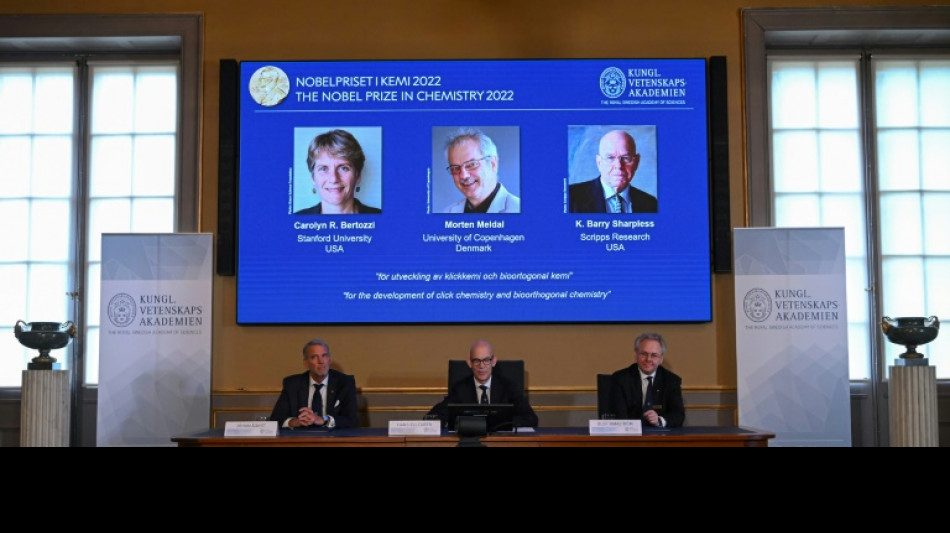
US duo and Dane win Nobel for 'click chemistry' / Photo: Jonathan NACKSTRAND - AFP
A trio of chemists from the United States and Denmark who laid the foundation for a more functional form of chemistry where molecules are snapped together on Wednesday won the Nobel Chemistry Prize.
Americans Carolyn Bertozzi and Barry Sharpless, together with Denmark's Morten Meldal, were honoured "for the development of click chemistry and bioorthogonal chemistry", the jury said.
Bertozzi is the only woman among the seven Nobel laureates honoured so far this year, with women vastly under-represented in the history of the prizes, especially in the science disciplines.
The award marks the second Nobel for 81-year-old Sharpless, who won the chemistry Nobel in 2001.
Only four other individuals have achieved the feat of winning two Nobel Prizes, including Polish-born Frenchwoman Marie Curie, who won the chemistry prize in 1911 after first winning the physics prize in 1903.
She was followed by American Linus Pauling who won for chemistry in 1954 and peace in 1962. American John Bardeen won the physics prize in 1956 and 1972, and Britain's Frederick Sanger won the chemistry prize in 1958 and 1980.
- To make drugs, map DNA -
Click chemistry "is an elegant and efficient chemical reaction that is now in widespread use," the jury said in a statement.
"Among many other uses, it is utilised in the development of pharmaceuticals, for mapping DNA and creating materials that are more fit for purpose," it added.
Sharpless, a professor at Scripps Research in California, "started the ball rolling" and "coined the concept of click chemistry" around 2000, the jury said.
Afterwards, Sharpless and Meldal, a professor of chemistry at the University of Copenhagen, "independently of each other, presented what is now the crown jewel of click chemistry: the copper catalysed azide-alkyne cycloaddition".
The process allows chemists to "snap" molecules together "with the help of some copper ions," which among other things allows for the production of new materials.
"If a manufacturer adds a clickable azide to a plastic or fibre, changing the material at a later stage is straightforward," the Nobel Foundation explained.
It is possible to click in substances that conduct electricity, capture sunlight, are antibacterial, protect from ultraviolet radiation or have other desirable properties, it said.
While there is widespread application of his research, Meldal said he was "very surprised and very proud" to receive the honour.
"There are so many good discoveries and developments in the world, it's incredible to be in this situation," Meldal told Swedish public radio.
- 'A new level' -
Bertozzi, 55, a professor at Stanford in the United States, was highlighted for then taking "click chemistry to a new level".
"She developed click reactions that work inside living organisms. Her bioorthogonal reactions take place without disrupting the normal chemistry of the cell," the jury said.
Her research is now being used to investigate how these reactions can be used to diagnose and treat cancer.
"I'm absolutely stunned, I'm sitting here and I can hardly breathe," Bertozzi told reporters via telephone, minutes after the announcement.
The trio will share the Nobel award sum of 10 million Swedish kronor (more than $910,000), and will receive the prize from King Carl XVI Gustaf at a formal ceremony in Stockholm on December 10, the anniversary of the 1896 death of scientist Alfred Nobel who created the prizes in his last will and testament.
Last year, the academy honoured Germany's Benjamin List and US-British dual national David MacMillan for their development of a precise tool for molecular construction known as asymmetric organocatalysis.
On Monday, the medicine prize went to Swedish paleogeneticist Svante Paabo for his discoveries on the genomes of extinct hominins and human evolution.
The chemistry prize will be followed by the highly watched literature and peace prizes, announced on Thursday and Friday respectively.
The peace prize is expected to hold a special significance this year given the Russian invasion of Ukraine.
Y.Keller--NZN