Zürcher Nachrichten - New potentially hazardous asteroid discovered

EUR -
AED 4.236995
AFN 75.564777
ALL 92.925304
AMD 422.338256
AOA 1057.950846
ARS 1720.186655
AUD 1.634576
AWG 2.076675
AZN 1.954279
BAM 1.95528
BBD 2.322983
BDT 142.38216
BHD 0.434894
BIF 3447.858408
BMD 1.153708
BND 1.477207
BOB 13.69636
BRL 5.975869
BSD 1.153294
BTN 110.017146
BWP 15.567863
BYN 3.419365
BYR 22612.684445
BZD 2.319634
CAD 1.606164
CDF 2619.559688
CHF 0.936743
CLF 0.026783
CLP 1054.109049
CNY 7.78476
CNH 7.784105
COP 3623.013531
CRC 522.972347
CUC 1.153708
CUP 30.573272
CVE 110.235704
CZK 24.259084
DJF 205.037586
DKK 7.475978
DOP 67.252127
DZD 153.435832
EGP 57.900816
ERN 17.305626
ETB 186.55832
FJD 2.550865
FKP 0.853025
GBP 0.854661
GEL 3.011003
GGP 0.853025
GHS 13.569394
GIP 0.853025
GMD 84.812008
GNF 10128.308297
GTQ 8.798662
GYD 241.545807
HKD 9.052971
HNL 30.913784
HRK 7.533829
HTG 150.799923
HUF 365.315418
IDR 20591.387346
ILS 3.45801
IMP 0.853025
INR 110.049993
IQD 1510.898463
IRR 1586031.766414
ISK 142.010199
JEP 0.853025
JMD 182.471506
JOD 0.818036
JPY 183.805935
KES 149.197336
KGS 100.892074
KHR 4672.758166
KMF 491.479148
KRW 1630.778433
KWD 0.356392
KYD 0.961145
KZT 537.888706
LAK 26022.084362
LBP 103281.951751
LKR 385.677502
LRD 208.174675
LSL 18.716326
LTL 3.406601
LVL 0.697867
LYD 7.355045
MAD 10.68546
MDL 20.033676
MGA 4962.681116
MKD 61.503655
MMK 2422.138913
MNT 4147.35178
MOP 9.321223
MRU 46.098749
MUR 54.27046
MVR 17.824855
MWK 1999.868514
MXN 19.733484
MYR 4.720861
MZN 73.727751
NAD 18.716326
NGN 1571.847041
NIO 42.438721
NOK 10.960702
NPR 176.02322
NZD 1.961933
OMR 0.443597
PAB 1.153294
PEN 3.899064
PGK 5.175625
PHP 70.640985
PKR 320.13932
PLN 4.302582
PYG 6867.174977
QAR 4.204383
RON 5.23876
RSD 117.319465
RUB 95.121228
RWF 1698.848513
SAR 4.321626
SBD 9.305462
SCR 15.863122
SDG 692.804035
SEK 10.989147
SGD 1.477168
SLE 28.403473
SOS 659.124831
SRD 43.778598
STD 23879.434346
STN 24.493491
SVC 10.091318
SZL 18.705434
THB 38.24947
TJS 10.628075
TMT 4.049516
TND 3.3864
TRY 55.075645
TTD 7.811093
TWD 37.209176
TZS 3063.093434
UAH 51.748047
UGX 4290.85966
USD 1.153708
UYU 46.437659
UZS 13713.355534
VES 871.929427
VND 30153.899336
VUV 137.115681
WST 3.15393
XAF 655.782719
XAG 0.017881
XAU 0.000264
XCD 3.117955
XCG 2.078693
XDR 0.815195
XOF 655.782719
XPF 119.331742
YER 275.046986
ZAR 18.710265
ZMK 10384.761593
ZMW 21.625253
ZWL 371.493631
  • RBGPF

    1.5600

    72.16

    +2.16%

  • CMSC

    -0.1090

    21.461

    -0.51%

  • BCC

    0.8520

    85.602

    +1%

  • NGG

    0.9050

    80.385

    +1.13%

  • RIO

    -0.9300

    100.98

    -0.92%

  • GSK

    -1.1150

    51.045

    -2.18%

  • BCE

    0.8750

    23.415

    +3.74%

  • BTI

    -0.2950

    56.755

    -0.52%

  • CMSD

    -0.0900

    21.6

    -0.42%

  • BP

    0.3550

    43.235

    +0.82%

  • RELX

    -0.2150

    35.405

    -0.61%

  • JRI

    0.0000

    12.73

    0%

  • VOD

    0.1500

    15.9

    +0.94%

  • RYCEF

    -0.3600

    20.54

    -1.75%

  • AZN

    -2.8400

    159.07

    -1.79%

New potentially hazardous asteroid discovered
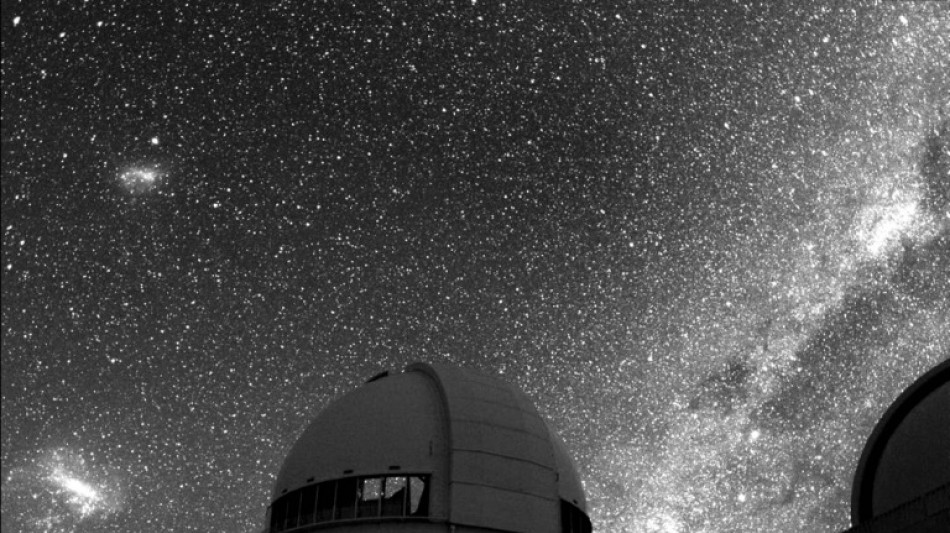
New potentially hazardous asteroid discovered / Photo: ROGER SMITH, AURA, NOAO, NSF - ROGER SMITH, AURA, NOAO, NSF/AFP

New potentially hazardous asteroid discovered

An international team of astronomers on Monday announced the discovery of a large asteroid whose orbit crosses that of Earth, creating a small chance far in the future of a catastrophic collision.

Text size:

The 1.5 kilometer- (0.9 mile-) wide asteroid, named 2022 AP7, was discovered in area notoriously difficult to spot objects due to the glare from the Sun.

It was found along with two other near-Earth asteroids using a high-tech instrument on the Victor M. Blanco telescope in Chile that was originally developed to study dark matter.

"2022 AP7 crosses Earth’s orbit, which makes it a potentially hazardous asteroid, but it currently does not now or anytime in the future have a trajectory that will have it collide with the Earth," said lead author of the findings, astronomer Scott Sheppard of the Carnegie Institution for Science.

The potential threat comes from the fact that like any orbiting object, its trajectory will be slowly modified due to myriad gravitational forces, notably by planets. Forecasts are therefore difficult on the very long term.

The newly-discovered asteroid is "the largest object that is potentially hazardous to Earth to be discovered in the last eight years," said NOIRLab, a US-funded research group that operates multiple observatories.

2022 AP7 takes five years to circle the Sun under its current orbit, which at its closest point to Earth remain several million kilometers away.

The risk is therefore very small, but in case of a collision, an asteroid of that size "would have a devastating impact on life as we know it," said Sheppard. He explained that dust launched into the air would have a major cooling effect, provoking an "extinction event like hasn’t been seen on Earth in millions of years."

His team's results were published in the scientific journal The Astronomical Journal. The two other asteroids pose no risk to Earth, but one is the closest asteroid to the Sun ever found.

Some 30,000 asteroids of all sizes -- including more than 850 larger than a kilometer wide -- have been catalogued in the vicinity of the Earth, earning them the label "Near Earth Objects" (NEOs). None of them threaten Earth for the next 100 years.

According to Sheppard, there are "likely 20 to 50 large NEOs left to find," but most are on orbits that put them in the Sun's glare.

In preparation for a future discovery of a more threatening object, NASA conducted a test mission in late September in which it collided a spacecraft with an asteroid, proving that it was possible to change its trajectory.

H.Roth--NZN