Zürcher Nachrichten - Homo sapiens in Europe used bow-and-arrow 54,000 years ago: study

EUR -
AED 4.276798
AFN 76.973093
ALL 96.541337
AMD 443.660189
ANG 2.0846
AOA 1067.888653
ARS 1669.958677
AUD 1.752514
AWG 2.096182
AZN 1.984351
BAM 1.955625
BBD 2.34549
BDT 142.477215
BGN 1.956439
BHD 0.438161
BIF 3440.791247
BMD 1.164546
BND 1.508565
BOB 8.047278
BRL 6.334667
BSD 1.164496
BTN 104.702605
BWP 15.471612
BYN 3.348
BYR 22825.091832
BZD 2.34209
CAD 1.610159
CDF 2599.265981
CHF 0.936209
CLF 0.027366
CLP 1073.571668
CNY 8.233458
CNH 8.232219
COP 4424.302993
CRC 568.848955
CUC 1.164546
CUP 30.860456
CVE 110.255106
CZK 24.203336
DJF 207.371392
DKK 7.470448
DOP 74.533312
DZD 151.068444
EGP 55.295038
ERN 17.468183
ETB 180.629892
FJD 2.632397
FKP 0.873977
GBP 0.872678
GEL 3.138497
GGP 0.873977
GHS 13.246811
GIP 0.873977
GMD 85.012236
GNF 10119.091982
GTQ 8.9202
GYD 243.638138
HKD 9.065875
HNL 30.671248
HRK 7.535429
HTG 152.446321
HUF 381.994667
IDR 19435.740377
ILS 3.768132
IMP 0.873977
INR 104.760771
IQD 1525.563106
IRR 49041.926882
ISK 149.038983
JEP 0.873977
JMD 186.393274
JOD 0.825709
JPY 180.924237
KES 150.636483
KGS 101.839952
KHR 4662.581612
KMF 491.43861
KPW 1048.137083
KRW 1716.311573
KWD 0.357481
KYD 0.970513
KZT 588.927154
LAK 25252.733992
LBP 104283.942272
LKR 359.197768
LRD 204.961608
LSL 19.736529
LTL 3.438601
LVL 0.704422
LYD 6.330432
MAD 10.755735
MDL 19.814222
MGA 5194.533878
MKD 61.634469
MMK 2445.172268
MNT 4132.506664
MOP 9.338362
MRU 46.438833
MUR 53.651052
MVR 17.938355
MWK 2019.3188
MXN 21.165153
MYR 4.787492
MZN 74.426542
NAD 19.736529
NGN 1688.68458
NIO 42.856154
NOK 11.767853
NPR 167.523968
NZD 2.015483
OMR 0.44694
PAB 1.164595
PEN 3.914449
PGK 4.941557
PHP 68.66747
PKR 326.476804
PLN 4.229804
PYG 8009.281302
QAR 4.244719
RON 5.092096
RSD 117.389466
RUB 89.441974
RWF 1694.347961
SAR 4.370508
SBD 9.584899
SCR 15.747587
SDG 700.4784
SEK 10.946786
SGD 1.508673
SHP 0.873711
SLE 27.603998
SLL 24419.93473
SOS 664.340387
SRD 44.985272
STD 24103.740676
STN 24.497802
SVC 10.190086
SYP 12876.900539
SZL 19.72123
THB 37.119932
TJS 10.684641
TMT 4.087555
TND 3.416093
TOP 2.803946
TRY 49.523506
TTD 7.894292
TWD 36.437508
TZS 2841.64501
UAH 48.888813
UGX 4119.630333
USD 1.164546
UYU 45.545913
UZS 13931.74986
VES 296.437311
VND 30697.419423
VUV 142.156724
WST 3.247609
XAF 655.898144
XAG 0.019964
XAU 0.000277
XCD 3.147243
XCG 2.098812
XDR 0.815727
XOF 655.898144
XPF 119.331742
YER 277.802752
ZAR 19.711451
ZMK 10482.311144
ZMW 26.923584
ZWL 374.983176
  • RBGPF

    0.0000

    78.35

    0%

  • CMSD

    -0.0700

    23.25

    -0.3%

  • GSK

    -0.1600

    48.41

    -0.33%

  • NGG

    -0.5000

    75.41

    -0.66%

  • RELX

    -0.2200

    40.32

    -0.55%

  • SCS

    -0.0900

    16.14

    -0.56%

  • BTI

    -1.0300

    57.01

    -1.81%

  • CMSC

    -0.0500

    23.43

    -0.21%

  • RIO

    -0.6700

    73.06

    -0.92%

  • JRI

    0.0400

    13.79

    +0.29%

  • BP

    -1.4000

    35.83

    -3.91%

  • AZN

    0.1500

    90.18

    +0.17%

  • BCE

    0.3300

    23.55

    +1.4%

  • VOD

    -0.1630

    12.47

    -1.31%

  • RYCEF

    -0.0500

    14.62

    -0.34%

  • BCC

    -1.2100

    73.05

    -1.66%

Homo sapiens in Europe used bow-and-arrow 54,000 years ago: study
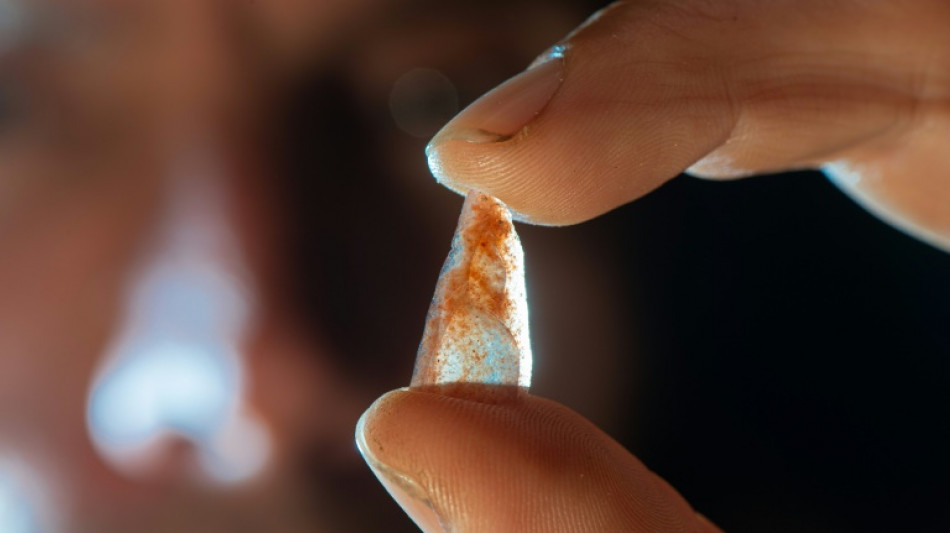
Homo sapiens in Europe used bow-and-arrow 54,000 years ago: study / Photo: Philippe Psaila - EUREKALERT!/AFP

Homo sapiens in Europe used bow-and-arrow 54,000 years ago: study

A cave in southern France has revealed evidence of the first use of bows and arrows in Europe by modern humans some 54,000 years ago, far earlier than previously known.

Text size:

The research, published on Wednesday in the journal Science Advances, pushes back the age of archery in Europe by more than 40,000 years.

The use of the bow-and-arrow in Africa has been documented to date back some 70,000 years.

But the oldest previous evidence of archery in Europe was the discovery of bows and arrows in peat bogs of Northern Europe, notably Stellmoor in Germany, dating back 10,000 to 12,000 years.

The new research comes from the Mandrin rock shelter overlooking the middle valley of the Rhone River in southern France.

The Grotte Mandrin site, which was first excavated in 1990, includes layer upon layer of archaeological remains dating back over 80,000 years.

The researchers who conducted the latest study have documented previously that Neanderthals and their modern "cousins" -- Homo sapiens -- alternated in inhabiting the Mandrin cave.

A level known as the "Layer E" has been attributed to the presence of Homo sapiens some 54,000 years ago and is interposed between layers of numerous Neanderthal occupations.

The researchers conducted a functional analysis of flint artifacts found in Layer E that were more finely executed than the points and blades in the layers above and below.

Tiny flint points were the key because other elements of archery technology such as wood, fibers, leather, resins and sinew are perishable and rarely preserved in European Paleolithic sites.

- 'Too light to be efficient' -

For the study, the researchers reproduced the tiny flint points found in the cave, some of which are smaller than a US penny, and fired them as arrowheads with a replica bow at dead animals.

"We couldn't throw them at the animals any other way than with a bow because they were too tiny and too light to be efficient," said Laure Metz of Aix Marseille University, a co-author of the study along with Ludovic Slimak of the University of Toulouse.

"We had to use this kind of propulsion," Metz told AFP. "The only way that it was working was with a bow."

Fractures on the flint points were compared with scars found on the artifacts found in the cave, proving undoubtedly that they were used as arrowheads, the researchers said.

"Fractures for a lot of them, not all, were fractures of impact," Metz said. "And they are coming at the end of the point."

Metz said the evidence suggests that the Neanderthals and the Homo sapiens who used in the cave likely met at some point although "we don't know the nature of the meeting, whether it was nicely or not."

The Neanderthals who inhabited the Mandrin site continued to use traditional weapons, however, such as thrusted or hand-thrown spears and did not develop mechanically propelled weapons, she said.

"The traditions and technologies mastered by these two populations were thus profoundly distinct, illustrating a remarkable objective technological advantage to modern populations during their expansion into the European continent," the researchers said.

Metz said the occupants of the cave would have typically hunted horses, bison and deer and animal bones have been found inside.

O.Meier--NZN