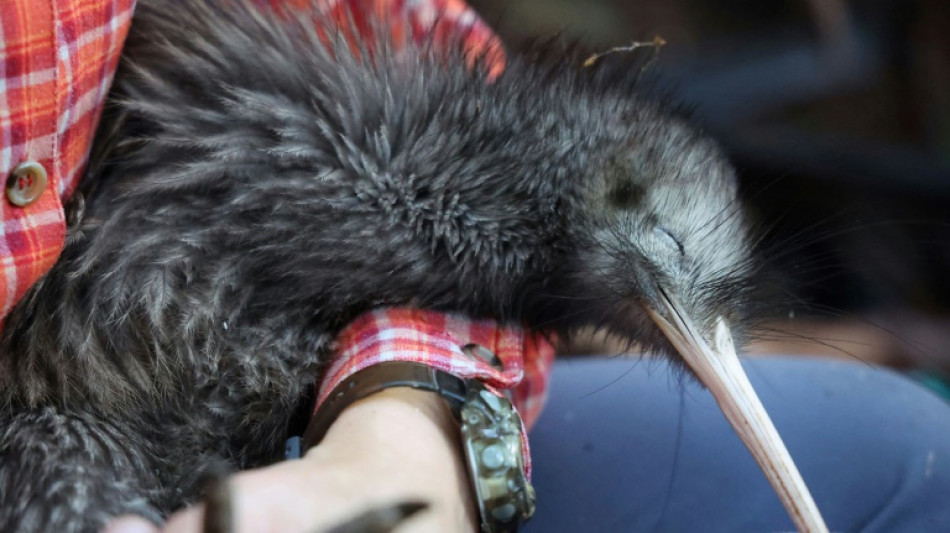
New Zealand fights to save its flightless national bird / Photo: Marty MELVILLE - AFP
New Zealand's treasured kiwi birds are shuffling around Wellington's verdant hills for the first time in a century, after a drive to eliminate invasive predators from the capital's surrounds.
Visitors to New Zealand a millennium ago would have encountered a bona fide "birdtopia" -- islands teeming with feathered creatures fluttering through life unaware that mammalian predators existed.
The arrival of Polynesian voyagers in the 1200s and Europeans a few hundred years later changed all that.
Rats picked off snipe-rails and petrels, mice chewed through all the seeds and berries they could find, leaving little for native birds to peck on.
Possums -- introduced for fur -- stripped trees bare. Rabbits bred like, well, rabbits, devouring meadows and paddocks alike.
Heaping disaster upon disaster, stoats were introduced to kill the rabbits but instead killed wrens, thrushes, owls and quails.
The population of native flightless birds like the kakapo and kiwi plummeted.
The Department of Conservation estimates there are only around 70,000 wild kiwi left in New Zealand.
Despite the bird being a beloved national symbol, few New Zealanders have seen one in the wild.
However, numbers are rising again thanks to more than 90 community initiatives working nationwide to protect them.
One such group is The Capital Kiwi Project, a charitable trust backed by millions of dollars from government grants and private donations.
- Special connection -
"Ever since people came to New Zealand, we have had a special connection to the kiwi," founder and project leader Paul Ward told AFP.
"They are central to Maori myth. Our sports teams, our rugby league teams, our defence force and, even when we go overseas, we are known as kiwis.
"They are tough, resilient, adaptable, all values we think of as New Zealanders, but most of us have never seen a kiwi before."
Ward estimates wild kiwi last roamed the Wellington area more than a century ago.
The bid to save them required a sustained conservation effort.
The project had to first deal with the kiwi's natural enemies prowling through the undergrowth.
Local dog owners were invited to sessions to teach their pets to steer clear of kiwi while out for walks.
The project also had to declare war on stoats.
An adult kiwi can fight off a stoat using its powerful legs and sharp claws but a chick has no chance, Ward explained.
The project laid a huge network of 4,500 traps over an area equivalent to nearly 43,000 football pitches on the hills surrounding Wellington. The traps have claimed 1,000 stoats so far.
After "blitzing stoats", as Ward puts it, the predator population was low enough for the project to release the first batch of kiwi last November.
The birds were carefully transported nearly 500 kilometres (310 miles) from a captive breeding programme to a Wellington school, where they were welcomed by a traditional Maori ceremony.
Ward said a hush came over the 400-strong crowd as they caught their first glimpse of a kiwi when the first bird was released.
- Rare sightings -
"The power of that moment was palpable," he said. "Our job is to bottle that and spread it across the hills of Wellington."
Regular check-ups show that the first wave is thriving.
"Two months after we released the birds, we were ecstatic to discover they had gained weight," Ward said.
"One had put on 400 grams -- that's a considerable weight gain even for a human over Christmas or Easter. There's plenty of food for them on these hillsides."
Ward said the goal is to release 250 birds over the next five years to establish a large wild kiwi population.
He wants their distinctive shrill cry to become part of everyday life on the outskirts of the capital.
"It's our duty to look after the animal that's gifted us its name," Ward said.
"As one of our volunteers said, 'if we can't look after the thing we're named after we deserve to be renamed idiots'."
L.Muratori--NZN