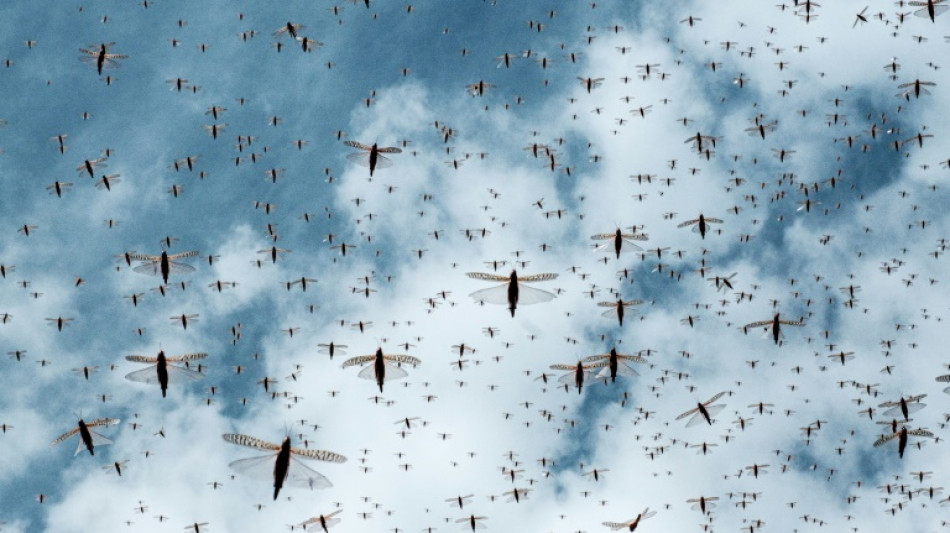
Scientists find chemical that stops locust cannibalism / Photo: Yasuyoshi CHIBA - AFP/File
Plagues of locusts that darken the skies and devastate all things that grow have been recorded since Biblical times, and today threaten the food security of millions of people across Asia and Africa.
But a new finding reported Thursday -- of a pheromone emitted by the insects to avoid being cannibalized when in a swarm -- could potentially pave the way to reining in the voracious pests.
Study leader Bill Hansson, director of the Max Planck Institute's Department of Evolutionary Neuroethology, told AFP that the new paper, published in Science, built on prior research that found swarms are directed not by cooperation -- but actually the threat of consumption by other locusts.
While repulsive to modern humans, cannibalism is rife in nature -- from lions that kill and devour cubs that are not theirs, to foxes that consume dead kin for energy.
For locusts, cannibalism is thought to serve an important ecological purpose.
Migratory locusts (Locusta migratoria) occur in different forms and behave so differently that they were, until recently, thought to be entirely different species.
Most of the time, they exist in a "solitary" phase keeping to themselves and eating comparatively little, like timid grasshoppers.
But when their population density increases due to rainfall and temporarily good breeding conditions, which is followed by food scarcity, they undergo major behavioral changes due to a rush of hormones that rev them up, causing them to aggregate in swarms and become more aggressive.
This is known as the "gregarious" phase and it's thought the fear of cannibalism helps keep the swarm moving in the same direction, from an area of lower to higher food concentration, according to 2020 research by Iain Couzin of the Max Planck Institute for Animal Research.
Hansson explained that "locusts eat each other from behind."
"So if you stop moving, you get eaten by the other, and that got us thinking that almost every animal who is under threat has some kind of countermeasure."
In painstaking experiments that took four years to complete, Hansson's team first established that cannibalism rates did indeed increase as the number of "gregarious" locusts kept in a cage went up, proving in the lab what Couzin had observed in the field in Africa (the triggering point was around 50 in a cage).
Next, they compared the odors emitted by solitary and gregarious locusts, finding 17 smells produced exclusively during the gregarious phase.
Of these, one chemical, known as phenylacetonitrile (PAN), was found to repel other locusts in behavioral tests.
PAN is involved in the synthesis of a potent toxin sometimes produced by gregarious locusts -- hydrogen cyanide -- so emitting PAN appeared to fit as the signal to tell others to back off.
- Genome editing -
To confirm the finding, they used CRISPR editing to genetically modify locusts so they could no longer produce PAN, which in turn made them more vulnerable to cannibalism.
For further confirmation, they tested dozens of the locusts' olfactory receptors, eventually landing on one that was very sensitive to PAN.
When they gene edited locusts to no longer produce this receptor, the modified locusts became more cannibalistic.
Writing in a related commentary in Science, researchers Iain Couzin and Einat Couzin-Fuchs said the discovery helped shed light on the "intricate balance" between the mechanisms that cause migratory locusts to group together versus compete with one another.
Future methods of locust control could therefore use technology that tips that delicate balance towards more competition, but Hansson cautioned: "You don't want to eradicate the species."
"If we could diminish the size of the swarms, steer them to areas where we are not growing our crops, then a lot could be gained," he added.
F.Schneider--NZN