Zürcher Nachrichten - Mammal bites dinosaur in 'once-in-a-lifetime' fossil find

EUR -
AED 4.275966
AFN 76.985545
ALL 96.539598
AMD 444.356938
ANG 2.084197
AOA 1067.681774
ARS 1670.224584
AUD 1.754052
AWG 2.098687
AZN 1.976418
BAM 1.955179
BBD 2.345765
BDT 142.374773
BGN 1.95533
BHD 0.438893
BIF 3440.407125
BMD 1.16432
BND 1.51032
BOB 8.076434
BRL 6.32494
BSD 1.164635
BTN 104.834248
BWP 15.494078
BYN 3.368245
BYR 22820.674814
BZD 2.342366
CAD 1.612897
CDF 2598.762557
CHF 0.93868
CLF 0.027391
CLP 1074.527603
CNY 8.233726
CNH 8.231644
COP 4450.031589
CRC 568.719341
CUC 1.16432
CUP 30.854484
CVE 110.229984
CZK 24.292841
DJF 207.39501
DKK 7.46884
DOP 74.666282
DZD 151.42024
EGP 55.3328
ERN 17.464802
ETB 181.048288
FJD 2.645096
FKP 0.873275
GBP 0.87359
GEL 3.137797
GGP 0.873275
GHS 13.305773
GIP 0.873275
GMD 85.579144
GNF 10123.784092
GTQ 8.921128
GYD 243.662598
HKD 9.057671
HNL 30.586772
HRK 7.530471
HTG 152.49156
HUF 384.795063
IDR 19426.798028
ILS 3.752021
IMP 0.873275
INR 104.716161
IQD 1525.259388
IRR 49046.985546
ISK 149.009323
JEP 0.873275
JMD 186.71069
JOD 0.825488
JPY 181.724747
KES 150.488675
KGS 101.819929
KHR 4662.538927
KMF 493.67135
KPW 1047.887976
KRW 1713.070036
KWD 0.357516
KYD 0.970596
KZT 595.133506
LAK 25258.085017
LBP 104303.648285
LKR 359.387381
LRD 205.563818
LSL 19.776303
LTL 3.437935
LVL 0.704285
LYD 6.329017
MAD 10.784518
MDL 19.746812
MGA 5193.350287
MKD 61.62069
MMK 2445.106092
MNT 4130.978283
MOP 9.333575
MRU 46.340054
MUR 53.722139
MVR 17.941884
MWK 2021.805692
MXN 21.280244
MYR 4.795257
MZN 74.401195
NAD 19.776303
NGN 1689.009573
NIO 42.856386
NOK 11.796094
NPR 167.735717
NZD 2.013127
OMR 0.447679
PAB 1.16463
PEN 3.91561
PGK 4.945919
PHP 68.838684
PKR 326.700985
PLN 4.237421
PYG 8009.490111
QAR 4.239308
RON 5.089829
RSD 117.397834
RUB 89.129445
RWF 1694.561708
SAR 4.369836
SBD 9.575163
SCR 16.697756
SDG 700.34093
SEK 10.934229
SGD 1.511119
SHP 0.873542
SLE 27.828039
SLL 24415.209085
SOS 665.410419
SRD 45.011447
STD 24099.076219
STN 24.49222
SVC 10.190807
SYP 12873.691057
SZL 19.770805
THB 37.106545
TJS 10.68566
TMT 4.075121
TND 3.420999
TOP 2.803403
TRY 49.564529
TTD 7.890527
TWD 36.299427
TZS 2852.583998
UAH 49.098903
UGX 4120.691027
USD 1.16432
UYU 45.495353
UZS 13964.623985
VES 299.936091
VND 30697.300586
VUV 141.864352
WST 3.246834
XAF 655.748696
XAG 0.020144
XAU 0.000279
XCD 3.146633
XCG 2.099042
XDR 0.815541
XOF 655.751511
XPF 119.331742
YER 277.748338
ZAR 19.847874
ZMK 10480.274931
ZMW 26.93256
ZWL 374.910611
  • RBGPF

    0.7600

    79.11

    +0.96%

  • NGG

    -0.0800

    75.33

    -0.11%

  • SCS

    -0.0200

    16.12

    -0.12%

  • CMSD

    -0.0800

    23.17

    -0.35%

  • CMSC

    -0.2100

    23.22

    -0.9%

  • GSK

    0.0600

    48.47

    +0.12%

  • BTI

    0.4000

    57.41

    +0.7%

  • AZN

    1.1000

    91.28

    +1.21%

  • RELX

    -0.8400

    39.48

    -2.13%

  • RIO

    -0.0400

    73.02

    -0.05%

  • BCC

    -1.2400

    71.81

    -1.73%

  • RYCEF

    0.2100

    14.83

    +1.42%

  • JRI

    -0.0700

    13.72

    -0.51%

  • BCE

    -0.2100

    23.34

    -0.9%

  • VOD

    0.0300

    12.5

    +0.24%

  • BP

    -0.0500

    35.78

    -0.14%

Mammal bites dinosaur in 'once-in-a-lifetime' fossil find
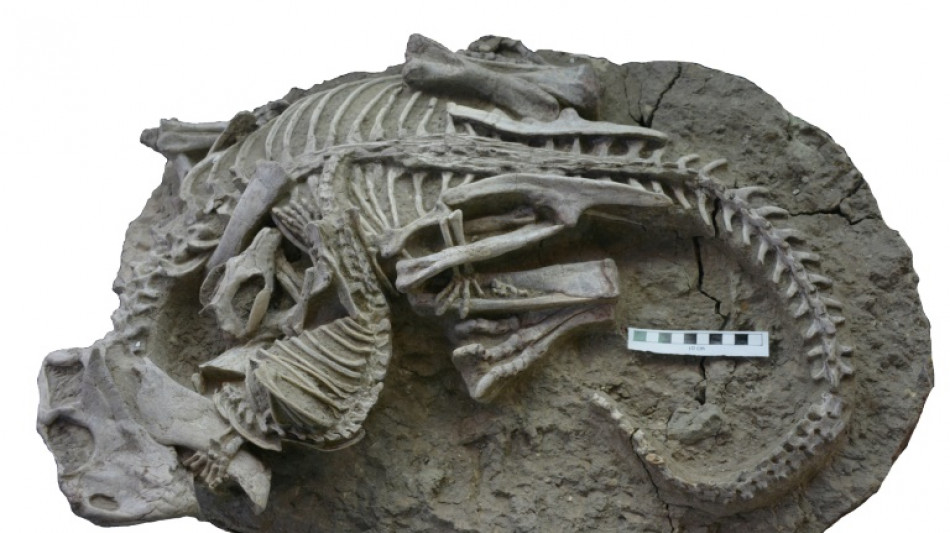
Mammal bites dinosaur in 'once-in-a-lifetime' fossil find / Photo: Gang Han - Canadian Museum of Nature/AFP

Mammal bites dinosaur in 'once-in-a-lifetime' fossil find

A badger-like mammal was sinking its teeth into the ribs of a dinosaur three times its size when they were buried in volcanic ash 125 million years ago, capturing the pair in a deadly embrace.

Text size:

The fight scene, preserved in a fossil discovered in China, suggests that small mammals preyed on the dinosaurs that ruled Earth during the Cretaceous period more than previously thought, scientists said on Tuesday.

Jordan Mallon, a palaeontologist at the Canadian Museum of Nature, told AFP that when he first saw the fossil "my eyes popped out of my head".

Mallon, a co-author of a new study led by Chinese researchers, said they believe the fossil is the first ever discovered that shows a mammal and dinosaur fighting each other.

Mammals were generally considered far too small to prey on the dinosaurs that dominated the world during the tens of millions of years they shared on Earth.

But the fossil shows a badger-sized Repenomamus robustus sitting on top of Psittacosaurus lujiatunensis, a plant-eating dinosaur that stood 120 centimetres (47 inches) tall and had a beak like a parrot.

The mammal -- one of the largest of its time but still a third the weight of the dinosaur -- is sinking his sharp teeth into the dinosaur's ribs and gripping onto its leg.

- 'Feisty mammals' -

The way the pair are intertwined shows that the mammal was not scavenging on a dead dinosaur, Mallon said.

"The dinosaur has collapsed down and trapped the hind limb of the mammal in the fold of its knee," indicating it was an attack, he said.

The dinosaur also bears no bite marks, which mammals often leave on scavenged bodies.

While it is rare for mammals to prey on animals so much larger than them, Mallon said one example was how wolverines had been observed hunting far-larger caribou.

It was not possible to tell from the fossil if Repenomamus hunted solo or in a pack, he said, adding that either was possible.

The almost entirely complete skeletons were found in China's northeastern Liaoning province in 2012.

They were discovered at a site nicknamed "Chinese Pompeii" because of how many dinosaurs and other animals have been found preserved by volcanic debris there, similar to the ancient Roman city.

The first fossil suggesting that mammals ate dinosaurs was found at the Chinese site in 2005. It showed a baby Psittacosaurus in the stomach of a Repenomamus.

But the new fossil is the first piece of evidence that "there were at least some feisty mammals around during the Cretaceous... capable of taking down an adult dinosaur," Mallon said.

The "once-in-a-lifetime" fossil is being exhibited at a museum attached to a primary school in the Chinese city of Weihai, he added.

The study was published in the journal Scientific Reports.

Ch.Siegenthaler--NZN