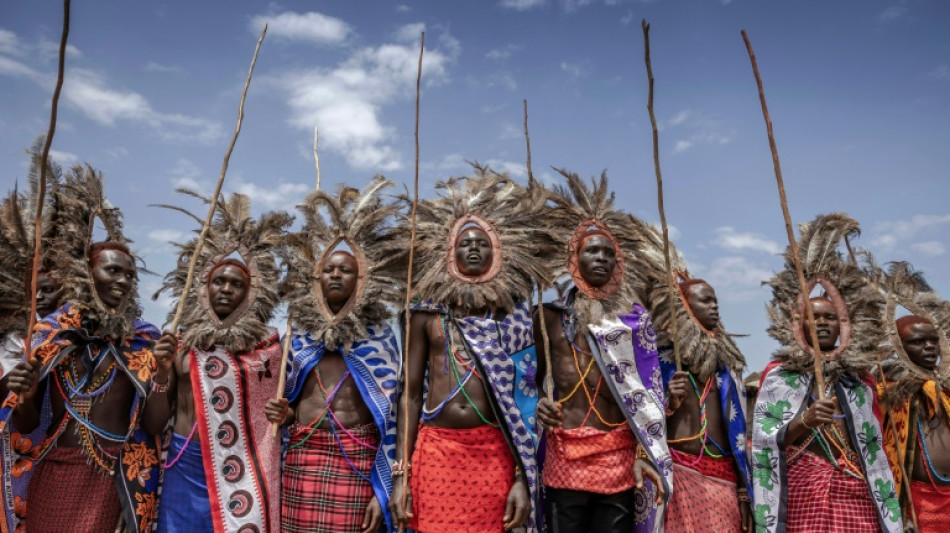
Kenya's young Maasai reconnect with their culture at Eunoto ceremony / Photo: Luis Tato - AFP
With beaming smiles, their hair dyed a red ochre and adorned with a ceremonial headdress of ostrich feathers, the young Maasai men are busy taking selfies.
They have just completed the first day of Eunoto, a traditional ritual marking the transition from young warrior to adulthood.
"Today we are becoming men," 22-year-old medical student Hillary Odupoy says proudly, wearing sunglasses and a string of pearls across his bare chest.
Aged between 18 and 26, the young men came in their hundreds to the village of Nailare in southwestern Kenya, all from the same generation of "morans" ("warriors" in the Maasai language), a status they have held for a decade.
Many left their homes in the region to work or study in the cities of Kisii or Nairobi, or like Odupoy, further afield in the town of Machakos that lies more than seven hours away by road.
"It is one of the biggest ceremonies we have in our life. We can never meet in such multitude. It unites the Maasai community," explains Odupoy.
All wear red, the sacred colour of the Maasai -- from their hair which is coated in a mixture of ochre and oil to their traditional plaid cloth shukas.
This rite of passage brings together the families of the morans as well as local inhabitants and officials, in all several thousand people.
For five days, the Eunoto ceremony features traditional guttural chants, single-file dances on one leg, and the adumu -- the famous Maasai jump.
Cows are sacrificed and their blood drunk by the young men, whose hair is shaved from their heads by their mothers.
They then abandon the warrior's sword for the fimbo, the walking stick of the "elders".
- Abandoned rituals -
For centuries, Maasai men have gone through three rites of passage which have been inscribed since 2018 on the UNESCO list of intangible heritage in need of urgent safeguarding.
Enkipaata is the transition from boyhood to moran status, Eunoto, the passage to "young elder", and finally Olng'esherr marks the start of eldership status.
But such traditions of the Maasai, originally semi-nomadic herders living in southwestern Kenya and northern Tanzania, have had to adapt to the changes and demands of modern life.
The morans no longer spend two years in an isolated village, called "emanyatta", but meet there during school holidays to learn Maasai history and traditions, as well as the rules of life in society.
"Apart from having the Western education, traditional education also matters," says agriculture student Peter Ledama Ntuntai, 24.
"Our culture teaches us good behaviour."
Olerina Karia is one of the elders teaching these life lessons to the young Maasai.
"We teach them to be responsible citizens and members of society," says 52-year-old Karia.
"But all the traditions that were not the best for the survival of our community, such as killing a lion or the circumcision of girls, we teach them to get rid of them, especially if they collide with the law."
The killing of lions was to prove the bravery of the Maasai men, but has been illegal in Kenya for decades to protect the threatened animal.
The decline of the lion population was also threatening tourism, a precious source of income in the southwestern region of Kenya which is notably home to the emblematic Maasai Mara wildlife park.
- 'Dynamics of society have changed' -
In theory, young Maasai men can only marry after Eunoto, and their bride must have been circumcised.
But female circumcision, or female genital mutilation (FGM) has been banned in Kenya since 2011 and is officially no longer practised or recommended.
"You can be a Maasai without killing a lion and without going through FGM," says Hillary Odupoy.
Nowadays, some morans do not wait for Eunoto to marry.
"The dynamics of society have changed. When they go to school, sometimes they meet their fiancées there, they marry," says Olerina Karia.
"We adapt, we adjust."
For many, it is a matter of survival to preserve the traditions and culture of the most famous of Kenya's 45 tribes.
The Maasai are the 10th largest tribal grouping in Kenya with a population of less than 1.2 million, according to the last census in 2019.
"It is our greatest fear that in the near future we may not be able to practise this culture," says Olerina Karia.
"Other communities and other people are commercialising it, while the real owners who know how to practise it are not in the limelight."
O.Pereira--NZN