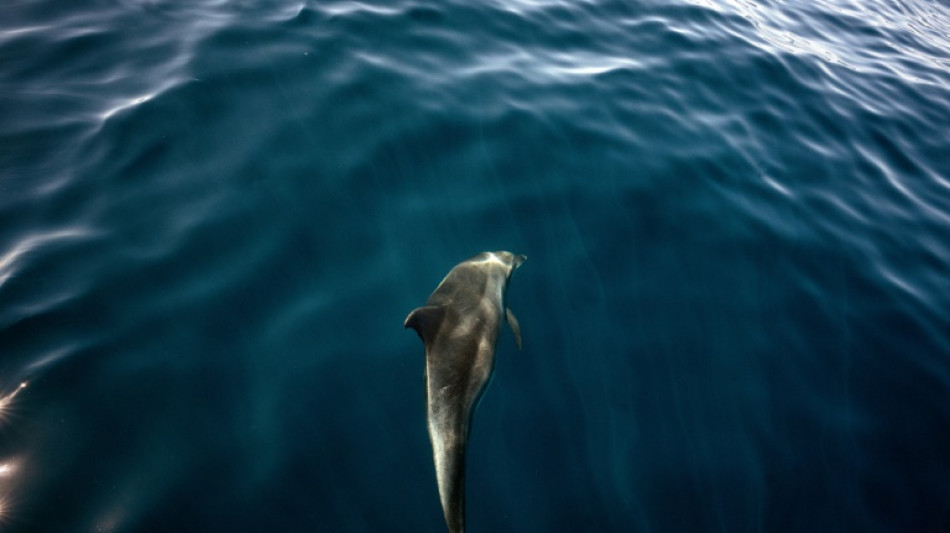
Scientists warn entire branches of the 'Tree of Life' are going extinct / Photo: Carl DE SOUZA - AFP
Humans are driving the loss of entire branches of the "Tree of Life," according to a new study published on Monday which warns of the threat of a sixth mass extinction.
"The extinction crisis is as bad as the climate change crisis. It is not recognized," said Gerardo Ceballos, professor at the National Autonomous University of Mexico, and co-author of the study published in Proceedings of the National Academy of Sciences (PNAS).
"What is at stake is the future of mankind," he told AFP.
The study is unique because instead of merely examining the loss of a species, it examines the extinction of entire genera.
In the classification of living beings, the genus lies between the rank of species and that of family. For example, dogs are a species belonging to the genus canis -- itself in the canid family.
"It is a really significant contribution, I think the first time anyone has attempted to assess modern extinction rates at a level above the species," Robert Cowie, a biologist at the University of Hawaii who was not involved in the study, told AFP.
"As such it really demonstrates the loss of entire branches of the Tree of Life," a representation of living things first developed by Charles Darwin.
The study shows that "we aren't just trimming terminal twigs, but rather are taking a chainsaw to get rid of big branches," agreed Anthony Barnosky, professor emeritus at the University of California, Berkeley.
- 73 extinct genera -
The researchers relied largely on species listed as extinct by the International Union for Conservation of Nature (IUCN). They focused on vertebrate species (excluding fish), for which more data are available.
Of some 5,400 genera (comprising 34,600 species), they concluded that 73 had become extinct in the last 500 years -- most of them in the last two centuries.
The researchers then compared this with the extinction rate estimated from the fossil record over the very long term.
"Based on the extinction rate in the previous million years we would have expected to lose two genera. But we lost 73," explained Ceballos.
That should have taken 18,000 years, not 500, the study estimated -- though such estimates remain uncertain, as not all species are known and the fossil record remains incomplete.
The cause? Human activities, such as the destruction of habitats for crops or infrastructure, as well as overfishing, hunting and so on.
The loss of one genus can have consequences for an entire ecosystem, argued Ceballos.
"If you take one brick, the wall won't collapse, he said. "You take many more, eventually the wall will collapse.
"Our worry is that ... we're losing things so fast, that for us it signals the collapse of civilization."
- 'Still time' to act -
All experts agree that the current rate of extinction is alarming -- but whether this represents the start of a sixth mass extinction (the last being the asteroid that wiped out the dinosaurs 66 million years ago) remains a matter of debate.
Scientists broadly define a mass extinction as the loss of 75 percent of species over a short period of time. Using that "arbitrary" definition, Cowie said, a sixth mass extinction has not yet occurred.
But if we assume that "species will continue to go extinct at the current rate (or faster), then it will happen," he warned. "We can surely say that this is the beginning of a potential sixth mass extinction."
Ceballos warned that the window of opportunity for humans to act is "rapidly closing."
The priority is to halt the destruction of natural habitats, and to restore those that have been lost, he said.
"But there is still time to save many genera," he said. "There are 5,400 genera, we can save many of them if we act now."
A.Senn--NZN