Canada's wildfires take devastating toll on wildlife / Photo: Handout - Nova Scotia Government/AFP
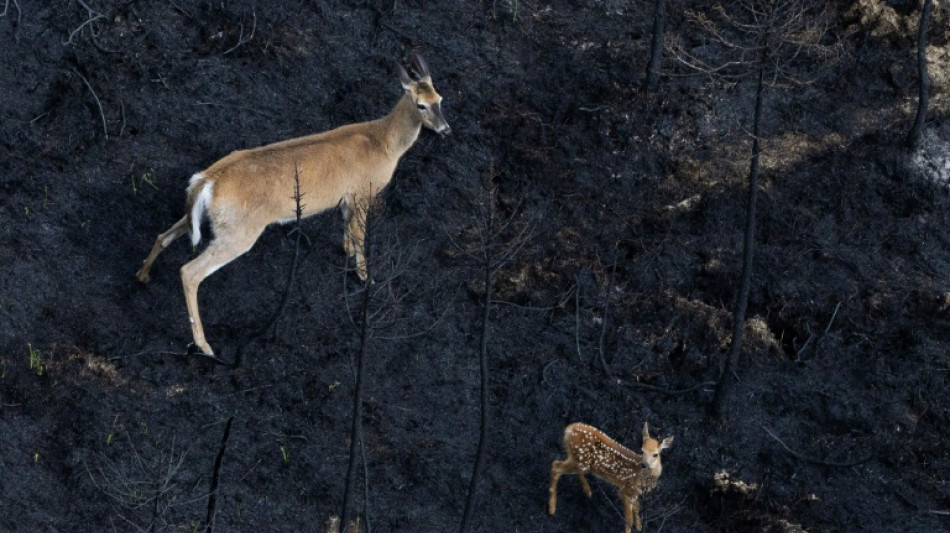
No droppings, tracks, nests or other traces of wildlife -- Canada's boreal forests were devastated by record wildfires this year.
In the woodlands of Quebec province, hunter Paul Wabanonik searches for fresh moose tracks on his Indigenous tribe's ancestral lands, which had sustained him and his family.
"Normally, we would see traces everywhere," says the Ashinabe tribesman. But "it's like a desert," he says as he leads AFP journalists along a forest trail.
People in his village, hundreds of kilometers north of Montreal, was forced to flee advancing wildfires in June.
A few green shoots are just now starting to sprout in the once-lush green forest left charred by the fires.
Heading into the fall, the foliage would normally explode with brilliant red, orange and yellow colors, but it is now all blackened.
With no forest canopy, there is nothing left to hunt in order to feed Wabanonik and his family, and there's little chance of wildlife returning any time soon, he laments.
"We don't have a precise idea of the number of animals that died, but it's hundreds of thousands," says Annie Langlois, a biologist for the Canadian Wildlife Federation.
Beavers, coyotes, skunks, wolverines, foxes, bears -- the Canadian boreal forest is home to 85 species of mammals, 130 of fish and 300 of birds, including many migratory birds.
But it has been devastated by this year's record wildfire season, with more than 18 million hectares burned -- an area close to the size of Tunisia.
- Smoke particles -
The biologist notes that certain species can quickly become trapped, because they do not have the capacity to fly or run fast enough and over long distances in the face of very intense and rapidly advancing fires.
And in certain regions, the fires struck very early in the season, therefore shortly after gestation, leaving no chance for hatchlings or sucklings to escape.
The consequences are severe also for aquatic fauna. In addition to ash that blankets lakes and rivers, soil erosion caused by the loss of vegetation alters water quality.
"Lakes with clear, clear water in the Canadian Shield will fill with algae which will suck the oxygen from the water, so there will be less for the animals," Langlois explains, referring to a large area of exposed rock.
The chemical composition of wildfire smoke particles is also different from particles from other sources of pollution, such as car emissions or industrial pollution.
It contains a greater proportion of carbon-based pollutants in various chemical forms that are sometimes deposited hundreds of kilometers from the fires.
These fumes have acute or chronic effects on the health of wildlife, says Matthew Mitchell of the University of British Columbia.
"Young animals are often more susceptible to the effects of smoke, as are humans," he adds, and "even marine animals like whales and dolphins are affected when they emerge to breathe."
In Canada, nearly 700 species are already considered threatened, largely due to habitat destruction from logging and other encroachment.
Over the longterm, wildfires constitute an additional threat to wildlife.
This is the case for caribou. This Canadian emblem which lives in old forests , feeding on lichen, is unlikely to bounce back for several years from the ravages of fires.
"If the moose is likely to do well, the caribou will do less well, given that it is in a rather precarious situation," worries Gabriel Pigeon, professor at the University of Quebec in Abitibi-Temiscamingue.
The fires could also accentuate a phenomenon already observed by researchers and linked to climate change and the upheaval of ecosystems: certain species have moved north.
Thus is the case for a lynx that Pigeon follows using a radio collar. It has taken refuge 300 kilometers (185 miles) from its territory while its home range is generally 25 square kilometers.
The return of animals to burned areas will vary from one species to another. For some, it could take years.
E.Schneyder--NZN