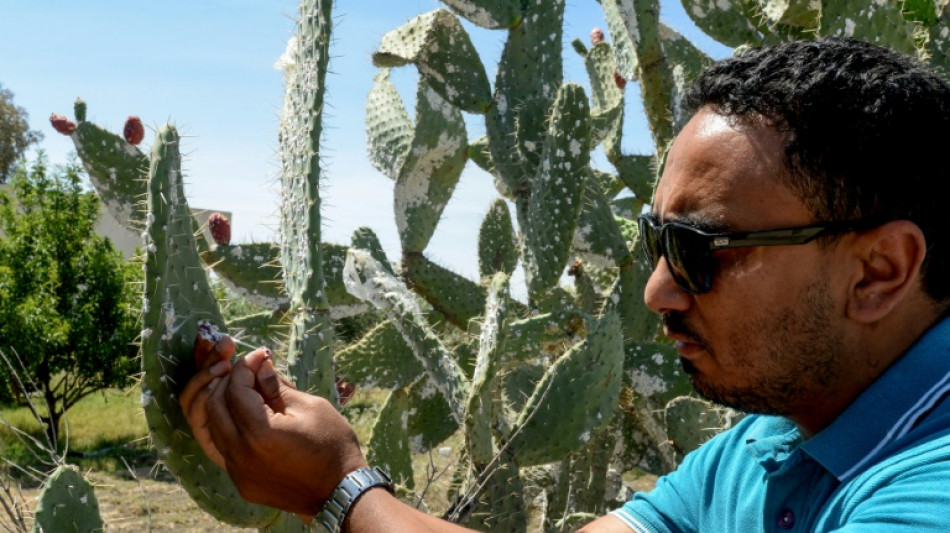
Insect infestation ravages North African prickly pear / Photo: Sofiene HAMDAOUI - AFP
Amor Nouira, a farmer in Tunisia's Chebika village, has lost hope of saving his prickly pear cacti, ravaged by the cochineal insect spreading across North Africa.
The 50-year-old has seen his half-hectare of cactus crops wither as the invasive insect wreaked havoc on about a third of the country's cacti after an outbreak in 2021.
"At first, I wanted to experiment with prickly pear production and gradually develop investments while looking for customers outside the country, especially for its natural oil," said Nouira.
"But... as the cacti became damaged, I abandoned the idea of investing and stopped thinking about it altogether."
Prickly pear is consumed as food and used to make oils, cosmetics and body-care products.
In Chebika, as in other rural areas in central Tunisia, many farmers' fields of prickly pear -- also known as Opuntia -- have been spoiled by the cochineal, which swept through North Africa 10 years ago, beginning in Morocco.
The insect, like the prickly pear, is native to the Americas and feeds on the plant's nutrients and fluids, often killing it.
The infestations have resulted in significant economic losses for thousands of farmers reliant on prickly pear, as authorities struggle to combat the epidemic in a country where its fruit is widely consumed as a summertime snack.
- Livelihood -
Tunisian authorities estimate that about 150,000 families make a living from cultivating Opuntia.
The North African country is the world's second-largest producer of its fruit, after Mexico, with about 600,000 hectares of crops and a yield of about 550,000 tonnes per year, according to the Food and Agriculture Organization (FAO).
Only production allocated for export -- about a third of overall crops -- has remained in good condition, said Rabeh Hajlaoui, head of the department of plant health at Tunisia's agriculture ministry.
"We're making every effort to save these plants, which are an important source of income to some locals," he explained, as one litre of extracted Opuntia oil can be sold for as much as $4,200.
Farmers also plant prickly pear cacti for their resistance to drought and desertification, and sometimes use them to demarcate and fence property in Tunisia and neighbouring Libya.
In Morocco, where the first cases of cochineal were found in 2014, Opuntia is cultivated over a total of 160,000 hectares.
In 2016, the Moroccan government issued an "emergency plan" to combat cochineal infestation by experimenting with various chemicals, burying infected cacti and conducting research on developing variants resilient to the insect.
Despite the plan, by August 2022, about 75 percent of Opuntia crops in Morocco had been infested, according to Mohamed Sbaghi, a professor at Rabat's National Institute of Agricultural Research (INRA) and the emergency plan coordinator.
In neighbouring Algeria, authorities recorded an outbreak in 2021 in Tlemcen, a city near the border with Morocco.
Prickly pear cultivation in the country covers around 60,000 hectares, and the fruit is so cherished that a festival dedicated to it is held every year in the eastern Kabylia region.
- 'Public safety' -
Neither the plant nor cochineal is native to North Africa, but the region's dry climate helped them spread, said Tunisian entomologist Brahim Chermiti.
"Climate change, with increasing drought and high temperatures, facilitates their reproduction," he told AFP.
The region has experienced severe drought in recent years, with declining rainfall and intense heat.
Chermiti believes it's a matter of "public safety" to combat cochineal infestation, requiring "strict border crossing monitoring and public awareness".
The researcher fears total contagion, as "sooner or later, it will spread, with the help of many factors such as the wind and livestock".
Hajlaoui, from Tunisia's agriculture ministry, said the issue could even cause social unrest if it spreads to farms in marginalised areas, such as Tunisia's Kasserine governorate, where Opuntia is nearly the only source of livelihood for many.
He said the "slowness of administrative procedure" during the first major outbreaks in Tunisia impeded efforts to stem the spread of cochineal.
At first, Morocco and Tunisia burned and uprooted infected crops, but authorities now aim for "natural resistance" to the insect, said Hajlaoui.
Last summer, Morocco's INRA said it identified eight cochineal-resistant Opuntia varieties that could potentially be cultivated.
The other solution, added the expert, is spreading the Hyperaspis trifurcata ladybird -- also native to the Americas -- among the cacti, which preys on cochineal.
In Morocco, farmers began raising the ladybird "so that it is always ready" in case of outbreaks, said Aissa Derhem, head of the environmental association Dar Si Hmad.
Last month, Tunisia received 100 ladybirds along with an emergency budget of $500,000 to battle cochineal, allocated by the FAO.
W.F.Portman--NZN