Zürcher Nachrichten - Monkey monikers: Like humans, marmosets give each other names

EUR -
AED 4.282286
AFN 72.889506
ALL 95.207603
AMD 430.01375
ANG 2.087753
AOA 1070.42764
ARS 1622.784305
AUD 1.615801
AWG 2.101792
AZN 1.980037
BAM 1.948086
BBD 2.348989
BDT 143.162498
BGN 1.947198
BHD 0.439945
BIF 3468.977203
BMD 1.166043
BND 1.484988
BOB 8.058985
BRL 5.837324
BSD 1.166277
BTN 111.748109
BWP 16.426743
BYN 3.258314
BYR 22854.438042
BZD 2.345552
CAD 1.600621
CDF 2617.765364
CHF 0.914545
CLF 0.02651
CLP 1043.367038
CNY 7.911775
CNH 7.916136
COP 4418.987218
CRC 529.980953
CUC 1.166043
CUP 30.900133
CVE 110.420738
CZK 24.310883
DJF 207.229054
DKK 7.473652
DOP 69.611585
DZD 154.439062
EGP 61.655687
ERN 17.490641
ETB 183.593618
FJD 2.556084
FKP 0.862511
GBP 0.870795
GEL 3.124803
GGP 0.862511
GHS 13.304314
GIP 0.862511
GMD 84.53284
GNF 10237.855419
GTQ 8.897767
GYD 243.990718
HKD 9.133322
HNL 31.040319
HRK 7.5352
HTG 152.719375
HUF 357.85873
IDR 20501.247154
ILS 3.384559
IMP 0.862511
INR 111.602244
IQD 1527.516012
IRR 1533346.225611
ISK 143.609809
JEP 0.862511
JMD 184.399822
JOD 0.82669
JPY 184.674396
KES 150.710561
KGS 101.97073
KHR 4678.163038
KMF 492.06927
KPW 1049.40427
KRW 1743.787798
KWD 0.359712
KYD 0.971947
KZT 552.061604
LAK 25600.468408
LBP 105018.290233
LKR 379.337915
LRD 213.677252
LSL 19.227736
LTL 3.443021
LVL 0.705327
LYD 7.380747
MAD 10.737796
MDL 20.047359
MGA 4871.140463
MKD 61.623214
MMK 2448.532445
MNT 4174.584911
MOP 9.409221
MRU 46.630148
MUR 54.687743
MVR 17.953612
MWK 2030.079949
MXN 20.097411
MYR 4.5843
MZN 74.521703
NAD 19.22769
NGN 1596.510503
NIO 42.811215
NOK 10.814812
NPR 178.792592
NZD 1.975224
OMR 0.448341
PAB 1.166257
PEN 4.019331
PGK 5.084821
PHP 71.905202
PKR 324.858355
PLN 4.243469
PYG 7106.858587
QAR 4.250809
RON 5.201602
RSD 117.404153
RUB 85.416661
RWF 1703.588468
SAR 4.323481
SBD 9.347158
SCR 15.925798
SDG 700.210747
SEK 10.964079
SGD 1.488553
SHP 0.870569
SLE 28.742478
SLL 24451.336053
SOS 666.396592
SRD 43.384983
STD 24134.730844
STN 24.778409
SVC 10.204331
SYP 128.881228
SZL 19.227966
THB 37.837714
TJS 10.898504
TMT 4.08115
TND 3.367544
TOP 2.807551
TRY 53.109051
TTD 7.918441
TWD 36.822696
TZS 3025.881057
UAH 51.26883
UGX 4361.616853
USD 1.166043
UYU 46.444895
UZS 14044.985317
VES 594.855331
VND 30719.39644
VUV 137.683599
WST 3.158251
XAF 653.355863
XAG 0.013988
XAU 0.000251
XCD 3.151288
XCG 2.101868
XDR 0.810364
XOF 650.065331
XPF 119.331742
YER 278.276306
ZAR 19.248742
ZMK 10495.787518
ZMW 21.954032
ZWL 375.465292
  • RBGPF

    -0.2100

    60.79

    -0.35%

  • CMSD

    0.0400

    23.6

    +0.17%

  • RYCEF

    -0.0700

    15.93

    -0.44%

  • CMSC

    0.0898

    23.14

    +0.39%

  • VOD

    -0.0300

    15.48

    -0.19%

  • AZN

    -2.7600

    184.96

    -1.49%

  • RIO

    -2.4500

    109.59

    -2.24%

  • BCE

    -0.2000

    24.19

    -0.83%

  • GSK

    -0.0300

    50.96

    -0.06%

  • NGG

    0.4500

    87.43

    +0.51%

  • RELX

    -0.1600

    31.46

    -0.51%

  • JRI

    0.0100

    13.14

    +0.08%

  • BTI

    1.3500

    66.7

    +2.02%

  • BCC

    2.4200

    69.4

    +3.49%

  • BP

    -0.0200

    44.12

    -0.05%

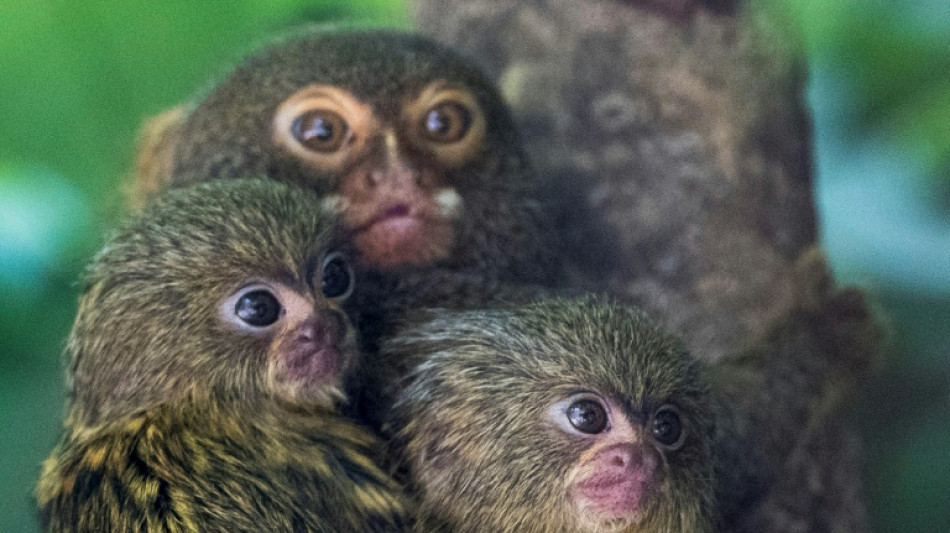
Monkey monikers: Like humans, marmosets give each other names
Monkey monikers: Like humans, marmosets give each other names / Photo: SEBASTIEN BOZON - AFP/File

Monkey monikers: Like humans, marmosets give each other names

Naming others is considered a marker of highly advanced cognition in social animals, previously observed only in humans, bottlenose dolphins and African elephants.

Text size:

Marmoset monkeys have now joined this exclusive club, according to a new study published in Science on Thursday.

The diminutive primates use loud, high-pitched calls to assign each other "vocal labels," as shown in research conducted by a team at the Hebrew University of Jerusalem.

"We are very interested in social behavior because we think that social behavior is essentially what drove us humans to be so special compared to other animals," senior author David Omer told AFP.

"We don't run fast, we don't fly, we don't excel in anything else besides being social and all our achievements as a society are our societal achievements."

Marmosets are ideal subjects to study the evolution of social behavior and language in humans, he explained, because they exhibit similar traits, living in small monogamous family groups of six to eight individuals that cooperatively rear their young.

Led by graduate student Guy Oren, the researchers recorded natural conversations between pairs of marmosets separated by a visual barrier, as well as interactions between the monkeys and a computer system that played back pre-recorded calls.

They discovered that marmosets use "phee calls" -- very high-pitched vocalizations, as loud as power tools -- to address one another. Notably, the monkeys could recognize when such calls were directed at them and were more likely to respond when addressed by their name.

- Machine learning advances -

The ten marmosets they tested came from three separate families, and the research also revealed that members within a family group used similar sound features to code different names, akin to dialects or accents in humans. This held true even for adult marmosets that weren't related by blood, suggesting they learned from others within the family group.

Marmosets are relatively distant relatives of humans. We last shared a common ancestor around 35 million years ago, while the split between ourselves and chimpanzees could have happened 5-7 million years ago.

Rather than genetic proximity, Omer attributes the acquisition of vocal labels by marmosets to "convergent evolution," or the idea that they evolved similar traits in response to comparable environmental challenges.

For marmosets, vocal labeling may have been crucial for maintaining social bonds and group cohesion in the dense rainforests of South America, where visibility is often limited.

How and when humans first began talking is a matter of debate, but until recently many scientists had dismissed the idea we could look to other primates for clues. Omer stressed the latest research was yet another blow to that long-standing opinion.

"We can still learn a lot from non-human primates about the evolution of language in humans," he said.

The team's statistical analysis of the marmosets' calls was made possible by recent advancements in computational power and machine learning, he added. Looking ahead, one exciting avenue for future research could be leveraging AI to further decipher the content of marmoset conversations.

E.Schneyder--NZN