Zürcher Nachrichten - Critically endangered whale species rebounds slightly

EUR -
AED 4.234559
AFN 72.641835
ALL 96.248565
AMD 434.904915
ANG 2.064044
AOA 1057.340806
ARS 1585.415706
AUD 1.673188
AWG 2.078361
AZN 1.957338
BAM 1.959852
BBD 2.322602
BDT 141.493133
BGN 1.970908
BHD 0.434666
BIF 3425.437109
BMD 1.153044
BND 1.48497
BOB 7.997534
BRL 6.036994
BSD 1.153179
BTN 109.301864
BWP 15.898074
BYN 3.432596
BYR 22599.658021
BZD 2.319164
CAD 1.59854
CDF 2635.280598
CHF 0.919074
CLF 0.027048
CLP 1067.995456
CNY 7.969204
CNH 7.979305
COP 4248.931725
CRC 535.504768
CUC 1.153044
CUP 30.55566
CVE 110.493432
CZK 24.511117
DJF 205.349878
DKK 7.472427
DOP 68.642207
DZD 153.427511
EGP 60.873218
ERN 17.295657
ETB 178.265943
FJD 2.602881
FKP 0.863702
GBP 0.865999
GEL 3.107433
GGP 0.863702
GHS 12.635122
GIP 0.863702
GMD 84.750785
GNF 10110.771248
GTQ 8.825283
GYD 241.395336
HKD 9.032858
HNL 30.617431
HRK 7.534216
HTG 151.163167
HUF 388.806939
IDR 19579.029239
ILS 3.631631
IMP 0.863702
INR 109.355882
IQD 1510.629592
IRR 1514292.392246
ISK 143.611654
JEP 0.863702
JMD 181.515261
JOD 0.817548
JPY 184.375734
KES 149.895922
KGS 100.833793
KHR 4618.548282
KMF 492.350276
KPW 1037.841215
KRW 1740.831224
KWD 0.354837
KYD 0.960999
KZT 557.48528
LAK 25080.524635
LBP 103264.286246
LKR 363.252555
LRD 211.60021
LSL 19.801824
LTL 3.404639
LVL 0.697464
LYD 7.361218
MAD 10.777782
MDL 20.255139
MGA 4805.873033
MKD 61.643865
MMK 2424.318926
MNT 4127.884218
MOP 9.304497
MRU 46.043389
MUR 53.927637
MVR 17.825829
MWK 1999.585924
MXN 20.794199
MYR 4.627166
MZN 73.691653
NAD 19.801824
NGN 1594.716963
NIO 42.437919
NOK 11.194637
NPR 174.878782
NZD 2.001828
OMR 0.443344
PAB 1.153169
PEN 4.017022
PGK 4.983302
PHP 69.751094
PKR 321.84457
PLN 4.283362
PYG 7539.587172
QAR 4.204392
RON 5.098416
RSD 117.407553
RUB 93.914995
RWF 1684.003378
SAR 4.326795
SBD 9.272749
SCR 16.106748
SDG 692.979097
SEK 10.87695
SGD 1.483956
SHP 0.865081
SLE 28.307763
SLL 24178.763955
SOS 659.059667
SRD 43.355598
STD 23865.678189
STN 24.550649
SVC 10.08986
SYP 127.441644
SZL 19.80002
THB 37.800276
TJS 11.018566
TMT 4.047184
TND 3.399829
TOP 2.776252
TRY 51.264903
TTD 7.835164
TWD 36.864537
TZS 2970.802359
UAH 50.546198
UGX 4295.881207
USD 1.153044
UYU 46.676498
UZS 14063.07368
VES 537.339322
VND 30368.290466
VUV 138.027623
WST 3.176444
XAF 657.31592
XAG 0.016391
XAU 0.000256
XCD 3.116158
XCG 2.078306
XDR 0.814962
XOF 657.31592
XPF 119.331742
YER 275.17389
ZAR 19.68986
ZMK 10378.76945
ZMW 21.707878
ZWL 371.279626
  • RYCEF

    -0.5800

    14.72

    -3.94%

  • AZN

    6.6850

    190.085

    +3.52%

  • RBGPF

    -13.5000

    69

    -19.57%

  • RELX

    0.0200

    32.09

    +0.06%

  • GSK

    0.3350

    54.275

    +0.62%

  • NGG

    -0.0400

    82.36

    -0.05%

  • BTI

    0.5049

    57.93

    +0.87%

  • RIO

    1.0050

    86.795

    +1.16%

  • CMSC

    -0.0700

    22.75

    -0.31%

  • VOD

    -0.0500

    14.58

    -0.34%

  • BCE

    -0.2850

    25.185

    -1.13%

  • JRI

    -0.0900

    11.98

    -0.75%

  • BP

    0.1500

    46.32

    +0.32%

  • BCC

    0.9200

    75.21

    +1.22%

  • CMSD

    -0.1000

    22.65

    -0.44%

Critically endangered whale species rebounds slightly
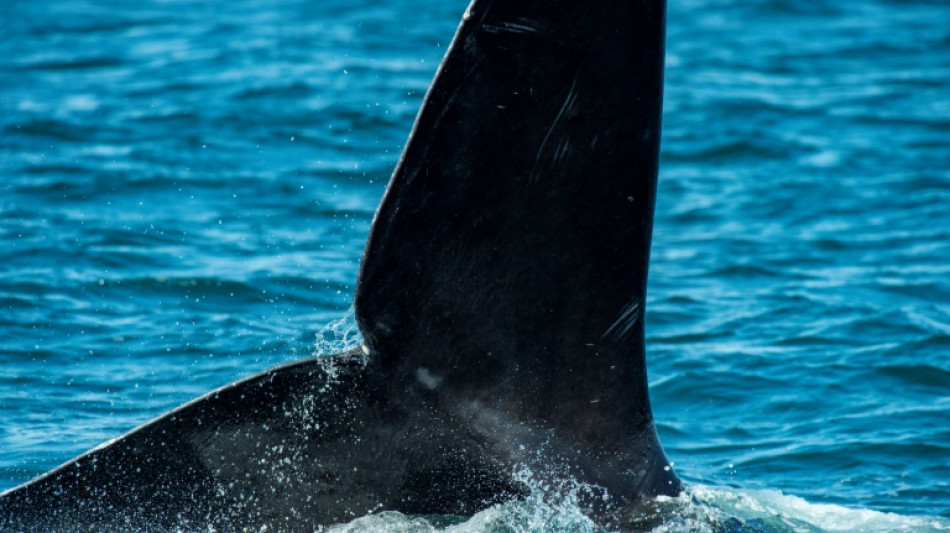
Critically endangered whale species rebounds slightly / Photo: Joseph Prezioso - AFP/File

Critically endangered whale species rebounds slightly

One of the world's rarest whale species has seen a slight population rebound, according to data released Tuesday, though experts warn it remains at serious risk of extinction.

Text size:

The number of North Atlantic right whales rose to 373 in 2023, up four percent from a recent low of 358 individuals in 2020, according to the latest estimates by scientists at the New England Aquarium and the National Oceanic and Atmospheric Administration (NOAA).

But the stabilization in numbers shouldn't be mistaken for a turning point, said conservationists, because the most serious threats to the marine giants, strikes by speeding vessels and entanglements in fishing gear, remain largely unaddressed.

Climate change is further exacerbating the situation by altering the distribution of zooplankton, the whales' primary food source.

"While we are happy to see that the population estimate has not decreased, we remain gravely concerned," said Kathleen Collins, senior marine campaign manager with the International Fund for Animal Welfare.

Approaching 60 feet (18 meters) in length and with lifespans similar to humans, North Atlantic right whales are thought to have once numbered up to 20,000 before commercial whaling decimated their population.

They were considered the "right whale" to hunt by whalers who sought their blubber for oil and their baleen plates (which the whales use to filter their food) for making a strong, flexible material in the pre-plastic era.

Whaling was eventually banned in 1935, leading to a recovery and a peak of 483 individuals by 2010, before a decade-long decline began.

In the fall of 2022, NOAA proposed rule changes to broaden the boundaries and timing of seasonal speed restrictions along the East Coast, and expand mandatory speed restrictions of 10 knots or less for vessels over 65 feet to those over 35 feet.

But two years on, these changes, strongly opposed by the boating and fishing industries, are still under review.

"The US government is too busy dealing in partisan politics rather than saving this species while we still have a fighting chance," said Collins.

The other main threat to the whales comes from entanglements with fishing gear -- which weigh whales down and prevent them from moving freely, feeding and breeding, or cut into their blubber and bones, killing them slowly from infection.

Recent years have seen progress in "on demand" fishing gear -- traps that catch lobster and crab on the seafloor without long buoy lines. Some use coiled ropes that rise to the surface only when triggered by fishermen, while others rely on inflatable bags.

These technologies however remain in their infancy and aren't yet widely deployed.

Despite the slight rise, scientists said too many right whales are still dying from human activity, including so far this year five documented mortalities and four lost calves that scientists presume are dead.

W.Odermatt--NZN