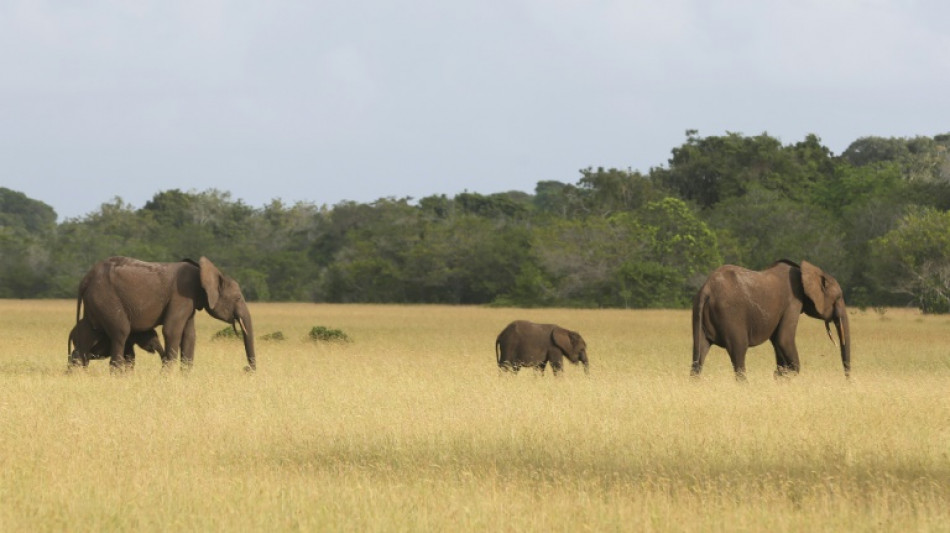
Time to put monetary value on conservation, says Gabon / Photo: Steeve JORDAN - AFP
A key UN summit this year must give biodiversity the same priority as climate change and press ahead with putting a financial value on natural resources, Gabon's environment minister says.
British-born Lee White, an ecologist who has helped make Gabon a powerful voice for the environment in central Africa, said Earth's climate and biodiversity crises went hand in hand.
COP15 -- an eagerly awaited conservation conference due to take place in Kunming, China, in the last quarter of 2022 -- must give biodiversity "the same level of priority as climate change", White said in an interview with AFP.
"We're looking at much higher ambition for conservation," he said.
"One of our priorities is the 30 by 30 target -- 30 percent protected areas across the planet by 2030 -- and moving the agenda forward on biodiversity credits, biodiversity financing."
Carbon credits, which have been around for more than two decades, offer financial incentives to reduce or avoid emissions of greenhouse gases.
Biodiversity credits would offer similar incentives to nurture conservation hotspots, which scientists say play a hugely under-estimated role in human survival.
"The Congo Basin stabilises Africa, it's the heart and lungs of Africa," said White, the author of dozens of research papers.
"Without the Congo Basin... we lose the rainfall in the Sahel, and you have hundreds of millions of climate refugees moving south," he said.
"We should be able to calculate that cost and then attribute it to the biodiversity services that the Congo Basin is providing. But today, biodiversity is worth zero."
Born in Manchester in northern England, White, 56, began his career in the African rain forests before he managed the activities of the Wildlife Conservation Society in Gabon for 15 years and in 2002 became an advisor to President Omar Bongo Ondimba for national parks and eco-tourism. In 2009, he was appointed minister for water, forests, the sea and environment.
- Gabon success -
White pointed to Gabon's own record in sequestering carbon by preserving its lush tropical forests.
In 2002, Gabon set up a network of 13 national parks covering 11 percent of its territory. Today, 22 percent of the land is protected.
In 2017, the country created 20 marine sanctuaries covering 53,000 square kilometres (20,500 square miles) -- the biggest ocean haven in Africa, and equivalent to 27 percent of its territorial waters.
"Since the Earth summit in Rio we have absorbed three billion tonnes of CO2," said White.
"I think if we find ways to give a value to all of that progress, if we find a way to find a value to our net sequestration of carbon, then other countries will maybe take a look at the Gabon example and potentially do something similar themselves."
Habitat conservation has helped Gabon's population of forest elephants grow from 60,000 to 95,000 animals, while across Africa numbers of this species have fallen by three-quarters.
This success story has a downside in conflict between elephants and humans, in which climate change also plays a part, said White.
- Hungry elephants -
Research at one of the forest sites, he said, has found that over 40 years, temperatures have risen by one degree Celsius (1.8 degrees Fahrenheit) and annual rainfall has fallen by 200 millimetres (7.9 inches), leading to a crash of 80 percent in rainforest fruits, which are a key part of the elephants' diet.
"The elephants are hungry -- we've actually proved scientifically that they are thinner," said White.
"So they are coming out of the forest as well because of climate change to eat people's fields, looking for food."
White said he had much sympathy for poor farmers who were exasperated by elephants which ate or trampled on their crops.
"The world loves elephants," he said.
"I would bet there are more elephants in Paris or London than there are in the whole of Africa. But those elephants are cuddly elephants -- they're toy elephants in children's bedrooms.
"Because for the West, the elephant is this wonderful lovely cuddly thing, and for rural African children, an elephant is a big scary thing that might have just killed their father or destroyed the food that they were going to eat in the next few months."
White said it was essential to resolve poaching in remote areas so that elephants could move away from areas inhabited by humans and back into their old habitat.
"We (also) have to protect rural people's crops, ideally using electric fences and other methods, rather than killing the elephants," he said.
"But we absolutely have to protect rural people's livelihoods and safety and quality of life."
This year, for the first time, the government has provided funds to help ease the elephant-human conflict, he said.
The equivalent of $5 million has been included in the 2022 budget for compensation for farmers whose crops have been damaged by tuskers.
A.Wyss--NZN