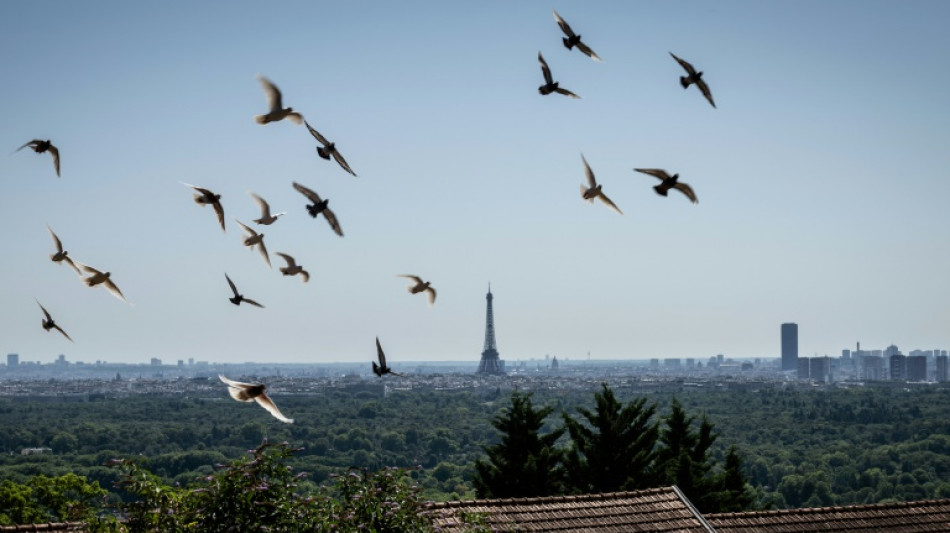
France's military pigeons race in memory of brave predecessors / Photo: BERTRAND GUAY - AFP
These days, French military pigeon number 193-529 is no longer needed to carry tiny messages during war-time communication blackouts.
But the racing bird serves as a reminder of the brave service of its predecessors in World Wars I and II, and the 1870 siege of Paris.
Inside Europe's last military pigeon loft, Sergeant Sylvain cradled 193-529, an alert feathered athlete with an iridescent green neck.
"He's a carrier pigeon, like the ones who served in World Wars I and II," said Sylvain, withholding his surname for security purposes.
"But today he races," added the member of the armed forces, whose grandfather was also a pigeon fancier.
In Mont Valerien outside Paris, Sylvain flits between dovecotes, tending to some 200 pigeons -- cleaning their shelters and making sure they have enough to eat.
These days, they only use their navigating skills when they are released during competitions, military ceremonies, or demonstrations for visitors, he said.
Humans have been using homing pigeons since Antiquity, but the French military started using them as a communication tool during the Franco-Prussian war of 1870 after the Prussians besieged Paris.
In October that year, the interior minister boarded a hot-air balloon to flee the French capital.
Around a month later, the French military had elaborated a messenger pigeon plan to communicate with people still in the city, according to a French government account.
- 'Pigeongrams' -
Patriotic Parisians donated more than 300 pigeons to the war effort, which were loaded into the wicker baskets of hot-air balloons and transported southwards to the city of Tours.
Upon arrival they were fitted with small tubes containing 3 to 4 cm (1 to 1.5 inch) of microfilm on which minute messages had been inscribed, called "pigeongrams".
They were then released as close to the capital as possible so they could carry them back inside.
Only around 50 pigeons made it.
Parisians who found the pigeons then placed the microfilm between sheets of glass and, using a magic lantern -- an early type of image projector, projected it onto a large screen to read it.
They transcribed the contents and delivered the message to its intended recipient.
During the two world wars, pigeons were used again when "modern means of communication reached their limits", such as "bombardments ripping down telephone lines", Sylvain said.
During World War II, a French pigeon helped alert Allies that six German U-boats were undergoing maintenance in the French port of Bordeaux, leading to aerial raids that destroyed four of them, Sylvain said.
The pigeon, nicknamed "Maquisard" like some members of the French Resistance, received an award.
- Old training manuals -
A British pigeon too made headlines.
Gustav, a homing pigeon in the British Royal Air Force, travelled 240 km (150 miles) back across the Channel to break the first news of the D-Day landings in June 1944, according to the Imperial War Museum.
He carried a message from a war correspondent, and was also awarded a medal.
The French military last relied on homing pigeons during the war in Algeria from 1954 to 1962 that led to the North African country's independence from France.
In 1961, the French armed forces ended the messenger pigeon programme.
Sylvain said the military continued to train the birds for a while, fearing an electromagnetic attack would bring down communications.
But today there is no longer such a risk, he said, with the military having set up specialised shields to protect its communications from any such attack.
Should the need for messenger pigeons however return, Sylvain says he is ready.
"I have all the training manuals from World War I right up to 1961," he said.
"It worked a century ago, so I don't see why it wouldn't again today."
T.L.Marti--NZN