Zürcher Nachrichten - Japan to sell eels bred in captivity in 'world first'

EUR -
AED 4.198679
AFN 74.313256
ALL 93.745492
AMD 418.131278
ANG 2.046923
AOA 1049.526636
ARS 1700.615415
AUD 1.646493
AWG 2.060754
AZN 1.949601
BAM 1.954672
BBD 2.299463
BDT 140.708801
BGN 1.933142
BHD 0.430734
BIF 3401.651878
BMD 1.143275
BND 1.477061
BOB 7.915847
BRL 5.848542
BSD 1.141736
BTN 108.840051
BWP 15.503985
BYN 3.263088
BYR 22408.194855
BZD 2.296065
CAD 1.619752
CDF 2579.228584
CHF 0.921937
CLF 0.026937
CLP 1060.159601
CNY 7.766097
CNH 7.752995
COP 3775.792266
CRC 519.379837
CUC 1.143275
CUP 30.296794
CVE 110.194181
CZK 24.264069
DJF 203.301791
DKK 7.475128
DOP 67.12862
DZD 152.212379
EGP 56.717541
ERN 17.149129
ETB 184.265713
FJD 2.553166
FKP 0.852757
GBP 0.852352
GEL 3.01825
GGP 0.852757
GHS 13.042618
GIP 0.852757
GMD 83.459102
GNF 10013.177883
GTQ 8.710402
GYD 238.81532
HKD 8.962758
HNL 30.564159
HRK 7.531669
HTG 149.415084
HUF 356.698433
IDR 20648.694249
ILS 3.436971
IMP 0.852757
INR 109.076803
IQD 1495.63691
IRR 1572003.465875
ISK 143.400941
JEP 0.852757
JMD 181.588063
JOD 0.810597
JPY 184.827019
KES 147.768604
KGS 99.977134
KHR 4609.380372
KMF 492.751736
KPW 1028.948123
KRW 1721.304015
KWD 0.353912
KYD 0.951438
KZT 533.725
LAK 25757.910529
LBP 102236.407978
LKR 382.884025
LRD 207.19684
LSL 18.732526
LTL 3.375795
LVL 0.691556
LYD 7.303753
MAD 10.675879
MDL 20.053252
MGA 4882.161289
MKD 61.64717
MMK 2400.087297
MNT 4099.43777
MOP 9.215182
MRU 45.573907
MUR 53.824975
MVR 17.67499
MWK 1979.579722
MXN 20.041067
MYR 4.652099
MZN 73.066916
NAD 18.732444
NGN 1572.712008
NIO 42.016121
NOK 11.157793
NPR 174.148649
NZD 1.982354
OMR 0.439579
PAB 1.141656
PEN 3.883672
PGK 5.020905
PHP 70.410873
PKR 317.356774
PLN 4.345635
PYG 6944.961883
QAR 4.161725
RON 5.235172
RSD 117.361744
RUB 87.605385
RWF 1678.765154
SAR 4.293776
SBD 9.220561
SCR 16.633912
SDG 686.540654
SEK 11.039975
SGD 1.475963
SHP 0.85357
SLE 27.838612
SLL 23973.914497
SOS 652.397841
SRD 42.988243
STD 23663.489364
STN 24.48587
SVC 9.989148
SYP 126.368611
SZL 18.726112
THB 38.104792
TJS 10.554117
TMT 4.012896
TND 3.374331
TOP 2.752733
TRY 53.716822
TTD 7.747428
TWD 36.76636
TZS 3006.811621
UAH 50.818952
UGX 4207.627101
USD 1.143275
UYU 45.900501
UZS 13711.087714
VES 799.549086
VND 30024.122918
VUV 137.693058
WST 3.166081
XAF 655.552896
XAG 0.0192
XAU 0.000279
XCD 3.089758
XCG 2.057595
XDR 0.815326
XOF 655.575818
XPF 119.331742
YER 271.071335
ZAR 18.651967
ZMK 10290.83601
ZMW 20.578135
ZWL 368.134163
  • RBGPF

    -0.8600

    67

    -1.28%

  • CMSC

    0.0100

    22.02

    +0.05%

  • CMSD

    -0.0400

    22.31

    -0.18%

  • BCC

    0.9500

    72.24

    +1.32%

  • JRI

    0.0300

    13.03

    +0.23%

  • RIO

    0.6900

    89.49

    +0.77%

  • NGG

    -1.2100

    82.32

    -1.47%

  • BCE

    -0.1300

    21.32

    -0.61%

  • RELX

    0.0200

    32.07

    +0.06%

  • RYCEF

    0.4600

    19.08

    +2.41%

  • VOD

    -0.0100

    13.08

    -0.08%

  • GSK

    -0.0500

    52.47

    -0.1%

  • BP

    -0.6600

    38.55

    -1.71%

  • AZN

    -10.7900

    178.49

    -6.05%

  • BTI

    -0.5200

    60.87

    -0.85%

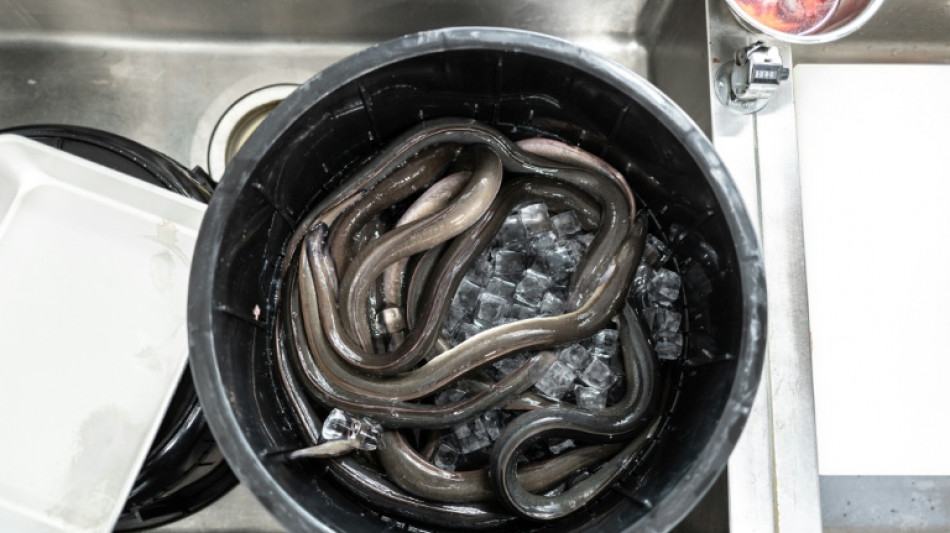
Japan to sell eels bred in captivity in 'world first'
Japan to sell eels bred in captivity in 'world first' / Photo: Philip FONG - AFP/File

Japan to sell eels bred in captivity in 'world first'

Eels bred in captivity will be sold in Japanese shops for the first time, in a move that could ease eventually pressure on the endangered fish, officials said Wednesday.

Text size:

Eel populations are falling worldwide, scientists say, largely due to factors linked to human activity such as the pollution of waterways, destruction of wetlands, hydroelectric dams, and fishing.

Eel is an enormously popular food in Japan and other parts of Asia.

The fish has proved stubbornly unwilling to reproduce in captivity without intervention, but Japanese researchers succeeded in breeding Japanese eels from eggs in a laboratory setting in 2010 at great expense.

Since then, they have been trying to reduce the "huge cost... so that the price could be accepted in the market," Yasutaka Okamoto, a fisheries agency official in charge of aquaculture promotion, told AFP.

"With countless small technological breakthroughs, the cost is now some 1,800 yen ($11) per one baby eel, down from more than a million yen at the initial stages, and down from some 40,000 yen in 2016," he said.

The price is still three to four times higher than a wild baby eel, "but we think it's time to test market reactions," he explained.

The project brought together government researchers, universities and the private sector.

Eel is eaten worldwide but is particularly popular in Japan, where it is called "unagi" and traditionally served grilled and covered in a sticky-sweet sauce.

"If the (Japanese) people didn't love eels so much, we wouldn't go to such lengths to research how to farm them," Okamoto said.

Grilled "kabayaki" using fully farmed eel will be sold from May 29 at a department store in Tokyo and several other outlets including online shops in Japan.

Yamada Suisan, the eel farming company selling the fish, said it was a world-first, and a "very significant step toward the future commercialisation of fully farmed eel."

Two kabayaki eels will be sold at around 9,000 yen ($57), a price that is broadly comparable to high-end produce.

Last year, a key global forum that regulates trade in threatened wildlife rejected an EU-led proposal to protect more species of eel.

The protections were fiercely opposed by top consumers of the fish, led by Japan.

The Japanese eel, along with the American variety, is listed as endangered by the International Union for Conservation of Nature.

The European eel is considered critically endangered.

L.Rossi--NZN