Zürcher Nachrichten - Cyclone hits Australia bringing 'record-breaking' wind speeds

EUR -
AED 4.180655
AFN 71.717881
ALL 91.589819
AMD 414.665361
ANG 2.038095
AOA 1045.02191
ARS 1725.834019
AUD 1.618368
AWG 2.049063
AZN 1.924187
BAM 1.957164
BBD 2.300782
BDT 140.457905
BGN 1.916376
BHD 0.43067
BIF 3432.757073
BMD 1.138368
BND 1.45966
BOB 13.623137
BRL 5.882179
BSD 1.142346
BTN 109.310953
BWP 15.534146
BYN 3.458935
BYR 22312.022383
BZD 2.29748
CAD 1.60523
CDF 2629.63073
CHF 0.938242
CLF 0.027773
CLP 1096.624192
CNY 7.639989
CNH 7.644423
COP 3743.866286
CRC 518.324868
CUC 1.138368
CUP 30.166765
CVE 110.335608
CZK 24.422487
DJF 203.422859
DKK 7.475865
DOP 67.954382
DZD 152.467342
EGP 58.539687
ERN 17.075527
ETB 186.592948
FJD 2.5508
FKP 0.854378
GBP 0.859639
GEL 2.976821
GGP 0.854378
GHS 13.233643
GIP 0.854378
GMD 84.239631
GNF 10046.56159
GTQ 8.71958
GYD 239.000294
HKD 8.927837
HNL 30.661891
HRK 7.534066
HTG 149.317359
HUF 365.41913
IDR 20377.93432
ILS 3.45373
IMP 0.854378
INR 109.105221
IQD 1496.543151
IRR 1564772.865519
ISK 138.00435
JEP 0.854378
JMD 179.986762
JOD 0.807067
JPY 179.769995
KES 147.430575
KGS 99.550101
KHR 4633.046275
KMF 492.913204
KPW 1024.532002
KRW 1561.568694
KWD 0.351972
KYD 0.952005
KZT 507.972842
LAK 25597.280192
LBP 101925.976202
LKR 375.830509
LRD 197.056104
LSL 18.63508
LTL 3.361306
LVL 0.688588
LYD 7.292763
MAD 10.935334
MDL 20.21965
MGA 5019.278181
MKD 61.567915
MMK 2390.092712
MNT 4095.762808
MOP 9.229233
MRU 45.738667
MUR 54.504917
MVR 17.587282
MWK 1980.793692
MXN 19.959129
MYR 4.646026
MZN 72.753363
NAD 18.634671
NGN 1508.861927
NIO 42.03764
NOK 10.806703
NPR 174.899462
NZD 2.005845
OMR 0.437698
PAB 1.142396
PEN 3.856688
PGK 5.089279
PHP 71.410212
PKR 316.572659
PLN 4.377527
PYG 6770.421884
QAR 4.164565
RON 5.274517
RSD 117.464813
RUB 96.53154
RWF 1686.093812
SAR 4.280343
SBD 9.107531
SCR 15.748274
SDG 684.725529
SEK 11.288288
SGD 1.456845
SHP 0.85947
SLE 28.060707
SLL 23871.008786
SOS 652.823503
SRD 43.055943
STD 23561.929364
STN 24.515796
SVC 9.995353
SYP 14801.067382
SZL 18.630168
THB 38.009826
TJS 10.572266
TMT 3.995673
TND 3.374259
TOP 2.740918
TRY 55.614418
TTD 7.764071
TWD 36.237665
TZS 3016.674244
UAH 51.273588
UGX 4443.98052
USD 1.138368
UYU 45.789705
UZS 13480.396382
VES 970.381102
VND 29584.489474
VUV 134.724064
WST 3.13339
XAF 655.957
XAG 0.017762
XAU 0.000266
XCD 3.076498
XCG 2.058835
XDR 0.804886
XOF 655.957
XPF 119.331742
YER 269.395117
ZAR 18.63125
ZMK 10246.679142
ZMW 22.247335
ZWL 366.554189
SSP 6503.033018
MXV 2.262092
  • RELX

    0.2400

    33.22

    +0.72%

  • RIO

    -2.2400

    95.25

    -2.35%

  • NGG

    -1.6100

    75.25

    -2.14%

  • CMSC

    -0.1020

    20.508

    -0.5%

  • RBGPF

    0.0000

    67

    0%

  • BCE

    -0.0900

    21.61

    -0.42%

  • GSK

    -1.0100

    49.71

    -2.03%

  • BTI

    0.1000

    55.85

    +0.18%

  • AZN

    -5.0400

    163.33

    -3.09%

  • CMSD

    -0.0800

    20.34

    -0.39%

  • RYCEF

    -0.2300

    19.67

    -1.17%

  • BCC

    -1.2400

    77.76

    -1.59%

  • BP

    1.3900

    44.49

    +3.12%

  • JRI

    -0.2350

    11.25

    -2.09%

  • VOD

    -0.2700

    16.35

    -1.65%

Cyclone hits Australia bringing 'record-breaking' wind speeds
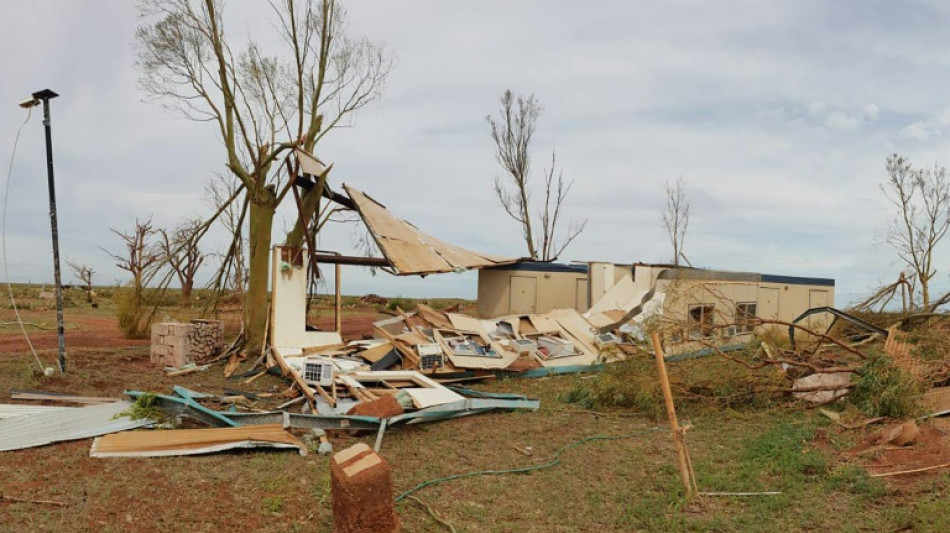
Cyclone hits Australia bringing 'record-breaking' wind speeds / Photo: Handout - Department of Fire and Emergency Services/AFP

Cyclone hits Australia bringing 'record-breaking' wind speeds

A severe tropical cyclone lashed northwestern Australia Friday bringing the strongest winds the country has ever recorded, but officials said towns and cities appeared to have escaped the worst of the storm.

Text size:

Tropical Cyclone Ilsa made landfall in the early hours as a category five storm -- the strongest on the scale -- near the sparsely-populated town of Pardoo, about 19 hours' drive northeast of Perth.

Images from the scene showed the storm's destructive power, blasting through walls and tearing off the roof at the Pardoo petrol station.

The Bureau of Meteorology's Todd Smith said the cyclone brought a wind gust of 289 kilometres (179 miles) per hour -- believed to be the strongest on record in Australia.

Ilsa also packed an Australian record for the strongest sustained wind speeds over a 10-minute period -- averaging 218 kilometres (135 miles) per hour.

The previous record was 194 kph, set by Cyclone George in 2007.

"It just shows how strong this system was as it approached the coast," Smith told reporters.

For the region's largest towns and settlements it was a narrow escape, and they appear to have escaped major damage, authorities said.

"I've been told that early assessments in those areas show damage is fairly minimal," acting Emergency Services Minister Sue Ellery told reporters.

The world's biggest iron ore-shipping hub reopened Friday after it was forced to close earlier in the week as the cyclone gathered pace above the Indian Ocean.

- Red Alert -

The cyclone has since been downgraded to a category two, but authorities remain wary as it barrels inland towards several remote Aboriginal communities and a major gold mine.

The Department of Fire and Emergency Services issued a new series of "red alerts" as the storm swerved inland on Friday afternoon, ordering people to stay indoors until given the all-clear.

"There are several remote communities and mining operations which are yet to be impacted," Ellery said.

These included the Aboriginal community of Punmu and the Newcrest gold mine in Telfer.

"It is too early to know the impact of the cyclone as it continues to pass through the area," Newcrest told AFP in a statement.

Tropical storms typically sputter out quickly once they reach land, but Ilsa was forecast to maintain an unusual intensity as it moved across the vast desert Outback in the coming days.

The northwest coast of Western Australia is the most "cyclone-prone region" in the country, according to the Bureau of Meteorology.

It also has "the highest incidence of cyclones in the southern hemisphere".

The region holds significant deposits of iron ore, copper and gold, and is home to some of Australia's largest mining operations.

Australian researchers have repeatedly warned that climate change amplifies the risk of natural disasters such as bushfires, floods and cyclones.

L.Rossi--NZN