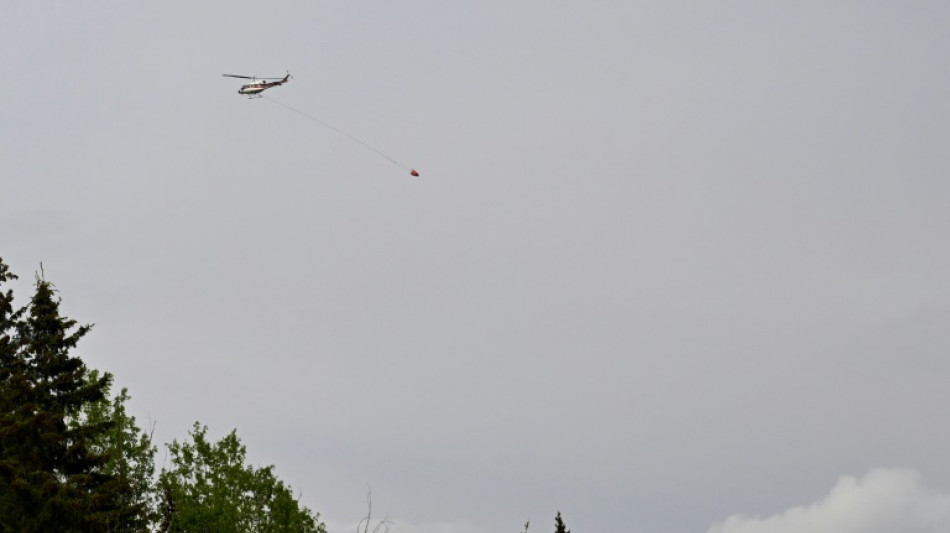
Western Canada seeks urgent help to fight wildfires / Photo: Walter Tychnowicz - AFP
Canada struggled on Monday to control wildfires that have forced thousands to flee, halted oil production and threaten to raze towns, with the western province of Alberta calling for federal help.
Some 30,000 people were ordered to leave their homes over the past three days, as more than 100 fires flared across the province -- including 29 currently out of control.
Federal disaster officials and the military were on standby, as Alberta Premier Danielle Smith was scheduled to speak by telephone with Prime Minister Justin Trudeau to formally ask for assiatance.
"We know that potentially there's some military supports that they can offer. We're going to see if they have any firefighting expertise. We'll see if they have any engineering support," Smith said late Sunday.
Firefighters have prioritized dousing flames threatening homes and businesses. Many roads near the provincial capital Edmonton were blocked off as temporary shelters welcomed evacuees.
Oil firms -- including Vermilion Energy and Crescent Point Energy -- announced temporary shutdowns of operations, slashing production by more than 125,000 barrels of oil per day.
Many residents and oil workers rode to safety in motorhomes or with campers in tow, and set up in empty parking lots.
Some are staying with friends or family, like Jerry Greiner, a resident from Dayton Valley, west of Edmonton.
"We could see the smoke on Friday and there was a pretty strong wind," the 55-year-old told AFP, his eyes tearing up as he recounted receiving the order to evacuate that night.
"We quickly grabbed our bags (and went) to our friends' house. About 12 people stayed there," he said. This marked the first time he has ever had to flee wildfires.
Dayton Valley, a small town of 7,000 was completely abandoned. Trees and grass fields all around were blackened by the fires, and smoke billowed from a few charred buildings, but most of the homes appeared intact, observed an AFP reporter.
It was not clear when residents would be permitted to return.
- 'Very scary, so surreal' -
"It's very scary and so surreal," said evacuee Dorothy Denis. "Every time there's an alert, you're scared to look (at your phone) as they might say it's your town that's on fire."
In the northern community of Fox Lake, a fire destroyed 20 homes, a store and a police station. Residents had to be evacuated by boat and helicopter.
The Alberta premier declared a state of emergency on Saturday, calling the wildfire situation "unprecedented."
The province -- one of the world's largest oil-producing regions -- "has been experiencing a hot, dry spring and with so much kindling, all it takes is a few sparks to ignite some truly frightening wildfires," she said.
Almost all of Alberta as well as much of neighboring Saskatchewan province, parts of British Columbia and a large swath of the Northwest Territories face extreme fire risks due to abnormally dry conditions and severe droughts.
Two out-of-control wildfires in westernmost British Columbia have also forced residents to evacuate, and authorities have warned they expect strong winds to swell those blazes.
In recent years, western Canada has been hit repeatedly by extreme weather, the intensity and frequency of which have increased due to global warming.
Forest fires in Canada's oil sands region in 2016 disrupted production and forced out 100,000 residents from Fort McMurray, pummelling the nation's economy.
More recently in 2021, British Columbia suffered record-high temperatures over the summer that killed more than 500 people, as well as wildfires that destroyed an entire town.
That was followed by devastating floods and mudslides.
Authorities were hopeful on Monday that rain and cooler temperatures would bring some relief to Alberta, notably in the south.
U.Ammann--NZN