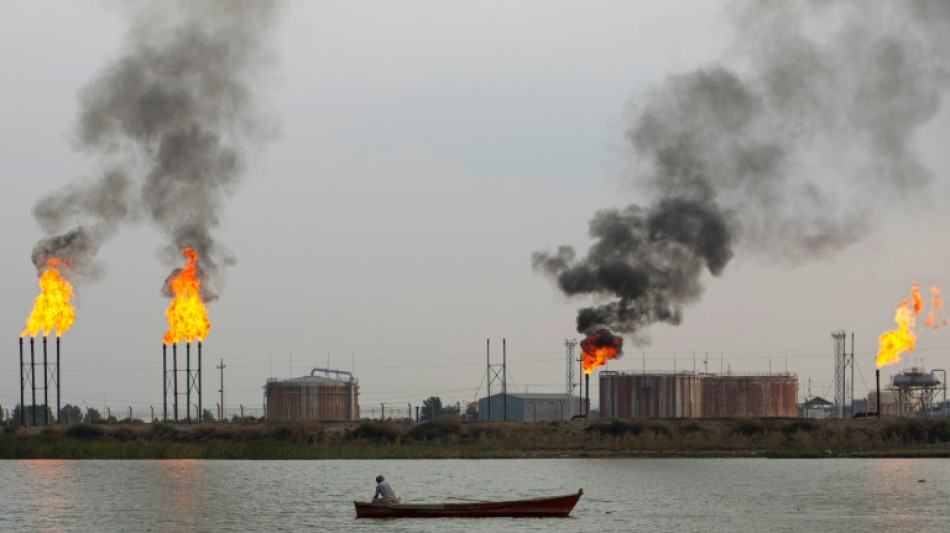
New carbon accounting rules target 'greenwashing' / Photo: Hussein FALEH - AFP
Common standards unveiled Monday for companies to report their greenhouse gas emissions could curb misleading climate claims in the corporate world, the chair of the body that wrote the norms told AFP.
Currently, most large companies report how many tonnes of carbon they emit into the atmosphere each year, but the data is often not reliable.
The poor quality of data and lack of common standards allows companies to overstate their climate credentials -- the practice of "greenwashing".
The new standards issued by the International Sustainability Standards Board (ISSB) on Monday will set uniform sustainability and climate standards for companies to follow worldwide from 2024.
"Greenwashing... will end the day our standards have gained a sufficiently significant position in the markets," ISSB chairman Emmanuel Faber told AFP.
The standards aim to "reassure the financial market about the information it is given", said Faber, the former chief executive of French food company Danone.
The ISSB was created by the International Financial Reporting Standards Foundation, a non-profit organisation governing international accounting rules.
The new standards -- dubbed IFRS S1 and IFRS S2 -- "will help to improve trust and confidence in company disclosures about sustainability to inform investment decisions," the ISSB said.
"And for the first time, the standards create a common language for disclosing the effect of climate-related risks and opportunities on a company's prospects," it added.
Companies have to voluntarily adopt the standards, or governments have to decide whether to require them to do so.
Countries are adopting measures to achieve carbon neutrality by mid-century in the hopes of limiting the increase in global temperatures at 1.5 degrees Celsius in line with the 2015 Paris climate pact.
This is creating a patchwork of regulations for firms to comply with and the financial stakes in the transition are becoming more and more important, both for the firms and their shareholders.
"When you have lots of countries all making regulations and requirements at the same time, that's a bit of a nightmare scenario for companies," said Kate Levick, the associate director for sustainable finance at independent think tank E3G.
IFRS accounting standards are required in many countries, while many companies in other countries use them in order to better tap international finance.
- Common language -
The ISSB believes that a number of states, including Japan and Britain, will quickly make the new climate standard mandatory, and hopes China, which boasts the world's second-largest economy, will adopt it as well.
The European Union is working on its own standards, which will also include biodiversity and human rights, and the ISSB hopes they will be compatible.
The ISSB standards also define how companies measure their direct and indirect emissions, using a method that is widely used but until now has not been mandatory -- the Greenhouse Gas Protocol.
The standards also require companies to audit their emissions data and ensure their climate strategy is adopted by the top management.
E3G's Levick believes that the ISSB standards will help reduce greenwashing by companies.
"The disclosure requirements have been very carefully considered and thought out and designed with anti-greenwashing in mind," she said.
"The whole idea of this is to hold firms accountable."
S.Scheidegger--NZN