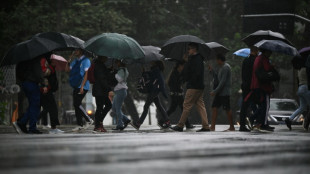
'Oppressive' heat wave scorches US west and south / Photo: Brandon Bell - GETTY IMAGES NORTH AMERICA/AFP/File
Swaths of the United States home to more than 80 million people were under heat warnings or advisories Sunday, as relentless, record-breaking temperatures continued to bake western and southern states.
The National Weather Service (NWS) warned of "a widespread and oppressive heat wave" in parts of the Southwest, western Gulf Coast and southern Florida, with sizzling temperatures carrying into the coming week raising health risks for millions.
Southern Californians, who saw thermometers peak at 105-110 degrees Fahrenheit (41-43 Celsius) on Saturday, face a second day of similarly brutal temperatures, with the mercury expected to top 115F (46C) in parts of California, Nevada and Arizona, the NWS said.
By Saturday afternoon, California's famous Death Valley, one of the hottest places on Earth, had reached a life-threatening 124F (51C). The next day, early afternoon temperatures were hovering around 118F (47.7C), amid forecasts it could reach up to 128F (53C).
Tourists visited the national park to get a glimpse of what the NWS warned would be "life-threatening daytime heat" set to last until Tuesday night.
Visitor Eliana Luna told broadcaster MSNBC on Sunday the heat felt like a "burning sensation" on her body.
"The heat, you can feel it dripping through the back, all the way down," she said.
The day before, the town of Idyllwild, east of Los Angeles and some 5,400 feet (1,645 meters) above sea level, blew past its previous record to reach 100F.
Imperial, California -- east of San Diego -- tied its daily record of 116F. Sunday's high was forecast at 114F.
The NWS has said heat is the leading weather-related killer in the United States and urged Americans to take the risk seriously.
"In total, from South Florida and the Gulf Coast to the Southwest, over 80 million people remain under either an Excessive Heat Warning or Heat Advisory as of early this morning," the NWS said in a Sunday morning bulletin.
- Health risks -
Authorities have been sounding the alarm for days, advising people to avoid outdoor activities in the daytime and to avoid dehydration, which can quickly become fatal in such temperatures.
In Arizona, the state capital Phoenix has recorded 16 straight days above 109F, as temperatures hit 118F Saturday afternoon and stayed above 90F (32C) overnight. The mercury climbed again Sunday afternoon to 109F, expected to peak at 114F.
The city, home to over 1.6 million people, is under an Excessive Heat Warning until Wednesday evening, according to the NWS.
Volunteers have been organized to direct Phoenix residents to cooling centers and distribute bottles of water and hats, but program head David Hondula told the local ABC station that its three-days-per-week schedule is "clearly... not enough."
In Miami, the NWS on Sunday issued its first-ever Excessive Heat Warning for the region, in effect until 7:00 pm, as heat and humidity mixed to create a "feels-like" temperature expected to hit 112F.
At a Texas construction site outside Houston, a 28-year-old worker who gave his name only as Juan struggled on Friday in the blazing heat.
"Just when I take a drink of water, I get dizzy, I want to vomit because of the heat," he told AFP, saying it was crucial to stay hydrated.
Residents of the metropolis have been asked to conserve electricity from 2:00 pm to 10:00 pm Saturday through Monday, in an attempt to mitigate high demand.
- 'Not typical' -
Heat waves are occurring more often and more intensely in major US cities, according to the federal Environmental Protection Agency, with a frequency of six per year during the 2010s and 2020s compared to two per year during the 1960s.
"This heat wave is NOT typical desert heat," the NWS's Las Vegas office tweeted Thursday, specifying that "its long duration, extreme daytime temperatures, & warm nights" were unusual.
In Canada, which is suffering from warm temperatures combined with months of below-average rainfall, the amount of land burned by devastating wildfires so far in 2023 climbed to an-all time high of 24.7 million acres (10 million hectares) on Saturday.
"We find ourselves this year with figures that are worse than our most pessimistic scenarios," Yan Boulanger, a researcher at Canada's natural resources ministry, told AFP.
While it can be hard to attribute a particular weather event to climate change, scientists insist human-linked global warming is responsible for the multiplication and intensification of heat waves.
Flooding has also ravaged parts of the northeastern US in recent weeks.
On Sunday, officials in eastern Pennsylvania's Bucks County reported four people dead and three others missing after a storm the day before unleashed up to seven inches (18 centimeters) of rain in one hour, causing flash flooding that swept away vehicles.
B.Brunner--NZN