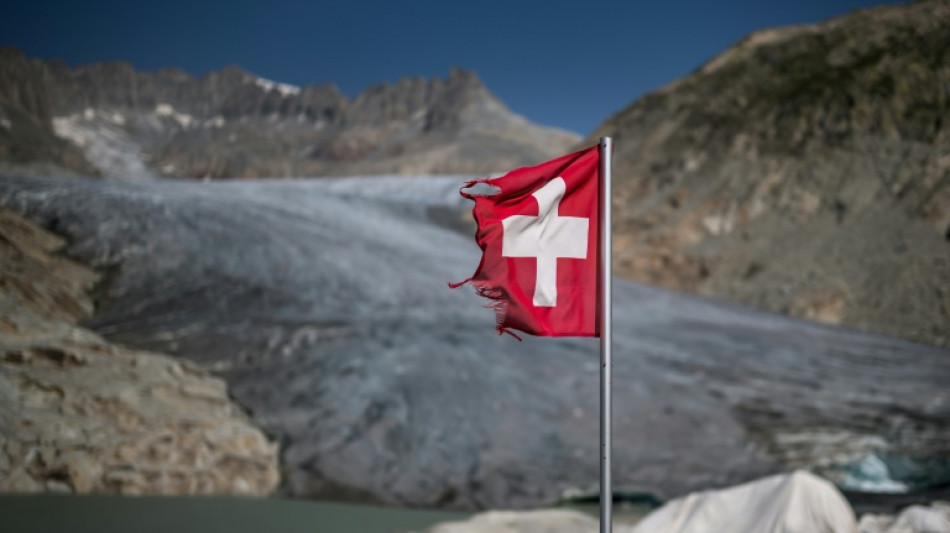
Two 'catastrophic' years melt away 10% of Swiss glacier volume: study / Photo: Fabrice COFFRINI - AFP/File
Two consecutive years of extreme warming in the Alps have obliterated 10 percent of Swiss glacier volume -- the same amount lost in the three decades prior to 1990, a report revealed Thursday.
Amid growing concerns over the dire toll of climate change, the study by the Cryospheric Commission (CC) of the Swiss Academy of Sciences showed a dramatic glacial retreat, and warned the situation would only get worse.
"Swiss glaciers are melting at a rapidly increasing rate," it said in a statement.
2022 marked the worst year on record for glacier melt in the Swiss Alps, with six percent of the total ice volume lost.
The glaciers have not fared much better this year, the CC report showed, with another four percent of ice volume destroyed, "representing the second largest decline since measurements began".
"The acceleration is dramatic, with as much ice being lost in only two years as was the case between 1960 and 1990," it said.
The result of two consecutive extreme years had been collapsing glacier tongues and some smaller glaciers vanishing all together.
"All glaciers melted a lot," Matthias Huss, head of Glacier Monitoring in Switzerland (GLAMOS), told AFP.
"But for the small glaciers, (the) melting is especially dramatic because these small glaciers are really disappearing right now."
- 'Dead ice' -
GLAMOS, which monitors 176 of Switzerland's some 1,400 glaciers, recently halted measurements at the St. Annafirn glacier in the central Swiss canton of Uri since it had all but disappeared.
"We just had some dead ice left," Huss lamented.
The massive glacier loss seen in Switzerland was linked in large part to a winter with very low snow volumes, as well as soaring summer temperatures.
"It's a combination of climate change that makes such extreme events more likely, and the very bad combination of meteorological extremes," Huss explained.
"If we continue at this rate... we will see every year such bad years."
Scientists have already warned that the Swiss glaciers could all but disappear by the end of the century without more action to rein in global warming.
"We have seen such strong climate changes in the last years that it's really possible to imagine this country without any glaciers," Huss said.
- 'Stabilise the climate' -
He stressed the need to "stabilise the climate by bringing the CO2 emissions to zero as soon as possible".
But Huss acknowledged that even if the world managed to meet the Paris targets of limiting global warming to 1.5 degrees Celsius above pre-industrial levels, only around a third of glacier volume in Switzerland would be saved.
That means that "all the small glaciers will be gone anyway, and the big glaciers will be much smaller", he said, but stressed that at least "there will be some ice in the highest regions of the Alps and some glaciers that we can show to our grandchildren."
This year's melt impacted glaciers across Switzerland, with those in the south and the east of the country particularly hard-hit.
The average ice thickness loss there was up to three metres (9.8 feet) and was "considerably higher than the values recorded in the hot summer of 2003", the researchers said.
The study showed that even some glaciers above 3,200 metres (10,500 feet), which until recently had "preserved their equilibrium", had seen several metres of ice melt away.
The year was marked by barely any precipitation at all over the 2022-23 winter months, meaning far less snow cover than usual, followed by the third-warmest summer in the Alps since measurements began.
It got so warm that at one stage, the freezing point above the mountain range rose to 5,298 metres (17,381 feet) -- way above the highest peaks and beating by far the zero-degree line record.
E.Leuenberger--NZN