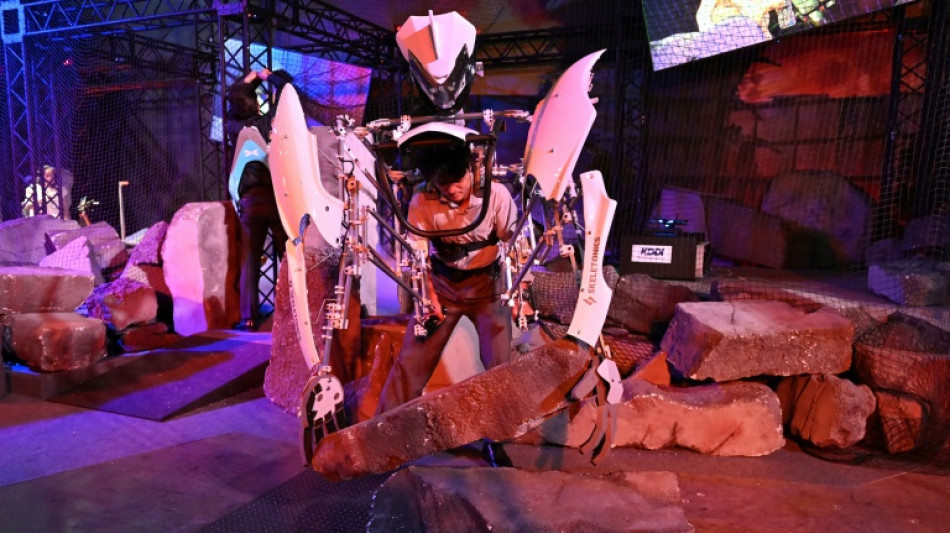
Japan show provides glimpse of robots as future of rescue efforts / Photo: Kazuhiro NOGI - AFP
With a drone camera, a survivor is spotted in the rubble. A robot on tracks brings him water while rescuers in exoskeletons clear an escape route for an autonomous stretcher to take her to safety.
This is the futuristic vision on display at the Japan Mobility Show, aiming to exhibit how technology can help and sometimes replace humans in a country short of workers and no stranger to disasters.
But so as not to alarm people, the imaginary tragedy is unleashed by Godzilla, who has unleashed catastrophe in Japanese disaster films since the 1950s.
In Japan nearly 30 percent of the country's population is aged 65 and over.
"Because of the decline of the population there are fewer and fewer people available for dangerous tasks," said Tomoyuki Izu, founder of Attraclab, a local start-up specialising in autonomous mobility.
"My idea is to help people such as firefighters with my machines," Izu, 61, told AFP.
It was Attraclab that co-developed the small delivery robot squeezing through the cardboard rubble at the Japan Mobility Show and designed the remote-control stretcher on wheels or tracks.
For now the Japanese government favours "traditional equipment" for relief efforts, he said at the event, which opens to the public this weekend.
But Izu believes there will be a market for more advanced technology in the future.
"There's a lots of anime with humanoid robots in Japan, and therefore people love them. But these kinds of autonomous vehicles are still very strange for them," he said.
Since 2016, Japan's Kawasaki Heavy Industries (KHI) has been developing Kaleido, a robust humanoid robot capable of delicately lifting and moving injured people.
- 'Shortage of labour' -
"In the future this robot will be able to save people, or go to dangerous zones, like fires," said Itsuki Goda from the robotics division of KHI.
He conceded, though, that the machine needs more development on its scanning capabilities to get through difficult terrain.
"We need more years of development if we want to use it in real situations, where conditions are always different," he told AFP.
Kaleido's current load capacity of 60 kilograms (132 pounds) will be increased very soon with a new prototype, promised Goda.
Price is also an issue.
Right now this robot is "maybe 10 times more expensive than a human, but if we produce 10,000 of them per year, the price will go down rapidly", Goda added.
Since the Fukushima nuclear disaster in 2011, another niche segment has exploded: robots to clear up disaster areas that are difficult or dangerous to access.
Engineering firm Sugino Machine presented a powerful but small robotic arm rigged on crawlers that can work in areas that emergency workers cannot go.
The machine was built in 2018 for a nationally run atomic research agency, as Japan continues the work to decommission the Fukushima Daiichi nuclear plant.
"This can be used for initial damage assessment or to remove debris or to remove heavy items that people cannot lift," Akira Inujima from Sugino Machine told AFP.
Various tools can be attached to its arm, such as image, temperature or radioactivity sensors, or a high-pressure water lance.
"We have a shortage of labour. It is difficult to go all robot. But we can offer solutions to help people's work," he said.
"After Fukushima, we have been able to continue technological development because there has been project after project (heavily supported by the government), like removing debris, that needs our work," Inujima said.
"It's important to continue this work and not make this fade away."
T.L.Marti--NZN