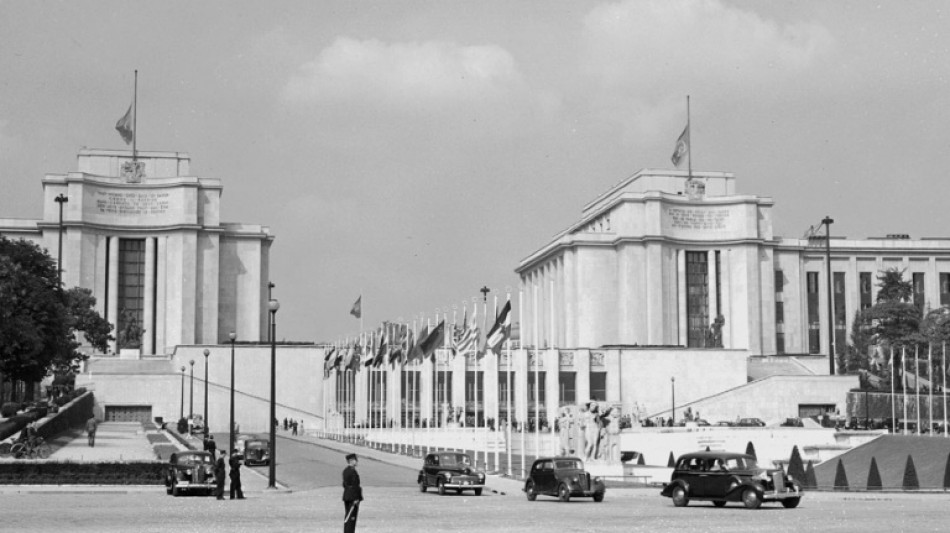
Universal Declaration of Human Rights turns 75 / Photo: - - INTERCONTINENTALE/AFP/File
On December 10, 1948, the United Nations adopted the Universal Declaration of Human Rights in the hope of creating a better world after the horrors of World War II.
Coming three years after the Allied victory over the Nazis, it was the first time that countries had agreed to protect fundamental rights and freedoms on a universal scale, for all people.
It was also one of the first achievements of the United Nations, itself born from the ashes of the Second World War, and inspired the development of international human rights law.
Its adoption in Paris was hailed with a lengthy standing ovation from delegates determined that the world would never again see the likes of Auschwitz, Hiroshima and other atrocities.
Although not legally binding, the declaration stresses the supremacy of individual rights over those of states.
It puts economic, social and cultural freedoms on the same level as civil and political rights.
Human rights were no longer exclusively an internal affair, as Hitler had claimed to prevent foreign interference. They were now a universal issue.
On the 75th anniversary of the adoption of the milestone charter, here is some historical background.
- Divided world seeks consensus -
The UN's first General Assembly in 1946 created a Commission on Human Rights -- made up of 18 members from various political, cultural and religious backgrounds -- to work on an international bill of rights.
The drafting committee first met in 1947 under the dynamic chairmanship of Eleanor Roosevelt, widow of the US president Franklin D. Roosevelt.
Its other representatives were from eight countries selected according to their geographical location, with Canada's John Peters Humphrey and France’s Rene Cassin playing key roles in the drafting.
"It is the first document of an ethical sort that organised humanity has ever adopted," recalled Cassin.
It was inspired by the principles behind the United States Declaration of Independence of 1776 and France’s Declaration of the Rights of Man and of the Citizen of 1789.
Several women played key roles in the drafting, namely Hansa Mehta, a fervent advocate of women's rights in India and abroad.
She is widely credited with changing Article 1 of the Universal Declaration of Human Rights from "All men are born free and equal" to "All human beings are born free and equal".
The declaration was adopted by the UN's third General Assembly in Paris on December 10, 1948.
It was supported by 48 of the UN's then 58 member countries.
Two others -- Yemen and Honduras -- were absent.
The remaining eight abstained -- Belarus, Czechoslovakia, Poland, the Soviet Union, Ukraine, Yugoslavia, apartheid South Africa and Saudi Arabia, which challenged the notion that men and women were equal.
- Inspiring but contested -
"At a time when the world was divided into Eastern and Western blocs, finding a common ground on what should make the essence of the document proved to be a colossal task," the UN says on its website.
Communists said there was an over-emphasis on individual and political rights at the expense of social rights.
Western democracies were wary of the declaration becoming a restrictive legal tool that could be used against them by their own their colonies.
Despite the doubts and debates at the time, the Universal Declaration of Human Rights inspired all post-war treaties and is regarded as the foundation of international human rights law.
The international conventions against the discrimination of women in 1979 and against torture in 1984; the rights of children in 1990; the creation of the International Criminal Court in 1998 -- all are its direct descendants.
It also inspired the "right to intervene" in another country on humanitarian grounds, as championed by former French foreign minister Bernard Kouchner, who co-founded Doctors Without Borders (MSF).
But the declaration has not been able to prevent violations of the rights it espouses.
Nor has it escaped criticism, including that the concept of "universalism" is little more than a Western diktat.
And it has met ideological, cultural and religious resistance from various countries, such as China and Russia as well as those that apply Islamic Sharia law.
Seventy-five years after its adoption, there are calls for the declaration to be updated, for example, to incorporate challenges such as climate change, mass migration and modern technologies.
Bur-cf-ccd-rap/mw/eab/gil/bp
O.Meier--NZN