Zürcher Nachrichten - Scientists in UK set fusion record

EUR -
AED 4.314099
AFN 76.936429
ALL 96.605599
AMD 448.400944
ANG 2.102883
AOA 1077.044807
ARS 1691.556453
AUD 1.764619
AWG 2.114155
AZN 2.001365
BAM 1.959379
BBD 2.366212
BDT 143.572249
BGN 1.956545
BHD 0.440843
BIF 3482.482632
BMD 1.17453
BND 1.517265
BOB 8.117793
BRL 6.365607
BSD 1.174841
BTN 106.244614
BWP 15.566367
BYN 3.463412
BYR 23020.795811
BZD 2.362806
CAD 1.618562
CDF 2630.948518
CHF 0.934916
CLF 0.027253
CLP 1069.11676
CNY 8.28573
CNH 8.284609
COP 4467.326371
CRC 587.670939
CUC 1.17453
CUP 31.125056
CVE 110.728901
CZK 24.276491
DJF 208.738004
DKK 7.472132
DOP 74.994227
DZD 152.329593
EGP 55.571073
ERN 17.617956
ETB 182.316528
FJD 2.660605
FKP 0.879936
GBP 0.878351
GEL 3.175767
GGP 0.879936
GHS 13.489529
GIP 0.879936
GMD 85.741137
GNF 10207.844111
GTQ 8.998437
GYD 245.78791
HKD 9.137671
HNL 30.777205
HRK 7.537789
HTG 153.990624
HUF 385.234681
IDR 19536.845016
ILS 3.785271
IMP 0.879936
INR 106.356551
IQD 1538.634822
IRR 49474.161194
ISK 148.465122
JEP 0.879936
JMD 188.10359
JOD 0.832789
JPY 182.940203
KES 151.401433
KGS 102.713135
KHR 4705.169188
KMF 492.719958
KPW 1057.060817
KRW 1732.409297
KWD 0.360233
KYD 0.979084
KZT 612.71658
LAK 25463.81945
LBP 105179.197597
LKR 363.02155
LRD 207.92129
LSL 19.826521
LTL 3.468083
LVL 0.710462
LYD 6.366402
MAD 10.795403
MDL 19.860192
MGA 5297.132504
MKD 61.543973
MMK 2466.385496
MNT 4167.553805
MOP 9.420668
MRU 46.676283
MUR 53.915339
MVR 18.092159
MWK 2039.576425
MXN 21.158465
MYR 4.812408
MZN 75.064681
NAD 19.826516
NGN 1706.088063
NIO 43.193401
NOK 11.906572
NPR 169.991784
NZD 2.023657
OMR 0.449616
PAB 1.174841
PEN 4.232665
PGK 5.002564
PHP 69.43241
PKR 329.132826
PLN 4.225315
PYG 7891.414466
QAR 4.276587
RON 5.092651
RSD 117.424033
RUB 93.579038
RWF 1704.243608
SAR 4.407202
SBD 9.603843
SCR 17.568707
SDG 706.484352
SEK 10.887784
SGD 1.517538
SHP 0.881202
SLE 28.335591
SLL 24629.319496
SOS 671.248424
SRD 45.275842
STD 24310.407882
STN 24.958771
SVC 10.279733
SYP 12986.886804
SZL 19.826507
THB 37.021631
TJS 10.796675
TMT 4.122602
TND 3.424975
TOP 2.827988
TRY 50.147872
TTD 7.972529
TWD 36.804032
TZS 2901.090478
UAH 49.639761
UGX 4175.627205
USD 1.17453
UYU 46.104017
UZS 14097.305357
VES 314.116117
VND 30897.196663
VUV 142.580188
WST 3.259869
XAF 657.154562
XAG 0.018954
XAU 0.000273
XCD 3.174228
XCG 2.117359
XDR 0.816516
XOF 655.388352
XPF 119.331742
YER 280.129715
ZAR 19.820676
ZMK 10572.187233
ZMW 27.109403
ZWL 378.198309
  • RBGPF

    0.0000

    81.17

    0%

  • SCS

    0.0200

    16.14

    +0.12%

  • BCC

    0.2500

    76.51

    +0.33%

  • NGG

    0.2400

    74.93

    +0.32%

  • GSK

    -0.0700

    48.81

    -0.14%

  • JRI

    -0.0200

    13.7

    -0.15%

  • AZN

    -0.4600

    89.83

    -0.51%

  • RYCEF

    -0.2500

    14.6

    -1.71%

  • CMSC

    -0.1300

    23.3

    -0.56%

  • RELX

    0.1000

    40.38

    +0.25%

  • BCE

    0.3100

    23.71

    +1.31%

  • RIO

    -1.0800

    75.66

    -1.43%

  • CMSD

    -0.1500

    23.25

    -0.65%

  • BP

    -0.2700

    35.26

    -0.77%

  • VOD

    0.0500

    12.59

    +0.4%

  • BTI

    -1.2700

    57.1

    -2.22%

Scientists in UK set fusion record
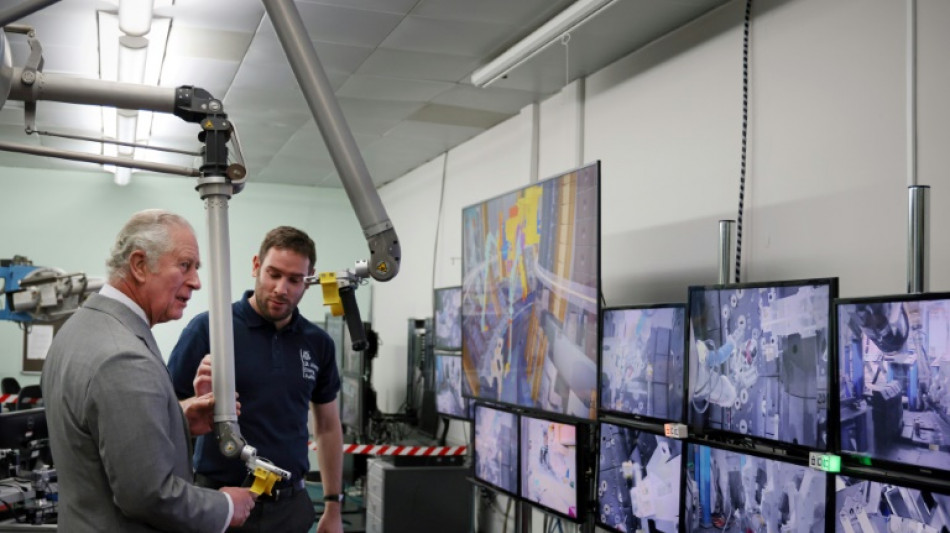
Scientists in UK set fusion record / Photo: ADRIAN DENNIS - POOL/AFP

Scientists in UK set fusion record

Scientists in Britain announced Thursday they had smashed a record for generating fusion energy in the final experiment using the Joint European Torus (JET) machines.

Text size:

Nuclear fusion is the same process that the sun uses to generate heat. Proponents believe it could one day help tackle climate change by providing an abundant, safe and clean source of energy.

A team at the JET facility near Oxford in central England generated 69 megajoules for five seconds using 0.2 milligrams of fuel, beating its previous record set in 2022 by 10 megajoules, the UK Atomic Energy Authority (UKAEA) said.

That is enough to power around 41,000 homes for five seconds.

It is the final experiment to be conducted at the JET site using a donut-shaped machine called a tokamak.

"JET has operated as close to power-plant conditions as is possible with today's facilities, and its legacy will be pervasive in all future powerplants," said Ian Chapman, UKAEA CEO.

"JET's research findings have critical implications not only for ITER -– a fusion research mega-project being built in the south of France -– but also for ... other global fusion projects, pursuing a future of safe, low-carbon, and sustainable energy," he added.

Over 300 scientists and engineers from EUROfusion, a consortium of researchers across Europe, contributed to JET's landmark experiments over 40 years.

Inside JET's tokamak, 0.1 milligrammes each of deuterium and tritium -- both isotopes of hydrogen -- were heated to temperatures 10 times hotter than the centre of the sun to create plasma.

This mixture was held in place using magnets as it spun around, fusing and releasing tremendous energy as heat.

Fusion is inherently safe in that it cannot start a run-away process.

Deuterium is freely available in seawater, while tritium can be harvested as a byproduct of nuclear fission.

Using equivalent weights, it releases nearly four million times more energy than burning coal, oil or gas, and the only waste product is helium.

Despite the new record, JET did not generate more energy than was put into producing it.

The Lawrence Livermore National Laboratory in the United States became the only facility to achieve this feat -- the holy grail of nuclear fusion -- in late 2022, using a different process involving lasers.

JET conducted its first deuterium-tritium experiments in 1997.

The results announced Thursday demonstrated the ability to create fusion for five seconds, as longer than that would cause JET's copper wire magnets to overheat.

ITER will be equipped with superconductor electromagnets which will allow the process to continue for longer, hopefully longer than 300 seconds.

If all goes well at ITER, a prototype fusion power plant could be ready by 2050.

International cooperation on fusion energy has historically been close because, unlike the nuclear fission used in atomic power plants, the technology cannot be weaponised.

The France-based megaproject also involves China, the EU, India, Japan, South Korea, Russia and the US.

M.Hug--NZN