Zürcher Nachrichten - April temperatures in Bangladesh hottest on record

EUR -
AED 4.247529
AFN 76.908434
ALL 93.25446
AMD 422.256034
AOA 1060.581278
ARS 1725.019417
AUD 1.637031
AWG 2.083285
AZN 1.970693
BAM 1.956523
BBD 2.322558
BDT 142.742747
BHD 0.434861
BIF 3452.475775
BMD 1.156577
BND 1.477646
BOB 13.705064
BRL 5.879227
BSD 1.153126
BTN 109.730548
BWP 15.564752
BYN 3.433669
BYR 22668.916725
BZD 2.319157
CAD 1.613466
CDF 2616.75369
CHF 0.933803
CLF 0.026839
CLP 1056.320336
CNY 7.804123
CNH 7.798559
COP 3634.943201
CRC 524.193703
CUC 1.156577
CUP 30.649301
CVE 110.305761
CZK 24.260948
DJF 205.34588
DKK 7.475844
DOP 67.314875
DZD 153.025547
EGP 57.297834
ERN 17.348661
ETB 186.120676
FJD 2.554359
FKP 0.857579
GBP 0.856804
GEL 3.018572
GGP 0.857579
GHS 13.532
GIP 0.857579
GMD 85.003173
GNF 10127.742451
GTQ 8.798251
GYD 241.249148
HKD 9.073552
HNL 30.907421
HRK 7.539497
HTG 150.775715
HUF 363.822817
IDR 20588.234011
ILS 3.469559
IMP 0.857579
INR 110.11831
IQD 1510.558189
IRR 1590930.020376
ISK 142.651808
JEP 0.857579
JMD 183.12767
JOD 0.82005
JPY 182.412495
KES 149.215139
KGS 101.142765
KHR 4683.730754
KMF 492.701994
KRW 1628.299593
KWD 0.35699
KYD 0.960955
KZT 540.439706
LAK 26035.620805
LBP 103262.458029
LKR 386.782926
LRD 208.136912
LSL 18.733723
LTL 3.415072
LVL 0.699602
LYD 7.33471
MAD 10.747171
MDL 20.05241
MGA 4920.818364
MKD 61.552745
MMK 2428.291317
MNT 4158.881925
MOP 9.318143
MRU 46.35613
MUR 54.439938
MVR 17.868685
MWK 1999.538879
MXN 19.842803
MYR 4.730516
MZN 73.911064
NAD 18.733723
NGN 1578.566081
NIO 42.435681
NOK 10.982478
NPR 175.568877
NZD 1.96293
OMR 0.442614
PAB 1.153126
PEN 3.905143
PGK 5.095883
PHP 70.210033
PKR 320.136598
PLN 4.298016
PYG 6856.533659
QAR 4.215258
RON 5.246579
RSD 117.383376
RUB 94.346312
RWF 1695.626576
SAR 4.3311
SBD 9.328602
SCR 16.711475
SDG 694.535451
SEK 10.926111
SGD 1.47809
SLE 28.45001
SOS 659.043533
SRD 43.795536
STD 23938.816727
STN 24.509057
SVC 10.089728
SZL 18.729921
THB 38.224743
TJS 10.637631
TMT 4.059587
TND 3.387652
TRY 55.157951
TTD 7.815888
TWD 37.300319
TZS 3052.928132
UAH 51.645684
UGX 4295.587326
USD 1.156577
UYU 46.417152
UZS 13791.096151
VES 874.097703
VND 30307.532057
VUV 137.120508
WST 3.161754
XAF 656.199482
XAG 0.018195
XAU 0.000266
XCD 3.125708
XCG 2.078268
XDR 0.816102
XOF 656.199482
XPF 119.331742
YER 275.730918
ZAR 18.668599
ZMK 10410.580205
ZMW 21.765043
ZWL 372.417446
  • CMSC

    0.0240

    21.744

    +0.11%

  • RYCEF

    0.2300

    20.85

    +1.1%

  • RIO

    1.4500

    101.1

    +1.43%

  • CMSD

    -0.1600

    21.82

    -0.73%

  • RBGPF

    0.7600

    70.5

    +1.08%

  • GSK

    0.7900

    52.96

    +1.49%

  • BCE

    -0.0200

    22.75

    -0.09%

  • VOD

    0.1900

    16.19

    +1.17%

  • NGG

    0.4700

    80.88

    +0.58%

  • BTI

    0.6000

    59.33

    +1.01%

  • JRI

    0.1500

    12.81

    +1.17%

  • RELX

    0.0485

    35.52

    +0.14%

  • BP

    -0.6000

    41.63

    -1.44%

  • BCC

    2.3400

    86.6

    +2.7%

  • AZN

    1.4100

    161.42

    +0.87%

April temperatures in Bangladesh hottest on record
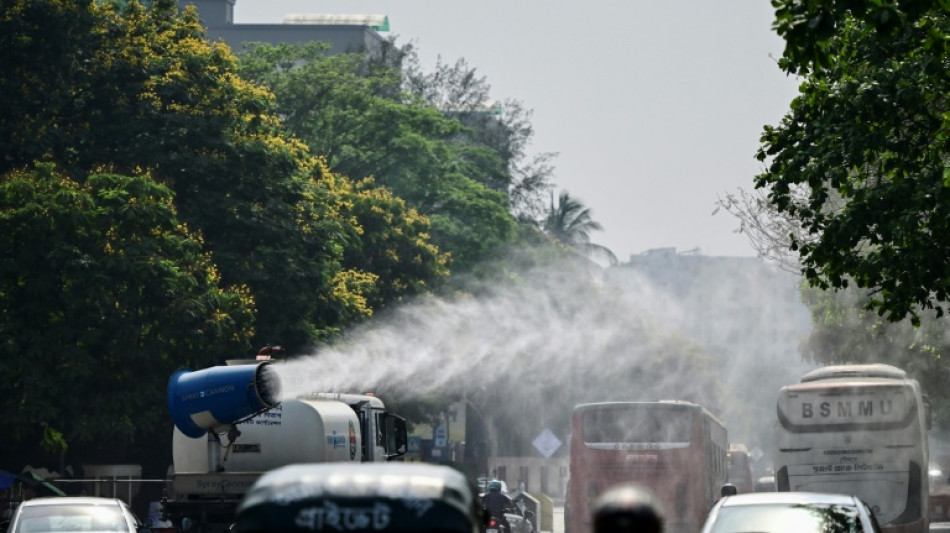
April temperatures in Bangladesh hottest on record / Photo: MUNIR UZ ZAMAN - AFP

April temperatures in Bangladesh hottest on record

Bangladesh's weather bureau said Wednesday that last month was the hottest April on record, with the South Asian nation and much of the region still enduring a suffocating heatwave.

Text size:

Extensive scientific research has found climate change is causing heatwaves to become longer, more frequent and more intense.

Punishing heat last month prompted Bangladesh's government to close schools across the country, keeping an estimated 32 million students at home.

"This year the heatwave covered around 80 percent of the country. We've not seen such unbroken and expansive heatwaves before," Bangladesh Meteorological Department senior forecaster Muhammad Abul Kalam Mallik told AFP.

He said last month was the hottest April in Bangladesh since records began in 1948 "in terms of hot days and area coverage in the country".

Weather stations around Bangladesh had recorded temperatures between two and eight degrees higher than the 33.2 degrees Celsius (91.8 degrees Fahrenheit) average daily temperature for April between 1981 and 2010, he added.

Health department spokesman Selim Raihan told AFP the government had confirmed at least 11 heat stroke-related deaths in the past 10 days.

Rains are expected to bring some relief to Bangladesh from Thursday after a week of sweltering temperatures, with the capital Dhaka recording several days over 40C (104F).

Mallik said the severity of the heat had been worsened by the absence of the usual pre-monsoon April thunderstorms which normally cool the South Asian nation ahead of summer.

"Bangladesh gets an average of 130.2 millimetres of rain in April. But this April we got an average of one millimetre of rain," he said.

Mallik said the bureau was checking data to confirm whether this year marked record low rainfalls for April.

Schools in Bangladesh will remain closed until Sunday.

The government ordered classrooms reopened last weekend, but a top Bangladeshi court directed them to be shut them again on Monday after taking into consideration reports that several teachers had died in the heatwave.

- 'Life has become unbearable' -

Thousands gathered at mosques and in open fields around the Muslim-majority nation last week to pray for rain.

"Life has become unbearable due to lack of rains," Muhammad Abu Yusuf, an Islamic cleric who led one such service, told AFP last week.

"Poor people are suffering immensely."

Large swaths of South and Southeast Asia are sweltering through a heatwave that has topped temperature records from Myanmar to the Philippines, with the El Nino phenomenon also driving this year's exceptionally warm weather.

Weather bureaus in Cambodia, Myanmar, Vietnam and India have also all forecast temperatures above 40C (104F).

The months preceding the region's monsoon, or rainy season, are usually hot but temperatures this year are well above average in many countries.

Asia is also warming faster than the global average, according to the World Meteorological Organization, a UN agency.

A.P.Huber--NZN