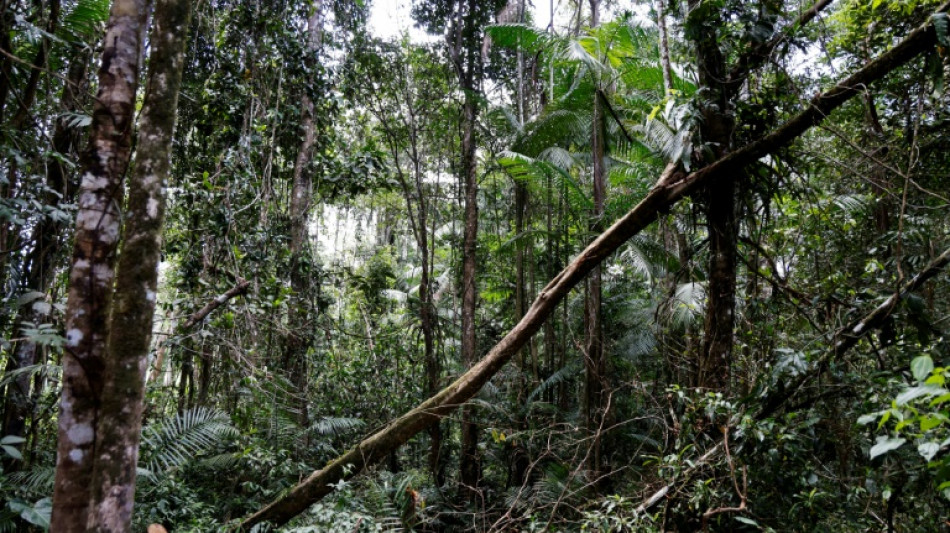
Market-based schemes not reducing deforestation, poverty: report / Photo: Ludovic MARIN - AFP
Market-based approaches to forest conservation like carbon offsets and deforestation-free certification schemes have largely failed to protect trees or alleviate poverty, according to a major scientific review published on Monday.
The global study -- the most comprehensive of its kind to date -- found that trade and finance-driven initiatives had made "limited" progress halting deforestation and in some cases worsened economic inequality.
Drawn from years of academic and field work, the report compiled by the International Union of Forest Research Organizations (IUFRO), a group of 15,000 scientists in 120 countries, will be presented at a high-level UN forum starting Monday.
Its authors urged a "radical rethink" of increasingly popular market-based approaches often promoted as effective at saving forests, curbing global warming and raising living standards in developing nations.
"The evidence does not support the claim of win-wins or triple wins for environment, economy and people often made for market mechanisms as a policy response to environmental problems," said contributing author Maria Brockhaus from the University of Helsinki.
"Rather our cases show that poverty and forest loss both are persistent across different regions of the world... where market mechanisms have been the main policy option for decades," she told AFP by email.
- No accountability -
Since the last IUFRO assessment in 2010, the report noted a rise in complex and overlapping market-based schemes "with financial actors and shareholders more often interested in short-term profits than long-term just and sustainable forest governance".
Its lead author, Constance McDermott from the University of Oxford, said this may not be true of all individual projects "but overall... it's hard to say they've been a rousing success".
The report said a $120 million project in the Democratic Republic of Congo had "reinforced entrenched interests" by restricting local people from forests without addressing logging by powerful extractive businesses.
In Malaysia, indigenous groups promised better livelihoods from a foreign-backed plantation venture on their customary land received no benefit, the report said.
"As both cases show, 'wins' are often gained elsewhere, while the burdens of forest loss, enclosures and forestland conversion are carried locally," said Brockhaus.
In Ghana, deforestation rates had risen despite a slew of sustainable cocoa standards, corporate pledges, and carbon offset projects, while farmers were earning less today than decades ago, said McDermott.
Meanwhile green trade policies imposed by wealthy countries -- like the EU's ban on imports linked to deforestation -- might look good from Brussels but did not consider the knock-on effects, she added.
"There's no accountability. If this doesn't work -- or farmers are pushed off their farm as a result -- it's not going to hurt the person eating chocolate in the UK or Germany," she said.
- 'Radical rethink' -
Despite recent turmoil, carbon markets are projected to grow into a multi-billion-dollar industry as corporations increasingly turn to credits to meet their net-zero climate targets.
Credits are purchased from projects, often in developing nations, that reduce or avoid the release of planet-heating emissions, such as protecting CO2-absorbing rainforests or peat swamps.
Kenya's President William Ruto has called Africa's carbon sinks an "unparalleled economic goldmine" that could generate billions of dollars every year.
But there are growing concerns about how much of that revenue poor communities might expect to see, with unscrupulous actors accused of exploitation.
Brockhaus said market-based approaches may be appealing to policymakers but would not be a solution without also addressing the broader economic and governance challenges around forest management.
"We advocate for a radical rethink," she said.
D.Smith--NZN